Monthly Archives: July 2021

My Friend’s Little Sister Has It In for Me!, Vol. 3

By mikawaghost and tomari. Released in Japan as “Tomodachi no Imouto ga Ore ni dake Uzai” by GA Bunko. Released in North America by J-Novel Club. Translated by Alexandra Owen-Burns.

Someone needs to tell Japan that “having the rest of the cast being creeped out about the appalling character” is not a get out of jail free card for everything the character does. I’ve said in the previous books that the shotacon tendencies of Sumire are not funny but awful. Well, she’s the main character of this book, and so we get a lot more of it than even the previous two, and it’s still awful. Saying that a guy would be the perfect husband if only he were 5 years old is not a “LOL” moment. So be aware as I write the rest of this that this is a big black mark, and made me not enjoy this book nearly as much as the previous two. That said, I’m still reading it, because I do like the cast and the romantic comedy situations. With, well, one exception. Fortunately, this is not We Never Learn, so the teacher has precisely zero chance of winning the romantic sweepstakes.
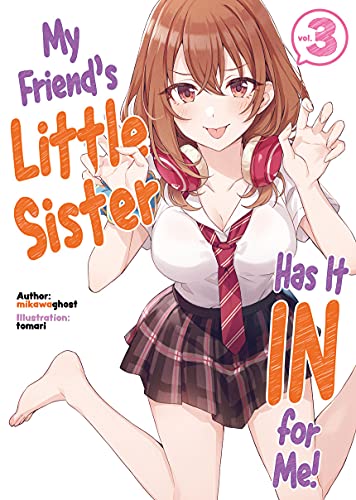
We pick up right where the cliffhanger left off, as Sumire begs Akiteru to marry her. As expected, her family has decided enough is enough, and is going to arrange marry her soon… which means she won’t be able to draw anymore. This is basically the only reason Akiteru agrees to the scheme. After some “wacky” date situations, which I will not go into as they are dumb, a trip that’s supposed to be to the beach becomes a trip to her remote mountain village, where her father wants to meet Akiteru… and force them to get married immediately. Can they possibly get around the marriage ceremony with a 100% success rate? Can Iroha continue to try to cleverly juggle all these relationships in the air, given sempai is a dense MF and won’t do it for her? And can Mashiro finally admit she’s secretly their star writer?

Again, this series leans pretty hard on the Higurashi pastiche. Their game is subtitled “When They Cry”, and Sumire’s home village essentially turns out to be Hinamizawa, complete with terrifying elders and obscure rituals. Having already mentioned the volume’s big weaknesses, I do want to applaud its really good moment, when Mashiro’s editor (who we meet here, ad boy does it take some fancy footwork to explain her presence) points out to Akiteru that he needs to be able to offer his fellow game creators a reason to stay on with him, or else they’re going to look for other opportunities. What can he personally offers them? (Other than, of course, being the romantic lead who has no idea half the cast are in love with him.) It’s not a question that’s answered here, but I do appreciate it was brought up. Iroha also remains quite enjoyable, a bit less “annoying” than the first two volumes, probably as she’s trying harder to have him “get” her feelings.

That’s unlikely to happen soon, and a cliffhanger means we don’t even get this one resolved in one volume. Still, hopefully it won’t take up all of Vol;. 4. I think two volumes starring Sumire is two too many.

Oresama Teacher, Vol. 29

By Izumi Tsubaki. Released in Japan by Hakusensha, serialized in the magazine Hana to Yume. Released in North America by Viz Media. Translated by JN Productions.

Though it’s not an explicit canon pairing, be warned I do talk about the IMPLICIT canon pairing in this review, so ‘ware spoilers.

The final volume of Oresama Teacher, a series that ran for thirteen years, and one of my own favorites, even though it will likely always be overshadowed by the still-running gag comedy Monthly Girls’ Nozaki-kun. It’s a shonen manga that ran in a shoujo magazine, and certainly had shoujo art, but one look at the plot and characters told you this was essentially a “gang” manga at heart, and featured a lot of “new bad guy arrives -> slowly win them over through being nice and/or beating the crap out of them -> now they’re friends! -> new bad guy arrives” in a circle with Mafuyu as its pivot. We’ve had so many ridiculous situations, so many awesome fights, so many cool teenage girls and dorky teenage guys. The journey to get here was wonderful. So, should I still be disappointed if the ending is not one I personally wanted? I mean… if you exist in fandom, yes, it ruins everything. Fortunately, Oresama Teacher only has 29 fanfics on AO3.

First of all, despite the cover art, this is not an OT3 ending, alas, and we do not see Mafuyu getting married. We start off resolving the cliffhanger from last time, and if it feels a bit like it’s undercutting and mocking the drama, well, that’s what this series has always done best. Adfter this we deal with the last remaining open plot hook – what happened to Mafuyu’s memories when she was a kid? The answer, as Takaomi warns her, is not only something she will regret knowing when he tells her, but also something far less dramatic than you’d expect. It is, however, very in character for her. It even ties into the ending, as it turns out even Mafuyu can get into college if she applies herself… in the wrong way. We then get an extended “where is everyone off to after graduation” chapter, and end with a brief epilogue showing our main characters as adults.

So yeah, surprise, once again Japan loves teacher/student and jerk pairings more than the West. I always suspected that we were going with a Takaomi endgame, particularly when Hayasaka’s past only turned out to be the end of Part II rather than the whole series. Mafuyu’s memory loss ties in to her obsession with him – she couldn’t imagine living without him after he had to leave her to go to educational college, so she literally erased her own memories, somehow, to forget him. That is both in character and EXTREMELY frustrating, frankly. As for Takaomi himself, he’s far less effusive, but honestly, he hasn’t stopped her chasing after him her entire life, so why would he stop now? The epilogue shows he’s started a company (it’s unclear what it does, but it’s implied it’s a “we fix your problems” sort of company) and both Hayasaka and Mafuyu are employees there. And again, while the implication is the “they’ll always be friends!” was meant to be the emotional heft, there’s also his implication he’ll propose to her in three more years. Eh.

So yeah, not the pairing I wanted, but I enjoyed everything else about it. In the end I’ve enjoyed every single Izumi Tsubaki series. Sometimes I am alone in this (I will defend The Magic Touch to my dying day), sometimes I am part of a much larger horde (Nozaki-kun 2nd season WHEN?). Oresama Teacher fits squarely in the middle. Its fans love it, but it’s still a bit of a cult. Its huge, huge cast can give readers a headache. And you’d better love dimbulbs, because this series runs on them. I’ll miss it dearly.

Altina the Sword Princess, Vol. 9

By Yukiya Murasaki and himesuz. Released in Japan as “Haken no Kouki Altina” by Famitsu Bunko. Released in North America digitally by J-Novel Club. Translated by Roy Nukia.

I’ve been waiting for plot developments like the end of this volume to happen for some time. Regis is a bit of a Golden Boy throughout the series – that’s the point, he uses his brains and Altina’s brawn and royal presence to help seize the day, even when it’s involving a bubbling under civil war. And now he’s been noticed enough that he’s forced from her side to Latrielle, the heir apparent, and is giving him the best advice fictional books can buy. Now, we’ve seen him lose troops based on his decisions before, to the point where he almost passed out, but the advice was correct and they won the day. Here, though, not to spoil too much, his advice is good but they do not win the day. Someone has anticipated him. They lose, and there are many casualties. And this is when you realize that, for all that the country is supposed to be on the same side fighting Britannia, Regis is very much surrounded by enemies.

Of course, the book is not just about Regis. Jessica, Franziska and Martina want to rescue their brother, but can’t, and they’re deep in enemy territory. So they accept the kind offer of the man who saved them last time to stay at his place. His place, of course, turns out to be the castle, much to their shock. (Elize is there as well, but one senses the author is not really sure what to do with her.) Altina is back at her fortress, dealing with Eric’s game-breaking injury, and finds that even though Regis is away from her side he can still come up with advice to win the day – in this case, suggesting a career change for Eric that would still allow them to remain a soldier protecting Altina. We get a brief glimpse of the enemy, which is dealing with a major problem – Queen Margaret is bored with all this and therefore doesn’t care what happens.

And then, as I noted, we get Regis’ plan to defeat the enemy, which is anticipated and rebuffed. He does get in one small triumph, which allows us to meet yet another new cast member and promises to take up a chunk of Book 10, but it also involves the deaths of a LOT of men – and these are not his own troops of the Fourth Division, which is back at Altina’s side. The generals were already annoyed with Regis for sacrificing their units earlier, they’re now livid. Fortunately for Regis, Latrielle is not stupid, and knows that the plan could have worked and exactly who was clever enough to anticipate it. The generals may be angry, but they know not to argue with their future King. As for Regis, I think it’s a good lesson for him, especially mentally. Now if he can only work on his physical stamina, which is laughably pathetic.

The author already admitted the final part of this book got so long it has to finish in the next book, so we’ll see what happens then. In the meantime, this is a solid volume of Altina that shows events moving along slowly but surely – will we see the end of the war with Britannia next time?