Monthly Archives: November 2022

Accomplishments of the Duke’s Daughter, Vol. 7

By Reia and Haduki Futaba. Released in Japan as “Koushaku Reijou no Tashinami” by Kadokawa Books. Released in North America by Seven Seas. Translated by Andria Cheng.

If the first book in the “Accomplishments of the Duchess” prequel was about discovering the hellion that Merellis once was, this volume is about showing us how she came to be the woman we know from the main series. In essence, this is also a book about her training for battle, it’s just the battles she’s going to face are in society rather than in the military, and the enemy is anyone who dares to look down on her. And, frankly, she takes to this just as well as she took to being a swordswoman. Frankly, as I’ve said before, Accomplishment of the Duke’s Daughter is not a series to read if you want to see protagonists struggling valiantly against impossible odds. For the most part, it’s about seeing women kick ass, in a variety of settings. In that regard, this volume works perfectly fine. And, in case you were worried we’d lose the awesome swordplay and butchering of enemies, no worries, we get a bit of that as well.

There is an ominous beginning, where Merellis’ father forbids her from taking up the sword and announces she’s going to be engaged to be married to the son of Duke Armelia, a political marriage. She suffers greatly over this for about five pages, but the reader is in on the joke, so we know everything will be fine once she figures out who the duke’s son is. After that it’s just a matter of shifting gears. If she can protect the most people around her through politics rather than the blade, then politics it is. As such, Louis’ mother gives Merellis a crash course in nobility, something she has assiduously been avoiding for the past several years. Just in time too, as it’s time for her to make her debut and attend the academy. Let’s hope it goes smoother for her than it did for her daughter…

I enjoyed seeing how Merellis’ training in military and the sword can be of use to her in society, particularly in how she watches the way people move and stand. Twins who are indebted to her father for saving their lives arrive at the estate, and Merellis can tell very rapidly that a) they have some basic fighting skills, and b) they’re OK to trust. These skills will serve her well. The book’s pacing is sometimes a problem, and sometimes the plots it drops can be more ominous than intended – Merellis’ old maid injures herself and is forced to return home, and there is a suggestion that she will die… which she may indeed have done, as we never hear from her for the rest of the book. It’s at times like these that the series shows off its seat-of-the-pants webnovel roots.

Fans of the main series may still be a bit put off that Iris is only in the wraparound at the start and end of this, but for those who found her mother to be a cool character, good news, here’s more of her.

Death’s Daughter and the Ebony Blade, Vol. 2

By Maito Ayamine and Cierra. Released in Japan as “Shinigami ni Sodaterareta Shoujo wa Shikkoku no Tsurugi wo Mune ni Idaku” by Overlap Bunko. Released in North America by J-Novel Club. Translated by Sylvia Gallagher.

It’s probably time to bring up Michael Moorcock and the series Elric of Melnibone, a series that I’m 100% sure that Maito Ayamine has read over and over again. This particular light novel series happens to feature a silver-haired protagonist who wields a sword that supposedly takes the souls of those it kills and gives them to their patron. Which, well, is exactly what happens in Elric as well. That said, Death’s Daughter and the Ebony Blade does not remotely have a sense of tragedy or pathos in it, running instead on “gosh, that murderous military scamp, isn’t she adorable?”. In the Elric series, you can be reasonably certain that everyone around Elric, particularly his love interests or close friends, will die. Olivia has Ashton has her not-quite-love interest, and Claudia as her “in my heart, this is an OTP” best friend/morality chain, but I have little worry that they’ll be killed off anytime soon. The same can’t be said for anyone else on the side of the Empire.

After the events of the first book, Olivia has gotten a bit of a reputation. In fact, she’s being called a monster, something she is not happy with. (Later she gets upgraded to “God of Death”, which pleases her much more). The book rapidly becomes a series of battles where the moral of the story is “if Olivia is here, or able to get here in the nick of time, we will win. Otherwise, bad things will happen.” The Empire tries sending some of its strongest warriors to fight her, and then a few of its generals. The outcome is the same. It helps that she has Ashton’s tactics, of course, which are also rapidly being appreciated more and more, by her allies if not by the Empire. Can someone come along that causes Olivia to reflect on what she has become? Or is it just “I want to eat delicious cake and butcher enemies, and this town has no cake?”.

In case it was not crystal clear, you should only be reading this series if you have no trouble with a moral void of a main character. In any other series, Olivia would be the terrifying villain. Indeed, I was sort of expecting Claudia to turn to Ashton at some point, possibly after Olivia had decided on the blood and skulls-themed family name as the one she’ll take going forward, and say “Are we the baddies?”. No, you’re not, but that’s really only because there are no goodies in this book, really. Everything can be abandoned in the name of military victory. There is some lip service paid to what it means to be a good lord of a city, in terms of protecting the people who live in that city from harm, but even there the lesson is taught by the execution of the errant lord.

Essentially, this is a very dark series, but it’s not written in a dark manner. It’s written as if this is Haruhi Suzumiya with a sword. That sort of dissonance is probably what makes it interesting.

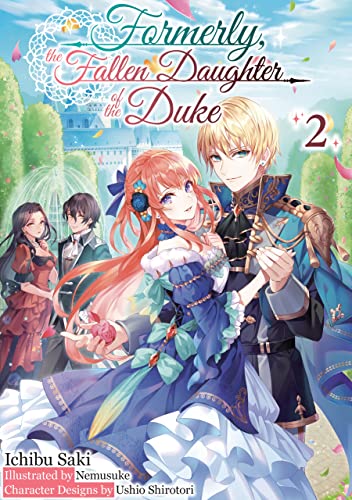
Formerly, the Fallen Daughter of the Duke, Vol. 2

By Ichibu Saki, Nemusuke, and Ushio Shirotori. Released in Japan as “Moto, Ochikobore Koushaku Reijou desu” by Mag Garden Novels. Released in North America by J-Novel Heart. Translated by Andrew Schubauer.

The author admits in the afterword that a lot of the fans of this work were very thrown off by the twist at the end of Book One, and even more by the start of the events in the second book. I can’t really blame them. Book one read like a nice, pleasant villainess story with a happy ending. A bit boring, but not actually so much so that you walk away. And now we’re back to the start, and we have to do things all over again. The trouble here is that our heroine does not quite have the self-esteem needed to try to regain her fiancee, so we get nearly an entire book of “it’s OK if he doesn’t love me this time around, I’m fine with being friends”. The other issue, of course, is Charlotte, who remains The Absolute Worst. It’s never quite made clear if she also has memories from Japan, but there’s certainly a lot of “I’m the heroine, why is everything not going my way?” to her.

After the events at the end of the last book, Claire finds herself back where she started, in her old country and about to get her old baptism. She manages to make a few quiet changes (like taking her mother’s note to her so it can’t be used by Charlotte), but for the most part everything goes as it did last time. Except… her family seems a lot nicer and more considerate? In fact, she’s being sent off to school in the country that she fled to in the last book, and can reunite with her old friends and old fiance. But there’s a hitch. Claire is not the only one that went back in time for a redo. And the forces of evil are using the power of capitalism to try to destroy any chance Claire has at getting the powerful magic she needs to achieve her happy ending.

The book keeps its feet firmly in the fantasy in this volume, with almost no mention of the “Japanese game” part of the series. For the most part, as I noted, the most interesting part of the book is Claire reacting to her family being nice to her. Claire never explicitly states this, but being treated like garbage in the previous world hurt her a lot, and it means that when her ex-fiance or brother are kind and caring towards her (indeed, the fiance is trying to fix the ‘ex’ part) it just throws her off. There is an iffy part of the book, though, which involves brainwashing someone. First of all, the setup to this is ham-handed and obvious, and I rolled my eyes. Second, even though the person being brainwashed is an antagonist, and Claire freaks out and tries to undo it, it really seems like an easy “get out of bad plots free” card. Fortunately there’s still Charlotte around to make everything worse, but still.

This book does NOT end with another loop, much to my relief, and there is a third volume in the series. I’d put this in the middle tier of villainess books.