Monthly Archives: November 2022

The Bride of Demise, Vol. 2

By Keishi Ayasato and murakaruki. Released in Japan as “Shūen no Hanayome” by MF Bunko J. Released in North America by Yen On. Translated by Jordan Taylor.

Sometimes you are an author with a wonderful idea, a grand epic tale that will span 30, nay, 50 volumes, and then you get told by editorial to wrap it up in the next chapter. So goes life. Then there is the opposite problem. Sometimes you get an idea for a great, short, punchy horror story with a side of friendship and bonding, and it’s great. In fact, it’s so great the publisher asks where the next volume is. There… isn’t one? It’s complete? Nonsense, you will write more. Because it was popular. Now, I’m not sure that’s exactly what happened with Keishi Ayasato and The Bride of Demise, but it would not surprise me if that was the cast. There’s nothing wrong with this book. It’s got evocative prose, startling horror, and some cool battle scenes. It’s just it doesn’t feel like it’s actually telling us all THAT much that’s new about the world, except for one thing which isn’t much of a surprise. But, if you enjoy Ayasato, it’s still very good.

Kou Kaguro, after 15,000 deaths to get there, finally has his happy ending. He’s at the Academy in his special class with his beloved White Princess. He even gets a big surprise when Millennium Black Princess joins the class as a “new transfer student”, something so blatantly false that the class boggles in disbelief. And they get a second teacher, Hibiya, who proves to be far more adept at actual teaching than the eccentric Kagura. Plus, it’s School Festival time! Admittedly, as part of the secret class, it’s harder to walk around the festival, but that’s why masks were invented. They’re even doing a haunted house, and trust me when I say it will be scary. Everything’s coming up roses for Kou… at least till he gets stabbed to death. And then stabbed again. And again. By his closest friends.

Kou can be a relatively passive protagonist, something he is called out for here by Kagura and Hibiya, who both tell him that he uses his time powers like a magical do-over, and that eventually that will get him into trouble. But he’s still trying to be a good guy… a “hero of justice”, as it’s explicitly stated here, and towards the end of the book he finally gets a handle on this, realizing that sometimes justice makes you need to do terrible things to people that don’t really deserve the=m. We also get some new insight into the kihei, which should be too surprising if you’re read enough conspiracy novels, but also lends a nice air of “uh oh” to the series going forward. And there’s even a smidgen of romance, though for the most part it’s either of the “let’s hold hands” variety (Kou and his princesses) or an ominous setup for the third book (Asagiri).

So yeah, this was good, and I enjoyed it. But I don’t think the book was all that necessary. Possibly the publishers agreed – the next book is the final one in the series, I believe.
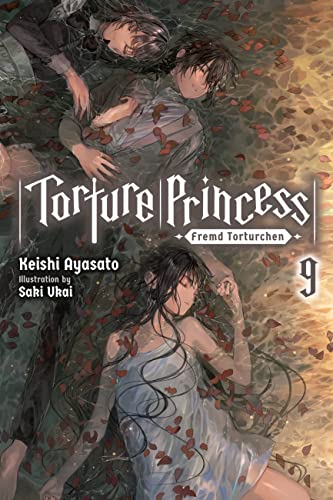
Torture Princess: Fremd Torturchen, Vol. 9

By Keishi Ayasato and Saki Ukai. Released in Japan as “Isekai Goumon Hime” by MF Bunko J. Released in North America Yen On. Translated by Nathaniel Hiroshi Thrasher.

It might come as a surprise, particularly if you read the early books, but the main character in the Torture Princess novels is, in fact, the Torture Princess. Kaito is definitely the co-protagonist at the start, but as the volumes go on it becomes clear that he’s more an ideal, a symbol of hope, rather than the one whose character development we see as the books go on. That’s Elisabeth’s role, and in this final book we see her mask cracking more than any other, as she tries to keep up the “you want to die, fine, whatever” attitude even as she cries blood trying to stop everyone from dying. If you have read every volume of Torture Princess, Elisabeth is probably the main reason. (Yes, OK, Izabella and Jeanne are probably the main reason, I’ll get there.) The plot of this book is not really “will Elisabeth win?” or “will Alice win?”, it’s “how dark can the author make this and still have us care about the outcome?”. The answer is, unsurprisingly, pretty dark.

The big confrontation with Alice is happening, and unfortunately each person being brutally slaughtered leads to more power for Alice. Fortunately, a savior arrives (no, not him – not yet) to essentially remove Alice from the plot for the first half of the book, so that Elisabeth can deal with the fallout of everything else. There’s the Sand Queen, who may be dead but that’s not stopping them. There’s the battle between humans, mixed race and beastmen. And there’s the fact that even now she really wants to see Kaito one last time. Sadly, in the second half of the book Alice returns, and gets down to the mass extinction event that she’s now wedded to. Is there anything that can be stopped? And can the book actually manage to not kill everyone off?

Spoilers: not everyone dies. That said, a lot of people do die. I mentioned Izabella and Jeanne, and I must admit that Izabella has had “I am going to die tragically” written across her forehead from the moment we met her. Indeed, the arc of her character is how she keeps NOT dying. That and her love for Jeanne, which comes dangerously close to stealing the show here. I love Elisabeth, and she’s great here, but the best MOMENT in the final volume is the impromptu marriage ceremony that Izabella and Jeanne perform. It will make you smile and cry at the same time. I also appreciated how Alice’s story ended. There was literally nothing anyone in this world could do for her anymore, so she simply got dumped back in modern Japan. It’s cruel, yes, in a “not our problem” sort of way, but cruelty is old hat in Torture Princess. As for the very end, it’s possible to read it as metaphorical. It might seem a bit too pat if you read it literally. Either way, though, I’m fine with it.

In the end, though, it may be the grand guignol, over the top prose that was the main reason everyone ate this series up. Kudos to Nathaniel Hiroshi Thrasher for translating it. This was a good series, which I doubt is getting an anime anytime soon. A bit too much torture for that medium.

Banished from the Hero’s Party, I Decided to Live a Quiet Life in the Countryside, Vol. 7

By Zappon and Yasumo. Released in Japan as “Shin no Nakama ja Nai to Yuusha no Party wo Oidasaretanode, Henkyou de Slow Life Surukoto ni Shimashita” by Kadokawa Sneaker Bunko. Released in North America by Yen On. Translated by Dale DeLucia.

A lot of people, particularly since the anime debuted, have discussed the way that this series handles its Divine Blessings. Indeed, one might say that how to handle them is the point of the entire series. It comes down to how much is pre-determined and how much is free will, so is naturally going to be a bit contested by readers. That said, I think the series is trying to navigate an interesting middle ground, showing that in this world you have a role but you can manipulate that role how you like. Admittedly that’s easier for some than for others – see Ruti’s entire plot for the first four books. But even then, once she was able to free herself from the blessing’s stranglehold on her, she’s been saving people in the way she wants to, rather than the way she’s destined to. Leonor, though… oof. There’s trying to fight fate and then there’s ignoring fate.

We pick up where we left off last time. There’s pirates and princes in Zoltan, and its reputation as a backwater town where nothing happens is in jeopardy by an impending war. Red and company manage to work things out with the pirates, though admittedly the tragic backstory that is revealed helps an awful lot there. Leonor, though, is a very different matter. She will not stop until she destroys everything. And what’s worse, we discover that she and Red met back when he was a young knight, and she really, really, really took a liking to him. So she’s now determined to have him as well as destroy her sister and also make sure that her kingdom is taken over by demons. As for the demons themselves… they’re just doing what demons do, really. They may not have blessings, but they enjoy being jerks.

The outcome of the battle is not really in doubt. Zoltan has Ruti, who is basically this series’ equivalent of “we have a Hulk”. But it hits the right beats anyway, showing how well Rit can command a force even though, as she repeatedly says, all she wants to do now is live her lovey-dovey apothecary life with Red. Red shows off how well actual practice and skill can trump “Oooh, I’ve got a cool blessing”. And we also see that people do not HAVE to be beholden to what their urges tell them to. Tisse is an assassin. She’s really good at killing people. But here we see her take the Cooking skill, just so that she can join Red in making really good food. Heck, Mister Crawly Wawly also takes the Cooking skill! I am hoping that “Tisse and Mister Crawly Wawly write a spider cookbook” is a genuine subplot in this series, as that would be awesome.

Unfortunately, Slow Life may have to wait – again – as there’s a new hero in town, and I get the sense that the Church wants to make his first mission “destroy the old hero who dared defy us”. Still, for now peace reigns again, which is all we can ask. And hey, Season 2 of the anime coming soon.