Monthly Archives: February 2025

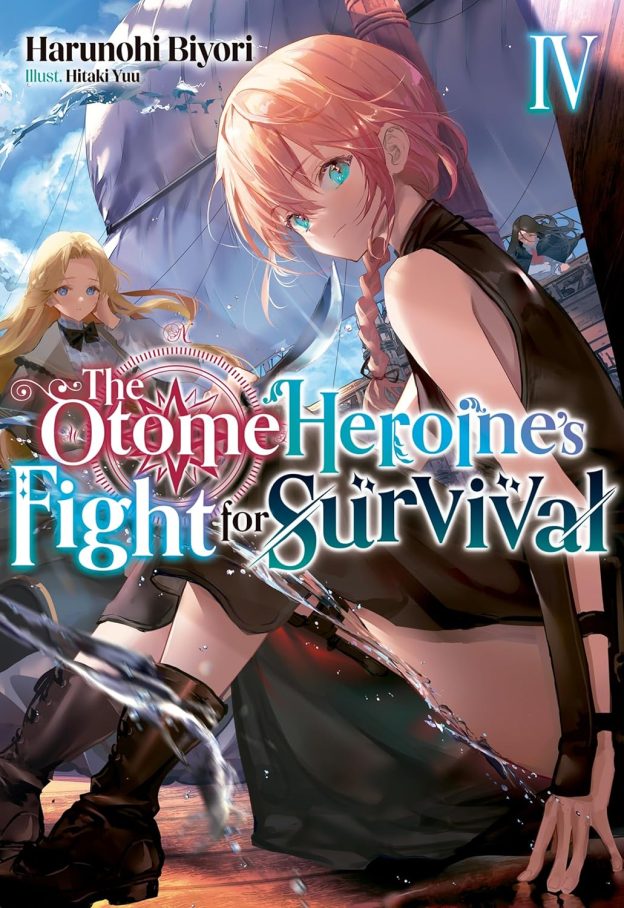
The Otome Heroine’s Fight for Survival, Vol. 4

By Harunori Biyori and Hitaki Yuu. Released in Japan as “Otome Game no Heroine de Saikyō Survival” by TO Books. Released in North America by J-Novel Club. Translated by Camilla L.

After spending the last four books ignoring the otome game aspect of this world for the most part and being devoted to showing pages of stat upgrades and lots of monster fighting, we will finally be getting around to the actual game in the next volume, with academy hijinks and everything. That said, some aspects of the game still shine through, and one of them is that, though she doesn’t really notice it herself, everyone and their brother is falling head over heels for Alia. Random passersby on the street gawk at her. Royal knights all vow to protect her. Elena thinks they’re soulmates. And Karla… well, we’ll talk about Karla later. Alia’s got that heroine energy for sure. Heck, at the climax of this book she’s forced to get rid of having ash in her hair and let her peach flag fly. The trouble is, Alia does NOT think of herself as the heroine of an otome game, so all of this, with the exception of protecting Elena, is irrelevant to her.

Alis is finally, somewhat reluctantly, joining the Rainbow Blade, mostly as that’s the only way she’ll be able to help Elena, who is going to a very difficult dungeon, along with her brother, her brother’s fiancee candidates, an annoying uncle, and various retainers, in order to gain the fantastic “any wish” reward the dungeon can offer. After officially leveling up, and dodging a murder attempt, Alia and the rest of the adventuring party arrive and head through a secret door that allows you to skip seventy floors of the dungeon – which still leaves us with the most dangerous floors. Can Alia keep Elena and the rest of the royal family safe without getting murdered by dangerous ogres, terrifying minotaurs, and the scariest being of all, Karla?

As with the last book she appeared in, Karla is absolutely one of the best reasons to read this, as she is legitimately mentally disturbed in a way very few anime villains really manage to pull off. “Yandere” is a word I hate because it gets abused, but there’s no denying that Karla’s death wish revolves around her obsession with Alia, and her desire to level up – even if it means murdering piles of people, which she does here – is solely so that she can achieve her wish of fighting Alia in the ruins of the entire kingdom until Alia kills her. It is a grand guignol death wish, and I have no doubt it will be the series finale – hopefully NOT in the ruins of the capital. As for Clara, the other villainess in this story… meh. Even her name is easy to mistype when I mean Karla. I get that she’s sort of trapped, but she needs to get more interesting. (Arguably Elena does as well, but at least she manages to solve the worst of her problems by the end of this book.)

With a big YMMV reminder over the series, which always reminds us how young these girls really are, this remains a strangely compelling narrative. I’m hoping spending time at the academy with petty nobles and classwork might mean a few less stat screens, though.
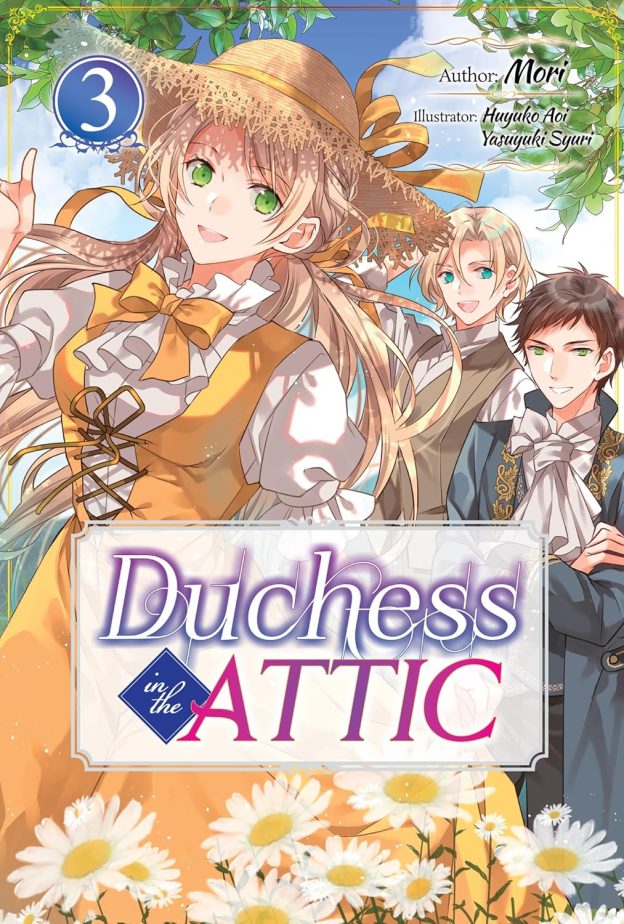
Duchess in the Attic, Vol. 3

By Mori and Huyuko Aoi. Released in Japan as “Yane Urabeya no Kōshaku Fujin” by Kadokawa Books. Released in North America by J-Novel Heart. Translated by piyo.

(This review discusses a plot twist near the end of the book, but I will wait till paragraph three to do so.)

This is a very odd series, in that it’s technically meant to be a thriller of sorts, where we see Opal struggle against events that are conspiring against her. But she’s never seriously in danger, and knows it. And we, the reader, are fine with that. We’re not reading this series to see Opal being threatened by goons, we’re reading this to see Opal being smug, and boy howdy do we get that here. We also get another attic, and this time she stays in it for an extended period. I sometimes wonder if the author thinks of Opal in the attic, and then writes a plot to get her into it, rather than the other way around. As for the book itself, well, it’s taking the events of Books 1 and 2 and telling the reader we should have been paying far closer attention to them.

After the events of the last volume, which ended with someone trying to break up Opal and Claude, she heads off to their new lands without him. There she finds an old-fashioned, Satan-hating land maintainer, a butler who screams “I am evil”, and a footman that she immediately dislikes on sight. Fortunately, she does have her loyal maid Nadja. Unfortunately, while on her way to inspect mines, which requires her staying at a ludicrously opulent mansion that looms over a poor neighborhood, she finds herself kidnapped, locked in an attic, and held for ransom, along with Nadja. At least she gets things to read from that footman she dislikes. As for why she’s been kidnapped, well, the anti-royal faction have decided to have their revolution, and she makes a great hostage. Supposedly. If their revolution were going well.

So, one mystery I love is The Murder of Roger Ackroyd, by Agatha Christie. It’s not loved by everyone, however, and gets into “is it OK to withhold vital information when you are a first-person narrator?”. This book does the same thing, with Julian, the footman. I already knew he was going to be more than just one of the three bad guys. For one thing, he’s on the cover, pictured happily next to Claude and Opal. For another, he gets a big interior illustration the moment he first appears. That said, I assumed that he would be, y’know, an old friend of Claude’s who’s being a spy. Which, admittedly, is 100% true. But he’s also someone we’ve been hearing about since the very, very start of the series, always present by his absence, and Opal’s immediate dislike of him should have been a bigger clue. No one fights quite like a brother and sister, after all. This also makes the climax of the book, which should be tense and anxious, hilarious, as the two cannot stop sniping at each other. It’s glorious.

The first book had a definite ending, and then it continued. This third book also has a definite ending, and yet there is more. I’m looking forward to it a great deal, though.

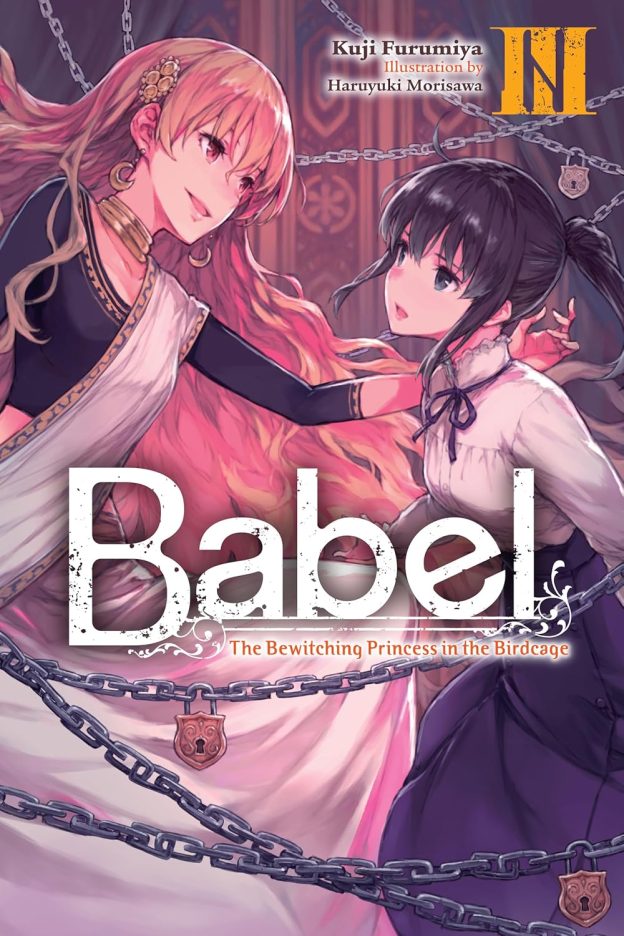
Babel: The Bewitching Princess in the Birdcage

By Kuji Furumiya and Haruyuki Morisawa. Released in Japan as “Babel III: Torikago Yori Izuru Youki” by Dengeki Bunko. Released in North America by Yen On. Translated by Amelia Imogen.

So, first of all, I want to note that I *loved* this volume. It’s not only my favorite volume of Babel so far, but it may actually be my favorite book by Furumiya I’ve read so far. That said… boy, this is absolutely exhausting to read. As always with this author, it’s a brick – the digital version comes in at 463 pages – and much of it, especially in the back half, is a series of “is this going to end badly with Shizuku dead?” mini-cliffhangers. More to the point, while the start of the volume does indeed continue the themes of the previous one, showing Shizuku trying to explain how teaching language can be a good way to solve the current crisis – it rapidly derails into Shizuku doing what she does best, which is speaking to those in power and smacking them down. With Lars that mostly just led to a lot of arguments. With Princess Ortea, it leads to revolution.

We pick up from the cliffhanger of the previous book: Shizuku is being kidnapped and brought to another country by the evil mage Niké, with Erik’s life being threatened till she gives in. (As a result, Erik is almost entirely absent from this volume.) When she gets there, she discovers that mages have been conducting cruel experiments on children to solve the language issue, and Shizuku is there to try to solve it with her own solution, education. The one she has to impress is the cruel and capricious Princess Ortea, who has been running much of the nation behind the scenes and has a tendency to have people who displease her executed. As the book goes on, Shizuku becomes Ortea’s aide, and gradually comes to realize that there’s a lot more going on here than an evil princess and her worried brother the King. Is the answer overthrowing the monarchy? Yup.

For the most part, I adored this, though I could do without the curse above Shizuku’s womb that’s even more agonizing because she’s a virgin. The only thing more annoying than having superpowers that only work because someone is a virgin is having suffering that is even worse because someone is a virgin. That said, the best part of the book is talking about how you cannot erase your past actions, even if they’re atrocities (especially if they are), but you can try to atone for them and move forward, especially if you care more about the country than about power. Honestly, I kind of wonder if the final book will end with Lars and Ortea marrying, as while they get on even worse than Lars and Shizuku, I could see it working – they’re very similar. As for the lack of Erik, fear not, we do get a romance of sorts, as evil mage Niké turns out to not be all that evil really, and also gradually falling in love with Shizuku, despite her bad habit of getting kidnapped and shot at and stabbed and having painful womb curses put on her. Shizuku needs a break, let’s be honest. Anyway, needless to say he gets nowhere, but he does get in a kiss before she leaves, which is the one thing in the book that reads like a cliched anime moment.

The next book is the final one in the series. After Book 1, I was fairly sure that she would not be returning to Japan, but now I’m not so sure. Will Shizuku have to give up and settle down here? And can she solve the Babel crisis before she returns? A terrific series.