Category Archives: a certain magical index

A Certain Magical Index, Vol. 5

By Kazumi Kamachi and Kiyotaka Haimura. Released in Japan as “To Aru Majutsu no Index” by ASCII Mediaworks. Released in North America by Yen On.

After four novels that were basically one plotline, this fifth book gathers up three interlocking stories, one a novella and two short stories, all taking place on the last day before the school semester begins. Indeed, it’s a bit startling as you get into Index to see how fast everything is moving. The 4th book, and the Angel Fall arc, took place only a few days before this. These stories also share a certain theme, which I suspect was sort of shoehorned into the non-Accelerator ones to make it work better as a book, or people choosing to do the right thing rather than let someone else do it. It’s what makes a ‘superhero’, and given that Index is in many ways about a city filled with superheroes, it rings thematically true, though in some places more than others.
index5

Introduced in this volume: Last Order, Kikyou Yoshikawa, Eztali (as Mitsuki Unabara). There’s no real equivalent to this in the Railgun timeline, mostly as Misaka features in two of these stories. It’s still right after the final battle in the SS anime.

There’s no getting around the fact that one of these stories is much, much better than the other two, so let’s deal with the other two perfunctorily here. The scenes with Mikoto, Touma and the fake Mitsuki look to have been editorially mandated owing to a certain Railgun’s overwhelming popularity, and if you like Mikoto being the tsunnest dere in the city, there’s plenty for you to like here. But it’s very slight, and fake Mitsuki (we don’t actually learn his real name here) seems to fall for Mikoto for no real reason other than to allow the story to vaguely tie into the novels’ theme. As for the final story with Touma, Index, and Ouma, it’s even slighter (the villain is even Touma with one letter removed, though I suspect the Japanese name is suitably different). It does allow Index fans (are there Index fans?) to brag that that she’s actually a smart cookie when not whining at Touma about food or his harem hero tendencies.

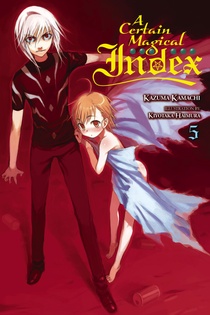
But the main reason to read this, as you might guess from the cover, is the beginning of Accelerator’s journey from a mass-murdering villain to a broken anti-hero. He does a lot of soul searching here, and doesn’t like what he sees, but he can’t really see any way to redeem himself for what he’s done, and has no real reason to do so. Enter Last Order, who despite fandom’s best efforts (and the artist’s, let’s be frank) to sexualize her is pretty much written here as a “little sister” figure for Accelerator. She’s tied heavily into the Sisters project, and is able to offer him as much forgiveness as she can given the circumstances, and show off that he was not being as sociopathic as he thought. In the end, he does manage to save the girl and save the day, though it gets him shot in the head for his troubles, thus solving the other problem with Accelerator, which is that he was simply far too powerful for this series. We haven’t seen the last of him, though.

The translation continues to have the usual strengths and weaknesses, but I really have to highlight two issues. First off, Last Order’s speech quirks are very hard to translate into English at all. I don’t mind the ‘like’ inserted into her words, as it’s a casualness the other Misakas (and Mikoto herself) don’t have that works well with Last Order. But the doubling of the ‘says Misaka’ makes it look more like someone accidentally screwed up the find-and-replace rather than a genuine adaptation choice. Secondly, did Touma really say the word ‘Japanimation’? In 2015?

The three stories in this novel are of variable quality, but the Accelerator one is excellent, and it’s also the longest, so it’s definitely worth reading the book for.
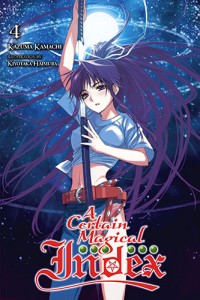
A Certain Magical Index, Vol. 4

By Kazumi Kamachi and Kiyotaka Haimura. Released in Japan as “To Aru Majutsu no Index” by ASCII Mediaworks. Released in North America by Yen On.

The early Index novels tend to follow an unfortunate pattern, which luckily goes away as the series goes on. The odd-numbered books, for some reason, are significantly better and more thought out than the even numbered books. And given that this volume of Index is 4, you can guess how I feel about it. Not that there aren’t great moments in the book, or good characterization. But like the second book, it reads more like the author trying to stall while he figures out to expand his far-more-popular-than-he-expected series into a huge franchise. Also, Kamachi’s attempts at wacky humor are pathetic in every way.

index4

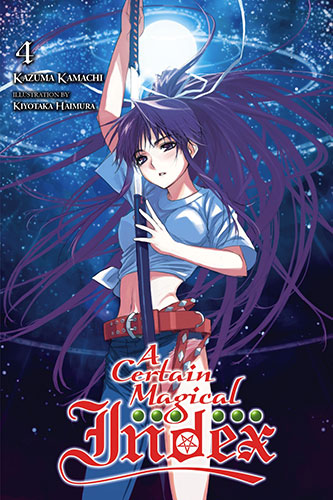
Introduced in this volume: Motoharu Tsuchimikado (who appears much earlier in the anime, to better effect, as he’s sort of out of nowhere here), Touya Kamijou, Shiina Kamijou (looking like Index), Sasha Kreutzev (appearance only), Angel Gabriel (looking like Sasha). For Railgun manga readers, this takes place around when Kongou is introduced (and quickly brought down to earth). For Railgun anime watchers, the anime-original ending to the Railgun S series (with Febrie) is taking place.

The first 30 pages of this volume are almost painful in the forced, unfunny wackiness that ensues. Even after Tsuchimikado and Kanzaki arrive, things still have to wait for comedy at times, as Kanzaki’s desire to kill Touma seems less due to Angel Fall and more due to her being embarrassed about looking like Stiyl. After this, things settle down to what we’ve gotten used to in the Index novels – pages upon pages of explanation of how magic works and the various systems behind it, which is mixed in here with a healthy dose of bizarro Christianity – in case any devout religious fans were still reading Index, I suspect they’ll likely stop here.

And then there’s Jinsaku Hino, the serial killer. As with the 2nd book, the anime decided he was irrelevant and completely cut him. And, as with the 2nd book, I can’t blame them at all, as his plot *is* almost totally irrelevant, serving to pad out the page count till we see who’s really behind Angel Fall and giving us a lot of discussion of split personalities. He’s certainly a creepy psycho, but we never get any sense that he poses a real threat to our heroes, and the main thing his plot seems to have done is show us the Kamijou home and thus show Tsuchimikado who the real culprit is.

Luckily, once we find out who that culprit is, the novel takes a huge upswing, and the 2nd half is much better than the first. Touma’s talk with his father is one of the most heartwarming in the series, as well as a really depressing glimpse back at his horrible childhood. Kanzaki, when she’s not being embarrassed about Touma in general, is also very well done, showing off the fact that she was holding back against Touma in book 1 a lot. Her past is also somewhat tragic, even if she and Touma are meant to be contrasted as polar opposites. As for Tsuchimikado, there’s a bit too much heel-face revolving door here, but you at least get the sense he’s trying to be on the right side, whichever one that may be, and he does get away with a cool (temporary) exit. And I did like him pointing out that Gabriel’s disguise is really obvious to anyone familiar with Russia, as it really, really is.

Yen Press’s translation is decent, though it’s fighting on multiple fronts here. Kamachi’s amazingly wordy prose is simply hard to translate in a way that doesn’t sound like an encyclopedia threw up. Tsuchimikado’s speech quirks are handled pretty well, but his habit of giving everyone nicknames runs up against Yen’s no honorifics policy. So Kamiyan is now Kammy, and Oneechin is now Zaky. Which is OK, but tends to make them sound more like J-pop band members than Index characters.

Luckily, we’re in for a big upswing with Book 5, and the even numbered books get better from here on out. This particular book, though, suffers from a stapled on subplot and bad humor (I did enjoy Misha’s obsession with chewing gum, the most subtle joke and therefore the best). I definitely recommend it for Kanzaki fans, but honestly, the rest might just want to wait till Book 5, where we’ll be discussing another divisive plot twist.

A Certain Magical Index, Vol. 3

By Kazumi Kamachi and Kiyotaka Haimura. Released in Japan as “To Aru Majutsu no Index” by ASCII Mediaworks. Released in North America by Yen On.

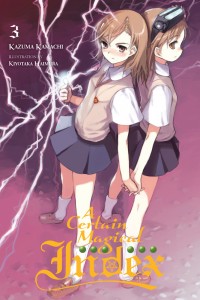
Index had a good start, but I felt the second novel was a bit rushed and inconsequential. Luckily, there’s no such issues here, as Kamachi puts out one of the strongest books in the Index series, and one with a lot of consequences, not least of which is the inspiration for side-series A Certain Scientific Railgun, which especially in the West has become more popular than its supposed parent. We continue to examine the world our heroes live in, this time entirely on the ‘Science’ side of things, and see just how far researchers will go in the search for knowledge and power, a running theme in this series on both the Science AND Magic sides. And we also meet a few characters who will prove very important down the road, for reasons that I will awkwardly try not to spoil here.

index3

Introduced in this volume: Kuroko Shirai, Misaka 10032 (aka Misaka Imouto) and her clone sisters, Accelerator, Maika Tsuchimikado (who I had forgotten gets introduced before her brother, though blink and you’ll miss her appearance.) For Railgun readers, well, you know this one. In fact, you know more than Index readers, as Railgun expanded this arc greatly.

The series may have as one of its main themes that trying to achieve knowledge for its own sake is a dangerous thing, but I can’t really ignore the fact that the series also has its unironic shonen side to it. This seems to aggravate readers, and not just in Index, as I know a lot of long-running shonen series have fans who keep hoping people will get killed off or the heroes will fail just so that manga can be more like DC Comics. Likewise, Index (who, along with Himegami, barely appears in this volume) is a lazy, hungry ball of moe, and therefore jars with anyone who wants to take A Certain Magical Index seriously. But I think it’s the tension between the two that makes it interesting – Touma goes through a ridiculous amount of hurt here, and the idea that he’s still getting up near the end of the book is laughable – but that’s what you do in shonen. You get back up.

Mikoto gets her first major role here, and I’m amused at the difference between the way she acts around Touma and the way Kuroko says that she is afterwards – dealing with Touma relaxes her, which is important given what she’s been trying to achieve. This isn’t her series, so she doesn’t get to save the day, but it’s her pain, and desire to kill herself if it will help to save her clones, that drives Touma to go beyond the impossible again and save her. She’s a serious girl, who clearly places a lot of weight on the choices she makes, even if she’s ignorant of what they mean. After this book, her popularity skyrocketed even higher, and I imagine Railgun was in development by around the 5th volume of Index.

Kuroko does appear here, but doesn’t do much beyond glomp Mikoto a couple of times and give exposition to Touma. Her lecherous habits will have to wait for a future volume for me to be irritated by them. Accelerator is more interesting. I’d forgotten that he actually had some depth here beyond “I am the villain of this arc”. He’s clearly bored with the entire experiment, demanding from the Sisters that they at least make it worth his while to bother coming out. He also states outright why he’s doing this – to be left alone. Being the most powerful Level 5 in the city means that everyone tries to challenge him all the time. This is why he gets so excited when Misaka Imouto, and later on Touma, actually manage to hurt him a little bit. It elevates the tedium. Unlike Isard from last volume, he’s not mentioned at all in the Epilogue beyond the experiment being suspended. The last we see of him is flying through the air via Touma Airways. I wonder if he’ll be back? (Spoiler: Yes, he will be back.)

This was also the first volume where I didn’t find Kamachi’s writing style difficult to get into. He’s still a very eccentric writer, and his narration can meander much of the time, such as when he’s discussing Japanese baseball pitchers, or explaining the plot of Index Volume 1 because Touma’s lost his memory and Mikoto wasn’t there. But it’s a page turner, even more than the last two, and you really want to find out what happens next. Also, his exposition, though frequent and voluminous, can be quite interesting. Not so much worldbuilding as a world textbook. Yen’s translation is quite good. Note they have a company policy of no honorifics, so Misaka Imouto is Little Misaka, and Kuroko says Big Sister rather than Oneesama. I think this is fine, though don’t be surprised if I tend towards what I’m familiar with in future reviews. More importantly, Misaka Imouto’s eccentric speech pattern is kept intact, which is hopeful news for Last Order fans waiting for Volume 5.

If you haven’t read any Index and want a volume that will show you why it’s popular, skip the first two and get this one. It really is excellent. Also, a reminder that Touma and Index spend the entire volume carrying cats around.