Category Archives: accel world

Accel World: The Seven-Thousand-Year Prayer

By Reki Kawahara and Hima. Released in Japan by ASCII Mediaworks. Released in North America by Yen On. Translated by Jocelyne Allen.

And so, at last, we come to the end of the Armor of Catastrophe arc, which was not only deliberately meant to be a long arc but also grew out of the author’s control, as he’s admitted himself in the afterword. The volume gives us a lot of what readers like about this series: good battles with some nice analysis from Haruyuki, some amusing harem comedy, some heartwarming romance with Kuroyukihime, and an examination of the nature of negative emotions and how to cope with them every day, because they don’t just magically go away merely because everyone believes in you really hard. That said, it also has some things that fans tend to not like as well: Haruyuki is not only the bestest person to ever be possessed by the evil armor, but he’s a shining magical beacon of hope for all. Oh, and he gets another girl confessing to him, and is caught with her lying on top of him, because harem comedy. It’s a balance.

The significant development here is a bit of a spoiler, but worth talking about. We learn the true identity of Ash Roller, which turns out to be somewhat confusing, meshing up a tragic tale of an introverted girl and her comatose brother with the nature of the neurolinkers that are omnipresent in this world. It’s left deliberately up in the air what’s going on here, whether Rin is literally being possessed by her brother while in the Accelerated world, or if she’s merely taking on his role to an almost absurd extent. (She genuinely seems to be unaware of what transpires without wearing her brother’s neurolinker, so odds are on the first.) That said, I admit to a bit of irritation at the fact that one of Haru’s only male friends turns out to really be a shy young girl who’s in love with him in real life. (The shyness is conveyed via an odd speech pattern – Rin talks in sentence fragments, and it’s unclear if this is a mental issue like Utai’s or if it’s meant to be natural introversion.)

That said, once again after a lot of harem tease we are reminded that at the end of the day there is only one who is top of the heap, and it’s Kuroyukihime. We get a little more insight into her real-life background – she lives alone in a very rich neighborhood, and it’s implied that the murder of the Red King in the Accelerated World had a counterpart in real life as well. That said, just as Haruyuki is a Pillar of Hope for All despite his omnipresent self-hatred, Kuroyukihime tends towards the perfect accepting girlfriend much of the time, listening calmly as Haru pours out his fears, getting the crap beaten out of her in the AW waiting for him to overcome the Disaster, and bushing cutely when he’s accidentally proposing marriage to her without actually realizing it.

So in the end Accel World has much the same strengths and weaknesses as the author’s other series, Sword Art Online. Which means fans of one will enjoy the other, and those who hate Kirito with a passion probably will find themselves getting annoyed at Haruyuki here. The next book should be standalone and lighthearted, and I fear that may mean MAXIMUM HAREM ANTICS. We shall see.

Accel World: The Binary Stars of Destiny

By Reki Kawahara and Hima. Released in Japan by ASCII Mediaworks. Released in North America by Yen On. Translated by Jocelyne Allen.

Much as I said last review that this one was probably going to be nothing more than a string of fights, that doesn’t appear to be the case. Bar the beginning, where despite everything Haru and Chiyuri do indeed succeed in punching hope into Takumu, this volume is a bit of breathing room in the midst of what has become a 4-volume arc. What this volume actually ends up being is a giant pile of good times for Haru, as if the author knew that too much bad stuff had rained down on him lately and so is trying to make up for it here. We get the renewed bonds of friendship, some cute ship tease, and finally succeed in busting out of the Accel World version of the Imperial Palace. We even get to see Haru bust some moves in a basketball game. No, really.

And look, another cover image that isn’t Kuroyukihime posing half-naked! (Don’t worry, it’ll be back for the 9th volume.) But yes, part of the plot of this book is to show how to move to the next level with the Incarnate system, and apparently it involved confronting what your worst trait is, and turning it into a positive. No prizes for guessing that Haru’s self-hatred and urge to escape his troubles is his big negative – this is what led to Silver Crow in the first place. But now we start to see him consciously apply what everyone else has always known are his good points – his ability to analyze a situation and come up with an appropriate response, combined with nearly infinite compassion. Let me tell you something, I realize that OT3s don’t actually happen in actual anime/manga, and also that the endgame of this series is clearly (and deservedly) Kuroyukihime. But after reading the first third of this book, you too will believe in the Childhood Friends Threesome of Pure Love.

Then there’s that basketball game. It’s not as if Haru magically becomes a good athlete, or even an average one – he literally works himself into unconsciousness. But this is the first time that we’ve really seen Haru take what he’s learned from fighting battles in the Accelerated World and apply it to real life – not in a cheating sense, but in terms of using his brain to analyze the best course of action. It’s telling that the one actual basketball player on the other team gives him respect – he’s earned it, simply by not giving up immediately and coming up with a solid plan. (They do still lose, I mean this isn’t Sword Art Online.)

Naturally, of course, it all crashes and burns in the end. After escaping from the Castle, we find that the ISS-infected users are busy torturing Ash Roller and his child – and likely doing so until they’re both forced from the game forever. Haru’s compassion is a big positive, but when he sees his friends cruelly tortured, it comes out in the worst possible way – revenge. And so the Chrome Disaster is back, and we have yet another volume to try to resolve this. Kawahara says it’s the last one, he promises. He’s said that before, of course. But I don’t mind. It’s a great arc in an underrated series.

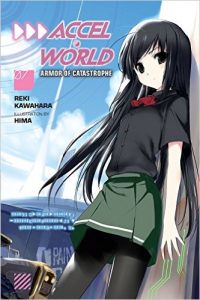
Accel World: Armor of Catastrophe

By Reki Kawahara and Hima. Released in Japan by ASCII Mediaworks. Released in North America by Yen On. Translated by Jocelyne Allen.

Accel World is about a group of elementary and junior high school students fighting battles to the death, and the novels are not afraid to show you the emotional fallout from such a situation. In fact, the first quarter of this book is devoted to a giant flashback to several years prior (when the best you could do is Level 5), where a young couple who have fallen in love in the Brain Burst world (despite not knowing who their real life identities are – oh, and she’s dying in real life as well) discover one of the seven Big Powerups in the game, and as a result are quickly turned on by their supposed friends and fellow players. It’s played for maximum tragedy and drama, and helps to explain why the Disaster Armor currently infecting Haru has a mind of its own.

aw7

And these are kids, even if they supposedly have more emotional maturity from all the time they spend in accelerated time. Nowhere is that more clear than with the confrontation Haru has with Takumu at the end of the book. Takumu’s jealousy of Haru was, of course, part of the plot of the very first volume, and it’s actually good to see that it did not magically go away, because those sorts of things don’t. It’s also not being helped by the new ISS pseudo-Disaster program, which is corrupting him so it’s hard to tell if these are his own thoughts or not. But you also see it with Haru, who is also still just a kid, and whose desire to punch hope into Takumu somehow is shown in the end to be just as foolish and short-sighted in a world where nothing is ever quite as easy as you expect. Which of course, means this is not a two-book series, but an arc, and we’ll see what happens next time.

Elsewhere in the book, Haru and Utai manage to at least get closer to escaping from the Imperial Palace world they’re still stuck in in the Unlimited section, helped along by a mysterious samurai-type who happens to have been in the section all along but refuses to tell them how he got there. It’s fairly clear this young boy is supposed to be a member of the Imperial Family (which explains why he’s there – he lives there), but Kawahara is being very coy about it for reasons that are also fairly clear. And Haru and Kuroyukihime get some nice shippy moments, much to the frustration of Chiyuri and Fuko, which leads to probably the book’s funniest moment (and also makes me think that Fuko is more interested in Kuroyukihime than Haru). And of course Haru remains marked for death, both from the Kings and from a group that has put a bounty on his head, as we realize that the flashback we see at the start of the book may come full circle.

This is mostly a setup book that will likely pay off with big fights in the next volume, but as always it’s eminently readable, and for once the cover is not something you have to hide from the outside world. And there should be less of a wait for the next one – the series seems to be shifting to four times a year.