Category Archives: my friend’s little sister has it in for me!

My Friend’s Little Sister Has It In for Me!, Vol. 5

By mikawaghost and tomari. Released in Japan as “Tomodachi no Imouto ga Ore ni dake Uzai” by GA Bunko. Released in North America by J-Novel Club. Translated by Alexandra Owen-Burns.

This series has a tendency to be very metatextual, and we certainly get a lot of that in this book. Everyone may not think that they’re in a light novel series, but they certainly know the way said series tend to go, and they’re noticing that all the things happening around Akiteru pretty much line up with those sort of plots. That’s not good news for him, as he’s supposed to be fake dating Mashiro, who has already not-fake confessed to him. His uncle is clearly very aware of the things going on in his life, especially the presence of Iroha, but for now seems to be content to give him enough rope to hang himself as long as he keeps making Mashiro happy. (Even if he is jealous of the little bastard.) As for Iroha herself, she should be reassured, given that in light novels her type tends to win rather than Mashiro’s type, but she is not. Are the others, a year older than she is, really going to abandon her?

So yes, Mashiro’s father, and Akiteru’s potential benefactor, has noticed that the fake dating part of the books has been left by the wayside almost since it began, mostly as Akiteru can’t quite bring himself to do it knowing she loves him for real. They’re going to have to try, though, and the upcoming festival seems like a good chance. Before that, though, Akiteru needs to continue his quest to find Iroha a friend who can take his place in her life (not realizing that this would be devastating to her). He may have found one in Sasara, Iroha’s classmate who is a classic “always comes in second to her” rival character who is also socially awkward. He may be on to something here. But that’s for later. For now, he has to pay attention to Mashiro on their fake date and not be a “piece of shit”.

First of all, the best possible news about this book: Sumire’s barely in it at all. Which means we get precisely zero shotacon jokes. Hooray! More seriously, Mashiro gets the focus for the first time since the second book, and she has all the hallmarks of the sweet, low-confidence girl that always comes in second in these harem genres. She’s trying her hardest here, determined to get stronger than she was as a kid (when she went to the same festival with Akiteru) and to outshine Iroha. But she may be running a bit late on that, because now that he’s suddenly realized that Iroha *can* be cute, Akiteru is leaning towards her almost unconsciously. Honestly, if it weren’t for the presence of Iroha’s mother, who will no doubt be the final boss, I’d say this series was ready to end by the next book. But that’s not happening.

So yes, fans of Mashiro will enjoy her here, and fans of Iroha… well, Iroha is the other protagonist, so you’re always happy. In any case, this remains a fun romcom, with Akiteru trying his best to logic love to death and failing.

My Friend’s Little Sister Has It In for Me!, Vol. 4

By mikawaghost and tomari. Released in Japan as “Tomodachi no Imouto ga Ore ni dake Uzai” by GA Bunko. Released in North America by J-Novel Club. Translated by Alexandra Owen-Burns.

Despite the presence of some of the worst metaphors in the world, this is a better volume than the previous one, mostly because it doesn’t keep hammering on Sumire’s love of young boys. It essentially wraps up the plot from the previous book in the first half, leaving the 2nd half to delve deeper into one of the characters who we’ve been waiting to hear more about: our narrator, Akiteru. Well, sorry to break it to you, but we still don’t learn all that much about him. That said, it’s a good examination of his mindset and how he views himself compared to the others in the group, and a reminder that sometimes middle management really *is* the best skill to have. And of course there’s romance – Akiteru may be slowly (very, very slowly) catching on to what love actually feels like, and iroha reminds the other two heroines that she is still Best Girl round these parts.

Of course, given that Iroha has been on the cover of every volume to date, the idea that this is an ‘equal harem’ series is ridiculous. We start off where we left off, with Akiteru and Iroha in the shrine of love. Unfortunately, the shrine of love does not come with a toilet, so any deep sexual yearnings will have to wait. And, in any case, the real issue resolved here is Sumire’s desire to be an artist warring with her desire to be a teacher. It helps that, in the best Japanese tradition, her stern, unyielding grandfather turns out to be quite yielding after all. Then our heroes finally get a beach vacation, at Canary’s private beach house. Of course, there’s a catch. While brainstorming a new character, Canary essentially comes up with it herself. And also is better at forcing Sumire to work. And their “ghost” writer too. Is… is there anything for Akiteru left to do?

The main reason to read this series is still the two leads, who are the best thing about it. Akiteru may talk a good game about being logical and pragmatic, but he’s repressing an awful lot, and seeing how well Canary can seemingly do what he does every day gets him depressed and jealous. And, of course, it’s up to Iroha to do something about this. I like how her pep talk does help to cheer him up, but it’s not the actual solution – the solution is that Akiteru really *is* better at managing a bunch of eccentrics, as Canary finds out to her horror. (That said, she was doing this to test him anyway.) We’re also seeing secret identieis out in the open – Sumire now knows who Mashiro really is, and Ozuma has figured out who the “secret voice actress” is as well. This sort of series can’t resolve too quickly, but it’s nice to see it determined to move forward a plot point of two each volume.

There’s a cliffhanger that suggests the next book might be a bit more uncomfortable for Akiteru. Till then, this is a decent high school romcom with likeable characters, except for Sumire sometimes, and great dialogue, except for Sumire all the time. Seriously, “the dick in my heart won’t get hard”? That’s the metaphor you go with?

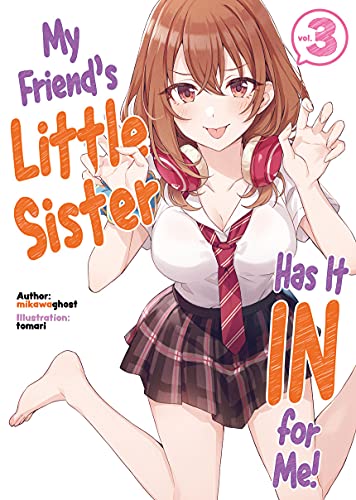
My Friend’s Little Sister Has It In for Me!, Vol. 3

By mikawaghost and tomari. Released in Japan as “Tomodachi no Imouto ga Ore ni dake Uzai” by GA Bunko. Released in North America by J-Novel Club. Translated by Alexandra Owen-Burns.

Someone needs to tell Japan that “having the rest of the cast being creeped out about the appalling character” is not a get out of jail free card for everything the character does. I’ve said in the previous books that the shotacon tendencies of Sumire are not funny but awful. Well, she’s the main character of this book, and so we get a lot more of it than even the previous two, and it’s still awful. Saying that a guy would be the perfect husband if only he were 5 years old is not a “LOL” moment. So be aware as I write the rest of this that this is a big black mark, and made me not enjoy this book nearly as much as the previous two. That said, I’m still reading it, because I do like the cast and the romantic comedy situations. With, well, one exception. Fortunately, this is not We Never Learn, so the teacher has precisely zero chance of winning the romantic sweepstakes.

We pick up right where the cliffhanger left off, as Sumire begs Akiteru to marry her. As expected, her family has decided enough is enough, and is going to arrange marry her soon… which means she won’t be able to draw anymore. This is basically the only reason Akiteru agrees to the scheme. After some “wacky” date situations, which I will not go into as they are dumb, a trip that’s supposed to be to the beach becomes a trip to her remote mountain village, where her father wants to meet Akiteru… and force them to get married immediately. Can they possibly get around the marriage ceremony with a 100% success rate? Can Iroha continue to try to cleverly juggle all these relationships in the air, given sempai is a dense MF and won’t do it for her? And can Mashiro finally admit she’s secretly their star writer?

Again, this series leans pretty hard on the Higurashi pastiche. Their game is subtitled “When They Cry”, and Sumire’s home village essentially turns out to be Hinamizawa, complete with terrifying elders and obscure rituals. Having already mentioned the volume’s big weaknesses, I do want to applaud its really good moment, when Mashiro’s editor (who we meet here, ad boy does it take some fancy footwork to explain her presence) points out to Akiteru that he needs to be able to offer his fellow game creators a reason to stay on with him, or else they’re going to look for other opportunities. What can he personally offers them? (Other than, of course, being the romantic lead who has no idea half the cast are in love with him.) It’s not a question that’s answered here, but I do appreciate it was brought up. Iroha also remains quite enjoyable, a bit less “annoying” than the first two volumes, probably as she’s trying harder to have him “get” her feelings.

That’s unlikely to happen soon, and a cliffhanger means we don’t even get this one resolved in one volume. Still, hopefully it won’t take up all of Vol;. 4. I think two volumes starring Sumire is two too many.