Category Archives: one piece

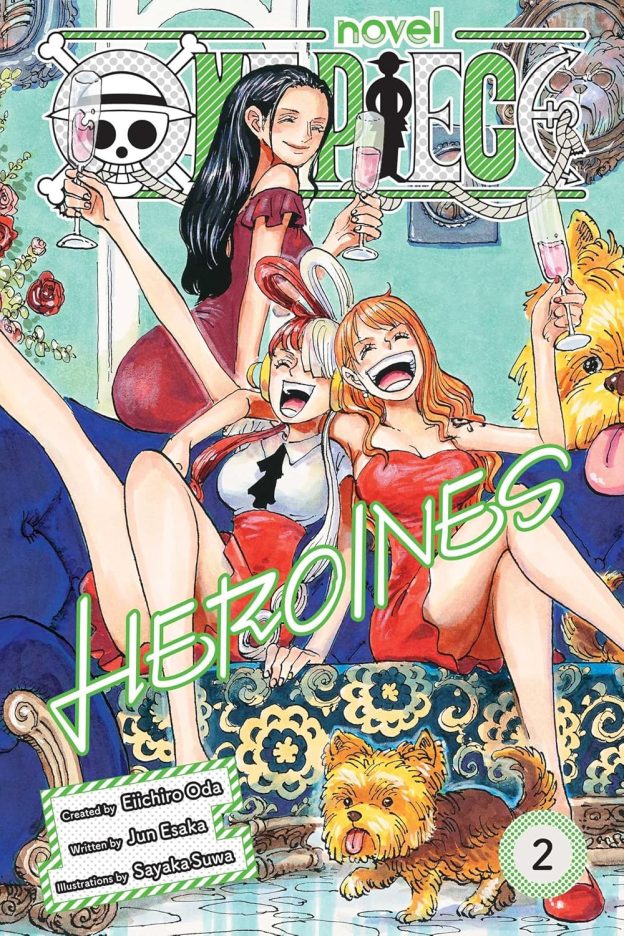
One Piece: Heroines, Vol. 2

Created by Eiichiro Oda. Written by Jun Esaka. Illustrated by Sayaka Suwa. Released in Japan by Jump Books. Released in North America by Viz Media. Translated by Stephen Paul.

Given the extreme shortness of the book, and my struggles with the first volume, I was a bit worried I would have even less to say about this one. But it’s honestly not that bad! You could argue that Shanks takes over Uta’s story the way that Koza took over Vivi’s, but unlike Vivi’s story Uta is present and correct throughout, so I think it’s fine. It’s also, with one obvious exception that the author can’t do much about, a bit better at showing off these are cool, admirable characters who are not the type to go nuts over a man or to trip while running and break a heel. (The exception is Boa Hancock, and it’s not a surprise that I find that story the weakest, but that’s Oda’s fault, not the author’s.) Even the last story, which is about Nami getting upset about a tiny zit on her face, is sympathetic towards her love of her own beauty and how she uses it.

As with the previous book, there are five short stories. 1) On the island of Amazons, one of their number who had been missing for two years returns, heavily pregnant. Now she has to be interrogated by Hancock… but does not realize what has happened to Hancock in the interim; 2) Smoker and Tashigi’s boat needs repairs, so they land on a tiny island which is beset by small-time pirates. Meanwhile, Tashigi befriends a young girl who wants to become a swordswoman, but who doesn’t like Tashigi’s self-deprecation; 3) The four non-Sanji siblings commandeer a ship, but forget to have a cook on board. Aside from Reiju, the POV character, they all try to cook and then give up. Once they get to their destination, Reiju learns how hard cooking can be; 4) Shanks and an Uta who is about 3-4 years old go ashore when she can’t sleep, and end up going on a shopping spree, where Shanks tries to tell Uta what “peas and tancrillity” is without telling her too much about himself; 5) As noted above, Nami finds a pimple and gets upset, and the others try to help her out.

The Hancock story relies on Hancock being a) horny and b) dumb as a rock, so I wasn’t a fan. The Tashigi story is much better. Her tiny charge is happy to learn from Tashigi till she admits she’s much weaker than other swordsmen out there, whereupon the kid is like “oh, well, you suck then”. After getting captured (natch), Tashigi is able to show that while she can’t take on the sword powerhouses of the series, she’s still really strong in general. It also has her, again, reflecting on what the navy is supposed to do. The Reiju story is the most character driven of the four, being entirely an excuse to remind us that she’s the nice one of the siblings and also the only one who is vaguely sensible. Shanks and Uta’s story requires you to have seen the Red movie, but really, who picks up a One Piece novel and hasn’t seen Red? (Stop looking at me like that.) The Nami story shows that, even though it’s about something like a pimple, everyone knows that her appearance is important to her and no one really makes fun of her at all except to note they can barely see it. And Robin is 100% in her corner.

So a definite must for One Piece fans, and for casuals who know the series, pick up a copy of Red as well.
One Piece: Heroines, Vol. 1

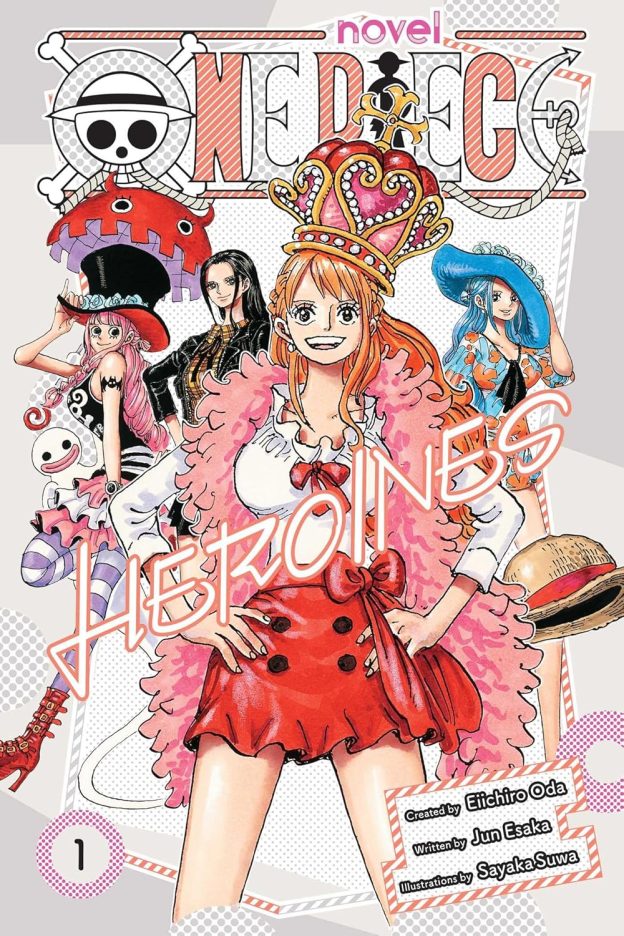
Created by Eiichiro Oda. Written by Jun Esaka. Illustrated by Sayaka Suwa. Released in Japan by Jump Books. Released in North America by Viz Media. Translated by Stephen Paul.

It’s been a while since I’ve dipped my toe into reviewing One Piece, but here they are with a light novel. Like most Jump light novels, the content is light as air, and you can read it in less than an hour. That’s not to say it’s bad, though. The author apparently is an old hand at this, having written a number of Sasuke spinoffs for the Naruto light novel series. The artist seems to be more on the fashion end, but it’s a terrific style – Oda does not do anything besides the cover art, but I didn’t miss him, as these have a style all their own. As for the stories themselves, well, they’re a mixed bag, as you’d expect. Our main two heroines do better, but things lag a bit in the second half. overall, frankly, the book suffers somewhat from what the manga itself does at times – it wants to write cool, strong women, but it also can’t help but objectify them.

In the first story, Nami buys shoes that will supposedly let her run fast in heels, but they’re terrible. When she goes to return them, she finds an arrogant designer and his jaded girlfriend/assistant. Told he’ll give her proper good shoes if she models for him, Nami does so, but also tells the assistant she’s better off without this jerk. Robin’s story takes place while she’s with the revolutionaries, as she tries to help the crew eat some very bitter mushrooms and Koala to decipher a newly discovered lost script. In the third story, a young boy has fallen in love with Vivi and writes a letter to her saying this, but it blows away. Trying to catch it, Koza ends up in trouble when everyone thinks he wrote it. Lastly, Zoro and Perona are living with Mihawk, and have a nice interlude – and a lot of fighting – when three bottles of delicious wine wash up at their castle.

The series is best when it’s living up to its title. Nami and Robin may be praised by the narrative as amazingly beautiful and stunning, but they’re also cool and clever – Nami gets exactly what she wants, gets a bit of revenge that nets her money, and (a distant third) helps a woman realize her life has value without a boyfriend. Robin could do everything in her story herself, but does not, knowing that Koala is undergoing the joy of discovery and working something out for herself. I also loved her washing the dishes. The weak story is the third one. It’s supposed to be about Vivi, but she only shows up for the resolution, and is used 100% as an object of worship. Koza’s relationship with her means that he takes over the narrative – Nami and Robin fortunately lack men in their lives. Perona is shown here midway between her “I am a minor villain” debut and the “I am Zoro’s friend and ally” we see later, and hers is probably the funniest story – yes, it revolves around Zoro and Mihawk too, but she’s the POV, so it works fine. (She’s not praised as the other three are. Shame, she’s cute.)

So overall, two excellent stories, one funny and good story, and Vivi’s story being hijacked. Not a bad batting average. Next time we’ll have Hancock, Tashigi, Reiju and Uta. For One Piece fans.

One Piece, Vol. 93

By Eiichiro Oda. Released in Japan by Shueisha, serialization ongoing in the magazine Weekly Shonen Jump. Released in North America by Viz. Translated by Stephen Paul.

Because One Piece has been running for so long, there aren’t a lot of plots that it hasn’t at least taken a glance at along the way. That’s probably why Oda is having so much fun with the time travel angle introduced here, with the long-lost heroes reappearing twenty years later, seemingly the same as before. The eventual beat when they all finally arrive hasn’t happened yet, but we do meet Momonosuke’s little sister, who is now of course a young woman, and also a striking reminder of how Oda loves to contrast ugly men and gorgeous women when he draws. (Or in this case ugly boys.) She’s got a lot going on in this volume, so it’s amusing that the thing I noticed most was Oda mocking shippers in her interactions with the completely sexless Zoro. (To be fair to Zoro, he does get that people would take them sleeping together the wrong way.) And then there’s Toko, which… well, I’ll get to her.

As with previous Wano volumes, the action slips from place to place almost too fast to follow, trying to make sure that everyone gets something to do. This means we get to see Nami and Robin in the baths (and Nami accidentally flashing everyone, which reminds me of her deliberately doing this in Alabasta); Sanji being, well, Sanji; Luffy, still in prison, having to fight off most of the guards one by one for entertainment, and meeting up with an old, seemingly feeble man who of course has a very badass past; and Shopper trying to deal with the fact that he’s now allied with Big Mom, who has lost her memories and thus is bright, cheery and friendly again. Chopper, of course, knows this will only last till her memories return, so spends a lot of the time terrified. (There’s some interesting lettering going on in these scenes to show “girly’ speech – excellent job by Vanessa Satone, the letterer and touch-up person.)

And then we get to the end of the book, where Oda reminds us how well he can have chaos quickly turn to tragedy, with the public execution of Yasu, who turns out to have a secret identity (not a surprise). He’s spent much of the time bopping around the manga dressed up as the stereotypical Japanese jester, with a giant grin on his face. The grin remains even as he’s about to be executed (by firing squad, a particularly dishonorable death in the period that Oda is riffing on here), and there is an explanation of everyone smiling and laughing in the face of tragedy… but then after his death, it turns far too creepy for that to really be the case, especially when his daughter sees his death and can’t stop giggling (as she has the entire book) even as she cries out that her father is dead. The cliffhanger, unfortunately, implies that it may be the One Piece equivalent of drugs at work once more.

So yeah, everything is kind of terrible at the moment. Sure would be nice if we could start a revolution soon. Still, this was a chaotic but solid volume of One Piece, a bit better than the last couple of books.