Category Archives: otherside picnic

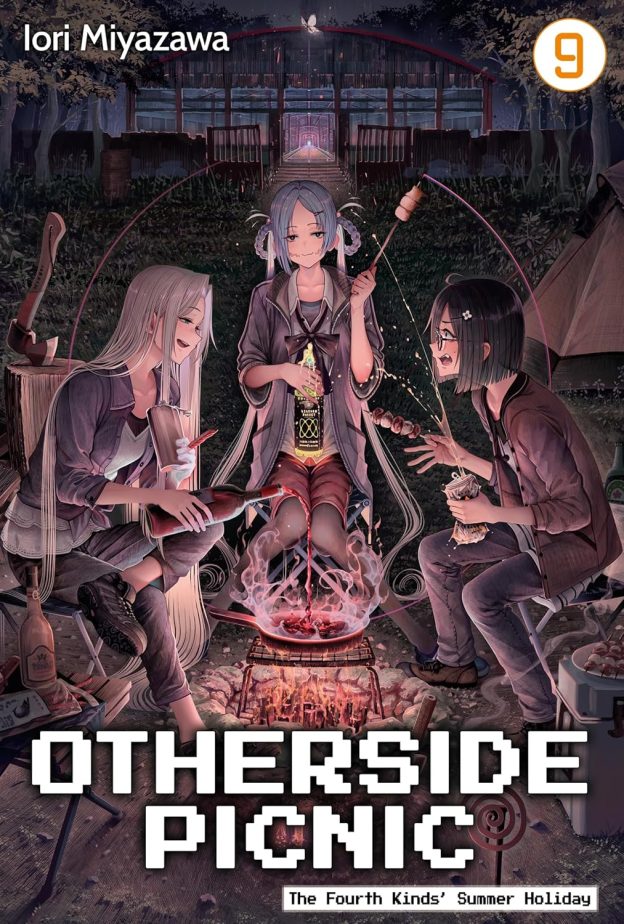
Otherside Picnic, Vol. 9

By Iori Miyazawa and shirakaba. Released in Japan as “Urasekai Picnic” by Hayakawa Bunko JA. Released in North America by J-Novel Club. Translated by Sean McCann.

It’s been about nineteen months since THAT volume of Otherside Picnic came out over here, and let’s be honest, the wait was excruciating. We all wanted to know what would happen next? What we got, as usual with the series, was three interconnected chapters tat also function as short stories. The “horror” part comes at the start and near the end, and it does a pretty good job, even though I’m never going to be one of those folks reading this series for the horror. The actual plot comes in the second half, where we bring Runa back into the series as more than just a cameo, and reintroduce the eccentric Tsuji, who I am suspecting might be the next major antagonist but I could be wrong. The rest of the volume is very strong. But yeah, I’m going to be talking about the middle chapter, which left me grinning like an idiot and jumping up and down in happiness.

But first, a recap. In the first chapter of this volume, Toriko and Sorawo go to the Otherside (its only appearance in this volume) to check on Todate and Hana, as after Sorawo’s Toriko-infested Otherside experience from the last book she’s worried about them. She’s right to be worried – this is the really scary part of the book, though not without its heartwarming, in a weird way. I the second story, Sorawo and Toriko head over to Kozakura’s mansion to inform her that they’re now a couple, and Sorawo struggles with the fact that everyone wants her relationship to be more romantic than she’s comfortable with. In the final, longest chapter, Migawa asks Sorawo and Toriko to help instruct soldiers from their facility on how to deal with Otherside terror, and they bring along Runa (who they are trying to figure out what to do with) and Tsuji (who is now Runa’s minder). Runa has a knack for interior decorating that is kind of cute, and then less cute.

So, let’s talk about that second story. First of all, everyone who enjoyed watching Sorawo struggle with what her relationship with Toriko is will be happy to note that even after they defined it together, Sorawo still hates talking about it with anyone else, as she always senses them making it more normal and ordinary. This fits in really well with Sorawo’s mindset. (The funniest parts of the book are where folks have to explain to Sorawo when she’s seducing people, and Sorawo’s “wut?” reaction to this.) The best part of the book for me, though, was Kozakura. They arrive at her mansion and find it brightly lit, and this worries them. But what it actually means is that she’s moved on and is now in control of her life again. She’s adopted Kasumi which is why the house is bright), and she’s using her degree to make the Otherside safer to think about and study. I wanted to shout “woo hoo!” when I saw this. I’m so happy for her.

Now, is Runa going to be able to have the same journey? Can Sorawo come to terms with the fact that everyone is going to interpret her relationship with Toriko differently? And can Toriko stop all these thirsty women macking on her nue so that she can get in some quality cuddling time? That will have to wait for Book 10, in all likelihood. I loved this book, though.

Otherside Picnic, Vol. 8

By Iori Miyazawa and shirakaba. Released in Japan as “Urasekai Picnic” by Hayakawa Bunko JA. Released in North America by J-Novel Club. Translated by Sean McCann.

For the most part, this book is an emotional journey. It’s about Sorawo, a woman whose emotions have always been something of a foreign country (to herself, not necessarily to others) learning about what love is, what it means to love someone, and how that can change a relationship. And she has perfectly normal fears. She has a great relationship with Toriko now, one defined in the first book: they’re accomplices. But Toriko wants something more, and Sorawo knows it. That said, in case you were worried that this book would be all fluff and lack the sheer horror of the previous books, fear not. The middle of the book is here for you. What’s more, given that the book is about Sorawo’s feelings about Toriko, it makes sense that the horror is all based around Toriko. Let’s just say I hope this is never animated – I deal far better with horror as a written word than I do with horror as a visual medium.

Toriko has confessed to Sorawo, and says she wants a response. But she knows Sorawo is who she is, so she’s giving her a week to come up with this answer. This allows Sorawo to do a minor tour of the supporting cast to get some advice. College friend Benimori gives probably the most sensible advice, and seems delighted to find Sorawo, who has a bit of a reputation at their college, going through a real relationship. She talks with Natsumi, whose advice seems to be more about Natsumi than it is about Sorawo. She talks with Kozakura, who points out that their desire to go to the Otherside constantly, something almost everyone else would find terrifying, is what unites them – but that Toriko would stop doing it without Sorawo. And then finally, after a bus ride home that devolves into a series of Toriko-related visions, she goes to her apartment and confronts the girl she loves but barely knows.

I emphasized the horror, but rest assured there’s a lot of funny stuff here as well. The entire scene with Natsumi is amazing, complete with Natsumi calling Sorawo a “raging lesbian”, which is projecting if ever I saw it. Kozakura’s talk with Sorawo goes off the rails thanks to the presence of Kasumi, and leads to a self-help guide from hell. And the last part of the book, with Toriko and Sorawo opening up to each other, while also filled with sweet, touching moments, has its share of hilarity. We’ve known for a while that Sorawo is an unreliable narrator, but Toriko describing how Sorawo is ogling her constantly ever since they first met drives that home very well. Of course, we the reader have also seen that, but it’s been in the context of her internal monologue, so it hadn’t been apparent that it was written all over her face as well.

The sweet emotional bits are there as well, of course. I loved Toriko trying to do research into what she feels Sorawo’s issues might be – it’s a sign of how much she’s prepared to devote to their relationship, but also a sign of how little Sorawo opens up about her past – her matter-of-factness is disturbing, not edifying, even when she has to bluntly say “my family did not sexually assault me”. We also finally get a long look at Toriko’s mothers, what they did and who they were, as Sorawo finally realizes that in order to be Toriko’s lover, she needs to know who Toriko is and where she came from. And then there’s the part of the book that I think everyone will be talking about, the sex scene. At first disappointing, though very true to what Sorawo has told us, the reader, about her sexuality so far, it then rapidly moves in a very different direction. What follows is not only fulfilling for both of them but also 100% in character – both for them and the book. Kozakura would be completely unsurprised. They’re freaks, of course they have freaky sex.

We’re caught up once again, so I’m not sure where the series goes from here. We were introduced to a new character, who I didn’t have room to talk about, so it may do something with her. That said, this book is for those who’ve been waiting forever for these two to get together.

Otherside Picnic, Vol. 7

By Iori Miyazawa and shirakaba. Released in Japan as “Urasekai Picnic” by Hayakawa Bunko JA. Released in North America by J-Novel Club. Translated by Sean McCann.

If Otherside Picnic is a series about ghost stories and legends, and going to another world to explore and confront them, then the series had to, at some point, deal with its own self-made ghost. Satsuki Uruma has been a part of this series from the very beginning, but we’ve never quite met her. Her presence has been felt, though, both from the impact her life and death had on Toriko and Kozakura and also because the Otherside has used her presence and likeness to hunt and destroy Sorawo. In this new volume, Sorawo finally meets Satsuki and has a conversation with her, and it helps to clear up a great many things. 1) the Satsuki they’re dealing with is not a human being, and b) Sorawo wants to murder her. Of course, this is Kozakura’s friend and Toriko’s former teacher/crush, so Sorawo will have to obfuscate her real motives… but not by much. Call it a funeral or an exorcism or what you will, it’s a final battle, and all it needs is a shootout.

While discussing Kozakura’s decision to take the wayward Otherside child Kasumi in (reasoning that she’s human because she’s not trying to look human), Sorawo and Toriko get into a fight because it turned out Toriko missed Sorawo’s birthday, which Sorawo doesn’t care about but Toriko certainly does. A few days later it’s not a fight but it’s not NOT a fight, so Sorawo, after her anthropology class, decides to return to the building where she first entered the Otherside and met Toriko. There she finds her doppelganger… and also Satsuki, who has a terrifying conversation with our heroine. After this, Sorawo is determined to do away with her, to the point where her romantic anniversary dinner with Toriko is somewhat waylaid by that fact. But how do you kill what Satsuki has become?

I brushed past the anthropology class, but it was a terrific part of the book, with Sorawo (who is no longer amnesiac, so is returning to her original topic) laying out the anthropological details behind ghost stories and the like. The class are doubtful but not mocking her, and the professor is quite supportive… especially when they do find evidence of T-san’s former presence. The other highlight of the book (aside from Sorawo really coming into her own as a leader and driver of the action) is, once again, Runa Urumi. Her interaction with Sorawo is fantastic, and I enjoyed seeing her assume that the only reason that Sorawo is allowed to walk around Japan with her eye that can drive people crazy is that she has friends in high places. Unfortunately, the final scene (which is both terrifying and vindicating, and makes you want to punch the air in victory) puts Runa away again” for a bit, but I now really look forward to seeing her again.

This is not the end of the series, but it’s very much the end of one of the major story arcs, and that makes it easier to wait for the 8th volume, which is not out in Japan yet. Till it comes out, this may be the best volume of the series to date.