Category Archives: reviews

Sword Art Online, Vol. 7: Mother’s Rosary

By Reki Kawahara and abec. Released in Japan by ASCII Mediaworks. Released in North America by Yen Press.

As I was reading this volume, I kept thinking that there was a pacing issue, and that events were happening far faster than I was expecting. As I came to the end, the reason why occurred to me: other than the first book, this is the only stand-alone Sword Art Online novel. In the main series, Books 2 and 8 are short story collections, 3-4 and 5-6 are two-volume arcs, and 9 onward is an epic 9+ volume arc. But this book completes its story in one compact volume, and it’s even pretty short compared to some other books in the series. Once the brain has adjusted to that, the reader can see what’s really going on: this is one of the best books in the series, where Kawahara finally balances storycraft and emotional manipulation perfectly, to the benefit of Asuna, who’s the co-star and narrative focus of this book.
sao7

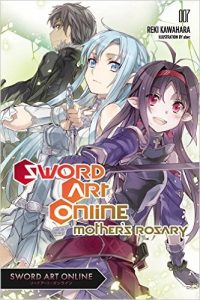
Fear not, Kirito isn’t the other star of the book; for once he only has a small supporting role. (Though he does appear on the cover, apparently at the request of the editor.) No, the other star is Yuuki, the spunky girl with the sword you see next to Asuna on the cover. The first half of the book introduces her to us and has as its main mystery why she is so good with a sword – to the point where she can defeat Kirito, twice. She defeats Asuna as well, but Asuna gets closer than anyone else, so Yuuki introduces her to the rest of her Guild and asks for her help in taking down the boss of one Level – in a party of seven. Boss fights normally have at least 50. Clearly there’s another reason why they’re so desperate, and as Asuna discovers it despite Yuuki’s best efforts, we get the last third of the book, which will put a lump in your throat.

The second half of the plot is Asuna’s stormy relationship with her mother, who has demanded that she transfer out of the SAO survivor school and also set up a marriage for her (with her second cousin, because Japan). The repressed frustration and anger that Asuna feels whenever she talks to her mother will be achingly familiar to many readers, and it’s through Yuuki and her own struggles that Asuna finds the strength to fight back and stand up for her own life and experiences. (As an aside, I note that Yuuki seemed quite happy when she talked about getting married to Asuna in order to get around one of her problems.) SAO may have been a traumatic death game in many ways, but it did allow Asuna to really grow and reach out to others, and her refusing to be put back in her mother’s little box is a triumphant moment.

I’m trying to avoid spoiling more than I usually do in a review, but the book isn’t perfect. I am not a medical person, but even I could see that a lot of the details of the medical treatment and cause for it was a bit sketchy here. Also, I grow rather weary of the plot continuing to talk about how noble and good Kayaba was long after his death, given that he trapped 10,000 people in a game where they were allowed to die as his thought experiment. That said, Asuna and Yuuki are pitch-perfect in here, and for once the emotional and gut-wrenching final feels fully earned (Bonus points for not featuring sexual assault as a plot point, at last). Even if you gave up on SAO during Fairy Dance, I’d recommend getting this volume, as it’s one of the best in the series.


Black Bullet: The Destruction of the World by Fire

By Shiden Kanzaki and Saki Ukai. Released in Japan by ASCII Mediaworks. Released in North America by Yen Press.

When an author is writing a grim dystopia of a series, they have to be very careful sometimes. Because let me tell you, as a writer, the temptation to have horrible things happen to your characters can be unbearable. And I imagine this is particularly true in Black Bullet, where the only levity of the entire series of books is provided by wacky lolicon jokes. (We do get more of those here, and they’re worse than ever.) It’s entirely possible that the events of this book, and the ending in particular, are part of a long-term plan to advance the growth of Rentaro as a character and stop having him try to take on everyone’s problems. But I can’t help but hear the author, in a Beavis and Butthead sort of voice, telling me no, killing off 20 or so innocent young children in a horrific way is really brutal, and therefore cooler.

blackbullet3

(As a side note, that cover has so much stuffed into it that it verges on the incoherent. As long as I’m complaining.)

This book, which starts the popular light-novel schtick of a two-volume arc, begins with a bunch of killings as well, but those at last are plot-relevant and not there to make you gape at the page in a stunned silence. One of the monuments that protects the Tokyo area is breaking down, and once it collapses the Gastrea from outside will enter and basically kill/convert everyone in the city. As a result everyone has to band together to head off the monsters until a replacement can be built. This includes our heroes, who are asked to put together a strike force in order to be part of the maneuver. Of course, there’s a problem with this – Rentaro is a high school aged kid who’s moved up 10000 ranks in the last two books, and no one likes or trusts him.

This does lead to the best parts of the book, as we see him and Enju slowly trying to get anyone to work with them. The pairs he ends up with are not the most original in the world, but they bounce well off of a miserable stoic like our hero. We also get some lovely scenes between him and Kisara, who gets slightly more to do here than in the previous two books. I suspect her burning desire for revenge is going to come back and nite her in the ass one of these days, but as long as we get scenes of her and Rentaro staring at the stars and almost but not quite confessing, I’ll deal with it.

The volume ends with the beginning of a protracted battle that I suspect will take up all of Book 4. It’s a battle to save the citizens of this city, including the Cursed Children. So ending the book the wey it does sort of kicks the feet out from under the reader, making them, if not Rentaro, think “is it really worth saving a world like this?” More importantly, is it really worth slogging through so much death and hopelessness? Black Bullet continues to be well-written, and has good introspection, but if I wanted grimdark, I’d be reading American mainstream comics.

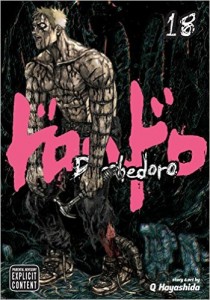
Dorohedoro, Vol. 18

By Q Hayashida. Released in Japan by Shogakukan, serialization ongoing in the magazine Hibana. Released in North America by Viz.

Well, I said last time that I thought Dorohedoro might get a little more gory in the next volume, and I was not wrong. Dorohedoro is something of a horror-fantasy-comedy, and frequently the horror elements take precedence, as they do in this volume big time. It mostly plays out with the fates of Shin and Noi. Noi’s love for Shin has seemed a bit one-sided at times, but we no know that he does want to protect her, even if it means slicing her brain open and inserting Sho’s ‘thingy’ into her head. (I’m sure the sexual implications are intentional.) Of course, he should maybe think about protecting himself, as somehow (as always, it can be difficult to follow chains of events without a reread) Shim ends up in a corpse factory, and seemingly killed and turned into a murderous zombie. Whoops.

dorohedoro18

Not that things are any better with the other groups. Fujita’s invisibility has worn off, and he’s forced to make an uneasy peace with the cross-eyed guy, though we hear both of them ;planning to double cross each other later. (Fujita is good at being idealistic and self-sacrificing, less good at scheming.) Of course, given they run into zombie Shin, neither plan is really going to come off. Noi, once she recovers from Shin’s lobotomy, ends up finding a trail of body parts, Hansel-and-Gretel style. And Nikaido’s group is torn up as well, as the department store is going to hell – possibly literally – and Risu and Asu both end up getting taken out over the course of the volume. This may not, admittedly, matter much to Nikaido, who is getting more like a Devil than ever, and spends most of the volume with a giant :D expression on her face.

In between all this gore, there is still something of a plot, most of it taking place with Kasukabe, who through a wacky set of circumstances ends up inside his wife Haru’s devil body, as the devils attempt to figure out what the hell is going on with Ai. Your guess is as good as mine, but we do see that Ai and company apparently have a revolving set of heads, although some are already dead. Whatever it is, it leads to a cliffhanger that I wasn’t expecting, as Nikaido discovers Caiman – with his lizard head, and seemingly with his regular old gyoza-lovin’ memories. The reunion will have to wait for next time, though. Oh yes, as an added bonus, we see what’s happening with En in hell, and it’s not pretty, though it is pretty funny.

I’ve often said Dorohedoro is not for the squeamish, and this volume proves that more than ever. But if you don’t mind blood, gore and dismemberment in graphic detail, it’s hard to think of a title out there with more style than this one. Which, as anyone will tell you, is far more important than pesky things like a coherent plot.