Category Archives: reviews

Not Lives, Vol. 1

By Wataru Karasuma. Released in Japan by ASCII Mediaworks, serialization ongoing in the magazine Dengeki Daioh. Released in North America by Seven Seas.

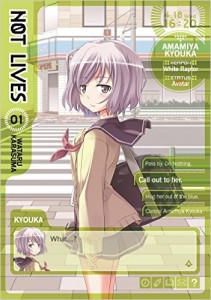
Once you see something make it big, be it here or in Japan, you’re going to see variations on the same basic theme in the hopes that a company can get some of that sweet profit. Be it vampires, zombies, Alices, or whatever, the media are ready to give you something that’s essentially the same with a few palette swaps. Even better is if you can mash more than one genre together – you get the chance to try to court multiple markets. Enter Not Lives, whose cover screams out that its’ a date sim, complete with an actual dialogue box, but it also ends up being ‘person ends up in a game world’ as well as the ever popular ‘survival game’ genre. The result isn’t terrible, but it feels like a title where stuff is thrown at the wall to see what sticks.
notlives1

Oddly, despite being the most obvious thanks to the cover, the datesim/high school romance part is the least developed of the bunch. Our hero, for a change, is rather extroverted and talkative, and also has a genius for making and marketing games of any kind, but is somewhat useless about matters of the heart – not realizing that his long-suffering childhood friend is in love with him, for instance. One day he accidentally gets a copy of a mysterious game called Not Lives, and when he tries to play it it loads itself into his chest rather than the CD drive, downloading him into a VR game where he’s playing a young woman. The catch being that the young woman actually exists, and is rather frustrated with this newbie losing in his very first game.

So far so cute, but the survival game aspect takes precedence as the series goes on, and we discovers the players are trapped in a rather nasty way. First time losers become ‘avatars’, i.e. somewhat less than human, and are forced to recruit other players. If the avatar then loses again… they’re ‘deleted’, which seems to involve severed body parts. Needless to say, things get a bit cutthroat, especially since it becomes apparent that some of the players/avatars can use game powers in the REAL world to, say, throw a bunch of thugs in front of a truck and kill them all. Our hero may be a genius gamer, but will he be able to level up and beat this game where the rules are still a bit vague? Especially once his avatar ends up transferring to his class, thus neatly taking us back to the datesim in the very end.

There’s nothing overtly wrong with this – there’s some fanservice, but honestly I was expecting worse, and the avatar, Kyouko, manages to be emotionally repressed without being a stoic robot. That said, nothing in it screamed that I absolutely had to get the next volume. It plays to folks who like “trapped in a game” (me), “survival game” (not me), and “dateim romance” (it depends). My main concern is the 2nd, as I worry that, like almost all survival game titles, we’ll be introduced to likeable, sympathetic people who will then meet horrible ends. Childhood friend, I’m very worried for your future…

Shoulder-a-Coffin Kuro, Vol. 5

By Satoko Kiyuduki. Released in Japan as “Hitsugi Katsugi no Kuro – Kaichu Tabi no Wa” by Houbunsha, serialization ongoing in the magazine Manga Time Kirara. Released in North America by Yen Press.

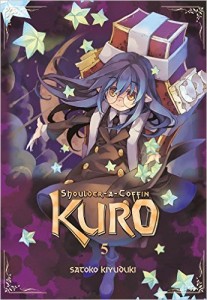
It can at times be rather hard to believe that this mostly dark and surreal fantasy series can come from the same author as GA Art Design Class, a 4-koma series about the adventures of five girls in art college. But there are moments when the two series seem to connect more than you’d expect. Kiyuduki frequently believes in “show, don’t tell” in regards to not only her plot but also her characterization, leaving the reader to guess much of what’s going on; we sometimes see this with The Professor in GA. Likewise, Kisaragi’s surreal and sometimes unnerving dream sequences could easily fit into Kuro – indeed, Kisaragi and Kuro look similar enough that you could headcanon this as one long nightmare she’s having. Because it does feel more and more like a nightmare – Kuro’s not getting as many fluffy stories as it did back in Volume 1.

kuro5

Part of the reason for that might be that this volume gives us a lot more background on the witch that has supposedly cursed Kuro – we see what may be a sort of origin story for her, and a story where we see her own journeys, which appropriately mirror Kuro’s. But I think it’s simply that almost all the stories in this volume deal with death and being unable or unwilling to move on. Three very different young women meet unfortunate ends but want to leave something behind. A balloon race seems to literally end up in heaven. Kuro, Nijuku and Sanju end up in a valley where perspective and illusions seem like an optional extra, and Kuo once again cannot let go of what she regards as the things that make her what she is – her hat and coffin. Even the happiest story in this volume involves a cursed painter whose subjects all seem to die right after they’re painted. Luckily, Kuro can’t seem to die, so that’s one problem solved.

The second half of the book gets even more chilling, at times almost seeming to descend into pure horror. Two sisters are offered a grim bargain by the Witch, and Kuro has to deal with the consequences, once again taking on someone else’s suffering into her own body. b The last story introduces us to what seems like another in Kuro’s long line of spunky female merchant girls she seems to run into, only to find that reality is murderously different. And this also gives us the reason for Kuro’s journey. Yes, she’s trying to seek death, but in order to do that, she has to take in life as well, because without life death is meaningless. It’s something that the witch doesn’t quite understand, and even Kuro isn’t really confident in her feelings till the end of this book. But it’s true, and also a reminder of the depth and quality of the stories in this volume. Anyone who likes dark, thoughtful fantasy should be reading this, no exceptions.

Nichijou, Vol. 1

By Keiichi Arawi. Released in Japan by Kadokawa Shoten, serialized in the magazine Shonen Ace. Released in North America by Vertical Comics.

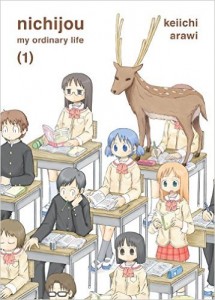
I have a weakness for gag manga, as some of you may have noticed, and also a weakness for high school slice-of-life starring a bunch of quirky high school girls. It should be no surprise, therefore, to learn that I have been awaiting the release of Nichijou for some time. It was initially licensed by Bandai Entertainment about 5 years ago, but they folded their US manga division before it could even get a volume out. That said, the anime did appear over here, and was quite popular – in fact, arguably far more popular than it ended up being in Japan. And so Vertical, which has been dipping its toes into the surreal gag world with titles like My Neighbor Seki, now introduces us to a very unordinary manga.

nichijou1

Nichijou has quite a large ensemble cast, but for the most part is the adventures of five girls. Three of them, Yuuko, Mio, and Mai, are classmates at the local high school. Yuuko is peppy, somewhat dense, and very fond of attempting to make jokes that no one finds funny but her. Mio is the “normal” girl in the csat, but that’s only a matter of degrees, as we discover when she realizes her secret yaoi manga doodle is about to be discovered and becomes Superwoman. Mai is my personal favorite, a quite and shy girl who loves to bait and get reactions from Yuuko, I suspect as it’s the only way she can really show her feelings. There are apparently fans of Nichijou who dislike Mai for her gadfly nature, but these people are objectively wrong, so there’s no need to worry about them.

The other two main cast members are Nano, a robot girl who also attends class and her child genius inventor Professor, who’s a genius at making robots but an immature child in almost every other sense. Those familiar with the anime might be taken aback by Nano appearing in class right away – the anime decided to move all the stories with her in class to the second half of the series, the better to separate the ‘school’ and ‘Professor’s house’ segments of the show. We also meet a few other amusing minor characters here, like the farmer’s son who acts like a stereotypical rich boy, and the parody of tsunderes who can be seen literally blowing people’s brains out (though they’re fine a panel later – this is essentially a cartoon, in the Western Looney Tunes sense).

There’s not a lot to review in Nichijou beyond the gags, which I don’t want to spoil if you haven’t seen them. As with most manga of this sort, the humor can be found in facial reactions, and Arawi is very, very good at these – check out Chapter 9 for the best example. The girls are cute as well, but there is a blissful lack of fanservice that I also greatly appreciate, and there don’t seem to be any obvious romances besides the one-sided crushes Mio and the tsundere parody have. Nichijou is content to make jokes and be strange, and if it has to choose between being funny or being strange, it will pick the latter. If you like laughing, or if you like tilting your head and going “wuh?”, either way you’ll enjoy this.