Category Archives: reviews

Tokyo ESP, Vol. 1

By Hajime Segawa. Released in Japan in two separate volumes by Kadokawa Shoten, serialization ongoing in the magazine Shonen Ace. Released in North America by Vertical Comics.

Sometimes it’s quite pleasant being totally ignorant of a title before digging into it. It’s very much unlike me, as I’m the sort who always spoils himself and reads the endings first, so when I preorder a title there’s usually a certain amount of research done on my part. Tokyo ESP is, I found, by the creator of Ga-Rei, another Shonen Ace volume about ghosts and demons that ran for about a dozen volumes and is available on Bookwalker’s online site. But I didn’t really look into Tokyo ESP much before I read it. It also involves ‘kids with powers’, but in this case they’re full fledged superhero powers. I’m not sure if there has been an uptick in Western-style superhero manga recently, or if we’re just actually seeing the titles licensed over here, but it’s interesting to compare My Hero Academia, which trains people to use their powers in a school, to Tokyo ESP, where the heroes are outcasts and have to hide everything.
tokyoesp1

There’s a lot I enjoyed in this first omnibus volume. The heroine is great throughout. The daughter of a cop who’s fallen on hard times, much of the humor in the title comes from her obsessive penny-pinching and attempts to hold down jobs – attempts which get far more difficult when she suddenly finds she can pass through walls, floors, etc. This turns out to have been the result of her seeing a swarm of flying fish in the sky one evening, one of whom went through her and seemingly gave her said powers. Now she teams up with an eccentric but handsome guy who seems to have a tragic past (and who can teleport) to fight off villains who want to become supervillains, and mysterious girls who want to change the world, in a totally ominous way.

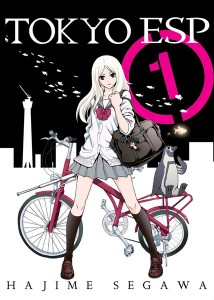
There’s a lot of humor in this volume, as I said before. The art helps – much of the fun comes from watching the goofy reaction faces that Rinka and the other characters put on. Sometimes the humor slips over into outright parody, such as when the Ghostbusters show up to attempt to capture the penguin you see on the cover, who’s also involved in this to a degree. And by that I mean the actual cast – they’re clearly drawn to be Harold Ramis and Dan Ackroyd (the Bill Murray likeness is less clear.) And there’s also the usual hijinks based humor you’d expect in a title like this – the superpowers can be hilarious, particularly Rinka’s dad, who winds up causing chaos due to his being able to attract things to him – i.e., cars.

That said, there’s a lot of death in this volume as well, and I would not be surprised if this is one of those series that gets darker the further it goes on. But it’s a solid series to start with, particularly if you enjoy supernatural action-adventure type stories. The action is well-handled as well, as Rinka’s been trained in various martial arts which she uses in addition to her superpowers, and there’s lots of fire and explosions too. I look forward to seeing what faces Rinka makes in the next volume.

Oh My Goddess!, Vol. 48

By Kosuke Fujishima. Released in Japan by Kodansha, serialized in the magazine Afternoon. Released in North America by Dark Horse.

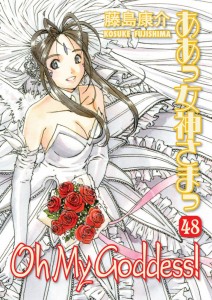
It’s going to feel very strange living in a world where no new Oh My Goddess is coming out. As I’ve said before, this was only my second manga series ever after Ranma, and I’ve been following it in various formats for as long as I’ve been in the fandom. And now it’s over, with an ending that’s a bit rushed, to be honest, but gives us one last look at our favorite gods, goddesses, and (one) human (more on that later), seeing them escape Hell and return to yet another completely destroyed temple in time to have a pseudo-wedding. No, there’s no kiss or honeymoon – this isn’t the Oh My Goddess of Vol. 1. Even if their sexy times limiters are now turned off, K1 and Belldandy are still incorruptibly pure pureness personified.

omg48

In a series this long, there are certain things that we not only expect to see, but which are brought out to help wrap the plot up – character development come full circle. This includes Skuld’s kludged-together improvements having self-destruct mode at the most opportune times, and Lind’s hilarious inability to repair anything being used in order to allow the gang the time to escape at the last second. There’s a lot of fast-paced action and chatter from the usual suspects, which don’t really include Keiichi and Belldandy – let’s be honest, their big emotional wrap up happened in the last couple of volumes. Hild and Ansuz also have a very interesting discussion on the nature of love and what is and isn’t appropriate to sacrifice for it, something that I think filters down into how their daughters were raised.

Everything ends with a wedding, but unfortunately it’s an impromptu one involving only the goddesses that have formed around Keiichi (and demons – Mara is still used here for comedy relief, as she has been for 48 volumes or so). While this is sweet and looks nice, I do wish we’d gone an extra chapter and shown K1 and Bell getting married among their friends and family. The human cast has at one time or another been just as important in the series as the goddesses,and while Belldandy has a token mention of some of them earlier in Hell, it would have been nice to see them. Certainly I imagine Megumi will have words with her brother about getting married without their parents or his sister involved.

And so the series comes to a close, and Fujishima has moved on to his next project,which debuts over here in 2016. I’m not sure how successful someone would be in getting new fans addicted to Oh My Goddess the way us old-school fans are – so much of what defines the series has been mined for other anime and manga over the years that you don’t really realize how influential it really was. There’s also the frustration of the main relationship being so static and sexless for so long, something unfortunately also highly influential in harem comedies, though at least Fujishima hammered on an explanation at the last minute. Have a happy marriage, Keiichi and Belldandy. We’ll miss you.

Showa 1953-1989: A History of Japan

By Shigeru Mizuki. Released in Japan as “Comic Shouwashi” by Kodansha. Released in North America by Drawn & Quarterly.

This was always going to be the trickiest volume of Showa. First of all, the span it’s covering is a good three times that of the other books. And secondly, the buildup and fallout from World War II, and the War itself, were amazing dramatic narratives. The rest of the Showa period has its interesting points, but there’s a struggle here to make it as exciting as the other three books. This might be why we see so much about murders and scandals, even more than the previous books. There’s also a constant reminder of the economic injustice in Japan, even as the country itself grows more prosperous. Again, having Nezumi Otoko as the narrator (though he’s at his most subdued here) helps. The success of postwar Japan is balanced by failures.

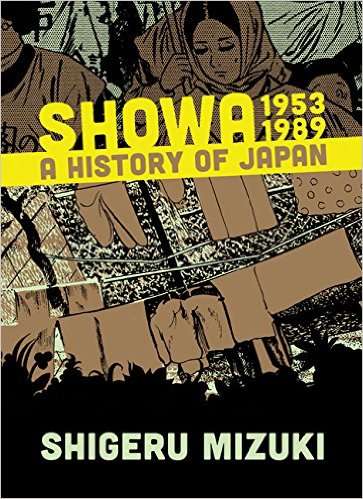
showa4

That cover image, by the way, has changed since its prerelease – the book I have has the bottom image replaced with a drawing of a bustling city with freeways surrounding it. Much of the final volume of Showa deals, in one way or another, with money. Companies get richer, politicians accept bribes, and at one point a man finds 100 million yen taped randomly to a bridge. As for Mizuki himself, we see him at the start just as poor as he’s always been, pawning everything he owns and eating food past its sell-by date. As time goes on, though, his desire to keep the ‘hopeless guy’ caricature starts to fail him, as we do see Mizuki doing better. He gets married in an arranged way, but seems reasonably happy about it, and has two kids. His yokai manga start to sell, and we see (but don’t really hear about) his improving circumstances. He’s even able to return to the South Seas a couple of times to meet the islanders who saved him in WWII.

There are also some highly disturbing fantasy sequences in this volume, reminding us that Mizuki makes his living writing horror, even if it can be goofy horror at times. One sequence where he has his soul stolen by a doppelganger and goes to the afterlife is surreal and cruel, as he narrates aloud that the “replacement” Mizuki has been living his life ever since that day. A funnier bit, but the humor is black as pitch, has a shyster talk Mizuki and his wife into a sort of ‘swingers’ arrangement where they get to choose from various girls-for-hire stacked up like cordwood on a boat. Mizuki asks what happens if the spouse gets cold feet, and we see a shot of his wife getting drugged and flash frozen in the back seat of a car. Mizuki’s sense of humor can be a bit beyond the pale at times, and I am pleased that the sequence sort of petered out after this.

There are many other reasons to enjoy this volume – I liked seeing the real-life visual inspirations for Nezumi Otoko and Kitaro here. And even though the story of Japan’s last 36 years of Showa is not the compelling narrative force of the first 27, this still remains one of his most important books. The final chapter ends with an inspiring rant against the evils of war, and how he hopes this history will show why it’s crucial to prevent it. An amazing series of books.