Category Archives: reviews

Witchcraft Works, Vol. 1

By Ryu Mizunagi. Released in Japan by Kodansha, serialization ongoing in the magazine Good! Afternoon. Released in North America by Vertical Comics.

Sometimes when a company has a reputation for left-field, odd or intellectual manga titles, it can be a bit of a shock to see a license that goes against the grain. Such is the case with Witchcraft Works, which is not exactly a lowest common denominator title per se, but it definitely feels odd at Vertical, being the sort of thing I would have expected to see more with one of the more mainstream companies. Vertical it is, though, and the production is as always first rate. The content is pretty good as well, with the proviso that this feels very much like a first volume that hasn’t quite gotten a running start yet.
wcw1

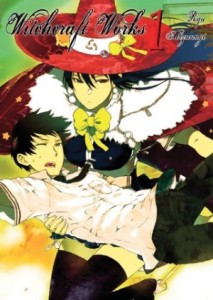
The best thing that Witchcraft Works has going for it are its two leads. The heroine, Ayaka, is the school princess, revered and good at everything she does. And, as we discover, she’s also a witch, there to protect our unwitting hero, Honoka. As a witch, she is also good at everything she does, being adept at fire magic to the point where she may literally be a fire elemental of some sort. Throughout this first volume, she doesn’t crack a smile or even vary her expressions, really – she is completely stoic. It works quite well for what she’s supposed to be. As for Honoka, given that his function here is mainly to be shocked at events spiraling around him and ask “what’s going on?” a lot, he does pretty well, and you identify with his frustration at being unable to do anything.

As for the villains and supporting cast, I will admit I was less impressed. The ‘moe’ aspect of the manga, since it can’t come out in its stone-faced heroine, tends to be shunted here. Thus, our first villain is a catgirl who uses bunnies to attack, her villain team that arrives later also looks like a collection of traits rather than people (though we’ve barely met them yet), and Ayaka’s waitress friend is there to have giant breasts and fall down a lot. It feels as if the author was told “there isn’t enough here that would remind people of Comic Alive, please add some fanservice pronto.” I hope that as the series goes on these villains will be fleshed out a bit more.

There is a healthy dose of humor, and I like that the story doesn’t take itself too seriously. I may have disliked the fanservice waitress, but her appallingness is lampshaded, and Honoka’s general bafflement can get so intense that footnotes are needed to remind readers that he’s an idiot. With a title like this, where catgirls are throwing around evil bunnies and our heroine decided to get intel by typing everyone to a stake and torturing them, a sense of humor is essential to not have it tip over into self-parody, and this strikes just the right note.

I wasn’t blown awway by this first volume, but it’s solid, and with an anime airing last year should definitely attract some readers, particularly those who like stoic female leads who don’t take any guff. We’ll see how it develops.

I Am Alice: Body Swap in Wonderland, Vol. 1

By Visualworks and Ayumi Kanou. Released in Japan by Media Factory, serialized in the magazine Comic Gene. Released in North America by Seven Seas.

I have noted in the past how this seems to be the age of the Alice in Wonderland manga, much as we have also had the age of vampire manga and ninja manga. This has its drawbacks, however. At least with vampire or ninja manga, there are a variety of different situations to put them in, and you can create your own characters. Alice in Wonderland kind of requires the Wonderland folks, and even if you make them bishonen, you still have a few series with many common elements. Thus I can perhaps be forgiven for constantly wondering, throughout this entire first volume, why the Hatter or the White Rabbit weren’t acting like their counterparts in the Country of Hearts Alice series, also based on an otome game.

alice1

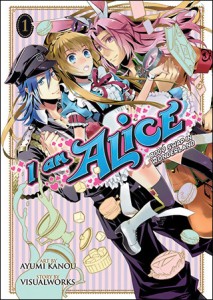
The artist behind this actually is the one who was responsible for Dictatorial Grimoire, a series I enjoyed more than I thought I would, mostly as it was filled with snarky people being verbally abusive. There’s some of that here, and it’s where the storyline really comes into its own. The premise, which is glossed very swiftly in the first few pages, is that a boy grabbed the Alice in Wonderland book in the library and fell into the book – and has now swapped bodies (you knew that subtitle would be explained at some point) with Alice herself, who is trapped in his body. Alice is the loud tomboy type, and Makoto quite reserved, so it’s not as jarring as you’d expect. As they travel through Wonderland, meeting the White Rabbit, Mad Hatter, etc., all of whom are handsome young men, they realize that to get back to their world and bodies, they have to defeat the… King of Hearts.

So Alice isn’t the only genderswap we’re dealing with. I was sort of hoping to see a Queen of Hearts – in the Country of Hearts series, Vivaldi helps to be a big sister to Alice and not make the series entirely about one girl and her many men. This Alice doesn’t have that luxury – we do find out the March Hare was a woman, but we find this out right about the time she’s fridged to give motivation to the Dormouse. As for the Alice in Makoto’s body, she’s more of a hindrance than anything else, though her love of huge guns is at least mildly amusing.

For the otome manga fan, there’s not much that’s objectionable here. Makoto in Alice’s body is a nice person, and therefore makes it easy for all the other guys to fall for her. There are a couple of “but wait, she’s a boy!” characters, but most simply don’t care, which clearly is a tease to BL fans. And as I said, Kanou has a way with snarky dialogue, so I smiled a few times throughout. That said, I honestly only have room for one Alice series at the moment, and this one falls short next to Country of Hearts’ psychological deconstruction of Alice’s tragic backstory. It’s an OK book, but in the end I’d only read it if you’ve played the game it’s based on.

Durarara!! Yellow Scarves Arc, Vol. 1

By Ryohgo Narita, Suzuhito Yasuda, and Akiyo Satorigi. Released in Japan by Square Enix, serialization ongoing in the magazine GFantasy. Released in North America by Yen Press.

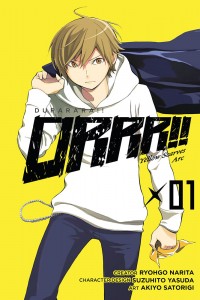
You’ll note in my header that I said ‘serialization ongoing’, even though this particular arc has ended in Japan. Square Enix and the author have decided to sell this series in self-contained arcs, each one taking in one of the light novels it’s adapting, rather that putting it all under one umbrella of volumes. Technically this is the 8th volume of Durarara!!, and it’s time to sit back and take stock of where we are. The first arc served to introduce one of our teen protagonists, Mikado, and show why he wasn’t quite what he seemed. The Saika arc did the same for Anri, and now here’s Masaomi on the cover of the Yellow Scarves arc, so it must be his turn.

drrr8

In some ways, Masaomi’s past is the least surprising of the three kids. He’s always seemed like his over the top happy, perverse guy side has been a front for something, and here we see what it is. The Yellow Scarves are his gang, and though he may not have had intentions of it becoming what it is today, what matters is that his people were hurt by the slasher. As such, he’s pulled back in in order to give the gang a figurehead and leader, and to get revenge. The irony here being that in the end, the person he may need to seek revenge on is also the girl he’s been hitting on this entire time.

Naturally his past is also tied up in Izaya’s, who appears here not just in his monomaniacal ranting phase of the present day, but also as a manipulative bastard in Masaomi’s past. I will say this for DRRR!!, it is not afraid to paint Izaya as an utter asshole. He confidently manipulates those he knows into doing what he wants; he spouts cod-philosophy that even makes Namie, a girl who has justified murder and her own incestual feelings, retch; and if it happens that someone who is equally broken latches onto Izaya and treats him almost like a savior, well, that’s fine too. Everyone in Ikebukuro is a game piece to Izaya, and since he mashes games together at will, the more pieces the better the chaos.

This leads me to Saki, who is introduced here. I had been spoiled a bit on who she was and the internet backdraft she was hit with when the anime came out. She is Masaomi’s old girlfriend, who suffered a crippling injury that has kept her hospitalized for an extended period, and she’s also utterly devoted to Izaya. Thus we have fans who hate her for being manipulative towards Masaomi (which she would be the first to admit, I suspect – I’m not pretending she’s a nice, innocent girl) and those who hate her for pairing reasons. Frequently I find myself drawn to characters who get this sort of backlash, and I find myself liking Saki, and wanting to see more of what makes her tick. Does she really love Masaomi? Is she merely a sleeper agent of Izaya’s? Both?

I suspect that this arc will lead up to a confrontation between the three kids – the cliffhanger here, showing Masaomi almost catching Anri spying on the gang, suggests it. This is a good thing. You can only sustain a buildup so much, sooner or later you have to have a payoff. We’ve had two smaller ones in the first two arcs, and I want a big one here. It should also be a lot of fun.