Category Archives: reviews

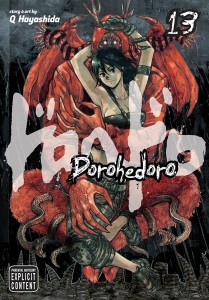
Dorohedoro, Vol. 13

By Q Hayashida. Released in Japan by Shogakukan, serialization ongoing in a Shogakukan magazine to be named later. Released in North America by Viz.

Most of the recent volumes of Dorohedoro have consisted of a lot of what readers are looking for with the series (gore, comedy, the odd gyoza mention) along with small dabs of plot and one big thing that everyone will remember after they finish the book. Last time it was Nikaido’s flashback, which was showing us how traumatized she was as a child and the circumstances that led to her use (and misuse) of her time magic. And I’m pretty sure that after Volume 13, everyone will be discussing what happens in the final moments with Kai and Natsuki. But let’s try to mention a few other things first.
dorohedoro13

Given the traumatic nature of what happens at the end of this volume, I knew we would have some humor in here somewhere, and a lot of it comes from seeing genderbent Nikaido, who has to disguise herself using magic to enter En’s mansion, now taken over by the Cross-Eyes. In her male body, she’s still her regular self, and is I believe what anime fans describe as a “keet”. This leads to more fun when she runs into Kai/Caiman, who is still having memory issues and has difficulty dealing with Nikaido being so informal. Particularly when the spell wears off and she transforms back into her buff, stacked, naked body in front of him. (This is a strong volume for fans of Dorohedoro’s fanservice – Nikaido fights as a man bare-chested for a while, and we also see Noi naked after her recovery.

Yes, Noi and Shin have been rescued from being mushroom’d at the end of the last volume. The fact that there’s yet another mysterious En family member with tremendous powers is played for laughs here – this man is able to become invisible, but does too good a job, so people forget he’s there after a while. She’s able to use smoke to heal Shin (via a full-on kiss, which I think startles Shin more than anything else) and they’re back in action. Actually, a great deal of this volume is the En family regrouping, and trying to resurrect their leader. Hasn’t happened yet, though.

And now let’s talk Natsuki. She’s been one of the most optimistic, hopeful and fun characters in the last few volumes, more of a mascot than a real threat. That changes here when a crisis shows off her repressed magic, which has almost godlike defensive capabilities. She’s delighted, but the rest of the cross-eyes are terrified – they know what Kai does to people with strong magic, and immediately plot to get her away from him. But in the end this is *not* particularly an optimistic, hopeful manga, and Natsuki is not one of the main characters. And thus, right before she leaves she runs into Kai, and gets brutally torn apart, in one of the goriest bits of the entire volume. And unlike En, I’m pretty sure she won’t be coming back. Kai is scary. I miss Caiman.

I expect the fallout from this will take up a chunk of Vol. 14, along with Nikaido’s continued practice of her magic and the search for En’s devil-shaped tumor. In the meantime, another fun yet brutal volume of Dorohedoro, which even in its most confusing moments still manages to be exhilarating through sheer verve.

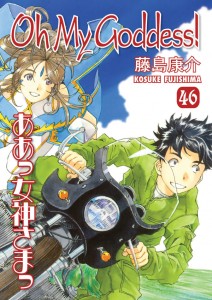
Oh My Goddess!, Vol. 46

By Kosuke Fujishima. Released in Japan by Kodansha, serialized in the magazine Afternoon. Released in North America by Dark Horse.

Since my last review of Oh My Goddess back in December, the manga has finally ended in Japan after 26 years, and will be 48 volumes total. For those who were reading this entire arc and noting it felt like a grand finale, congratulations, you are correct. There’s still some stuff to do before we get to what will no doubt be a final chapter with a wedding, not least of which is that Keiichi and Belldandy have to be reminded of something really obvious: she is a goddess and he is mortal. In fact, this is something that has happened to lovers in the past, as we see in the first have of this volume.

omg46

The flashback is painful, as you’d expect, but is also suffused with the selfless love we’ve come to expect from Keiichi and Belldandy, to the point where once the bard dies, the goddess is determined to see what he sang about even if it means her life. Unfortunately, due to the nature of contractual promises, she can’t even get peace in death. They’re being shown this to remind them that love is not worth all this pain that you’ll see in the end, but Oh My Goddess has spent 46 volumes so far showing us that yes, it absolutely is, so this argument doesn’t really hold up.

After last volume’s rewrite of its continuity, where we see that Keiichi was being repressed by heavenly forces to stop him getting it on with Belldandy, we get even more discussion of the original wish that began everything back in Volume 1. The wish: “I want a goddess like you to be with me always” – was said without being serious, but here we see a devastated Keiichi realizing what the burden of such a wish was on Belldandy, and cursing his past self for not being serious enough. Meanwhile, Belldandy confesses to Keiichi that, far from being surprised to see him when she descended to grant his wish, she’d actually been watching him from heaven for some time, and had fallen in love with him before they’d even met.

Fans of the anime won’t be surprised at this, as it also did a ‘we were destined to be together long before that wish’ plotline. It is nice, though, that Fujishima actually goes back to draw Belldandy somewhat like he did at the beginning – a larger marking on her head and her hair darker – to show us how she’s changed since then. (Keiichi, notably, does NOT get seen as his Vol. 1 self, which is fine, as that was more ‘the artist still needs work’.) And so finally Keiichi and Belldandy have pretty much taken every test of their love that can be thrown at them. We’ve even met her mother. And, as it turns out, her father – Gate turns out to be Tyr, Belldandy’s father and the ruler of Heaven.

Needless to say, he decides on one more test for Keiichi to be worthy of his daughter’s love, and even cheerfully frames it as ‘because a dad has to be a jerk to his daughter’s boyfriend’. Any reader of Oh My Goddess will be unsurprised at what happens next – the final battle involves a motorcycle race over an incredibly dangerous path, with K1 even driving a recreation of his regular bike. He also has to do it by himself, without Belldandy in the sidecar. Can he manage it? We’ll find out in March.

Black Rose Alice, Vol. 1

By Setona Mizushiro. Released in Japan by Akita Shoten, serialized in the magazine Princess. Released in North America by Viz.

I’m usually quite fond of series that try to get by on pure mood, even if the plot is not one that reaches out and grabs me. This odd shoujo series definitely falls into that category. It’s not exactly something I would read to see what happens next – the entire time I was reading the first volume, my thoughts were “Didn’t I read this in a Kaoru Yuki title 5 years back?” – but the aesthetic is glorious and gruesome, with the corpses stacking up and anguish present on every face. It’s dark, gothic grand guignol shoujo, and marks a welcome return of Akita Shoten’s titles to out shores (as well as the author of After School Nightmare).

blackrosealice

Most of the first volume is prologue to what we’ll be seeing from now on. One hundred years earlier, we meet Dimitri, who is not of noble blood but is possessed of a remarkable singing voice. He loves Agnieszka, a young and innocent noblewoman, but she’s betrothed to his friend Theodor, who, while he has been doing his best to advance Dimitri’s vocal career, will only go so far. It’s the sort of storyline that makes you await the inevitable tragedy, and sure enough, a runaway horse seems to kill our hero. But he’s not really dead, as it turns out that his body is now being used by Bradley, a vampire! If the plot sounds melodramatic, well, I hope you knew that when you purchased it.

This is a horror title, by the way, in case my use of the words ‘gothic’ and ‘vampire’ did not clue you in. There are many, many mass suicides about halfway through, and some grotesque shots of blood. Oh yes, and there’s the spiders, which is the way that Dimitri acquires blood after his victims have obligingly offered themselves to him. They’re supremely creepy, but also very effective at showing the horror of what Dimitri is becoming. There’s also a sexual assault, as a desperate Dimitri, who wants nothing more than to die when he hears what he has become, rapes Agnieska to try to achieve this. It doesn’t work.

The main part of the book looks like it’s set in present day Japan, and features a more prosaic teacher-student romance, which is no less forbidden and yet intoxicating than the previous one. Koya is trying to convince his teacher Azusa that she is not merely a schoolboy crush to him, and she’s trying to push him away but desperately unable to. This leads to her making quite a nasty bargain, whose effects we don’t quite see in this volume but I’ve no doubt will prove to resonate down the line. Also, Dimitri, who was so horrified at the prospect of turning evil in Vienna, seems to have warmed up to it now that he’s in Japan. Ah well.

I’m not sure that I’m the audience for this book, really. But I’m sure that there is a huge audience for it. Those who enjoyed the darker, more sensual side of Shojo Beat’s titles, and want another supernatural romance with vampires who are likely quite bad for you, won’t be able to put it down. The spiders may be horrible, but it’s the doomed yet overpowering love that will draw them in.