Category Archives: reviews

Accel World: Kuroyukihime’s Return

By Reki Kawahara and Hima. Released in Japan by ASCII Mediaworks. Released in North America by Yen Press.

This is the other major series that Kawahara has written, after Sword Art Online, and it’s interesting to see how the two series compare and contrast. SAO was written 6 years earlier and published online as a web novel, and only picked up for publication once Accel World won a major award. So it’s likely that this is the series that really kickstarted his career, with SAO along for the ride, though I’d argue that SAO is currently more popular than Accel World. And I can see why this book did well: it’s a strong first volume, barring a few hiccups, with a hero who is meant to be a definite contrast to the generic male lead that Kirito proves to be much of the time.

accel1

And right there is hiccup Nunber One, as we get yet another volume I can’t read on public transit. The cast of Accel World are all 13-14 years old, this time mostly for plot reasons, but there’s still the same amount of fanservice and sexualization you tend to get in series like these. Just as the Fairy Dance manga had Kirito’s younger sister showering for the benefit of readers, here we get the hero imagining Kuroyukihime in the shower. While I’m at it, I might as well bring up hiccup number two, which is the presentation of the villain of this volume, Cyan Pile. Kawahara seems to have trouble with villains in general, but here in particular it suffers from us barely getting to know this character at all before the big revelation, and therefore the emotional torture that should be there (and is written as if we feel it) simply isn’t.

That said, there’s a lot to like here as well. Let’s start with the hero. The author has apparently said in interviews that Kirito and Haruyuki were meant to contrast with each other, and that’s certainly evident here. Short, fat, and with an incredibly negative self-image, Haruyuki is so far away from the typical harem protagonist that he is completely unable to notice that he has two girls crushing on him over the course of this volume. His only skill (which, given this is another series about a virtual gaming world, proves to be highly important) is his speed and agility when playing virtual squash in a court no one ever goes to (so he doesn’t have to deal with people). This brings him to the attention of Kuroyukihime (real name deliberately not given, though there are hints), who tells him about a game, Brain Burst, that may allow him to achieve amazing things.

The game is the other success of this series, after seeing the generic RPG world of Sword Art Online. Much time is devoted to how to play it and strategy, and we see right away that Haruyuki is very good at thinking on the fly and coming up with solutions in battle. (Well, almost right away… he gets his ass kicked the first time. There are rules.) That said, I think that the main reason I liked this so much (and I did really enjoy SAO too, if you’ll recall), is that it’s a book that shows the skills the author has developed in the 6 years between that book and this one. It just reads easily. It’s a light novel, with all the cliches that this entails, so don’t read it if you dislike those sorts of cliches. But most fans of the genre should enjoy this, and I’m interested to see where it goes with Haruyuki.

Umineko: When They Cry, Vol. 7

Story by Ryukishi07; Art by Soichiro. Released in Japan in two separate volumes as “Umineko no Naku Koro ni: Alliance of the Golden Witch” by Square Enix, serialized in the magazine Gangan Online. Released in North America by Yen Press.

Umineko is in many ways a dark mirror of Higurashi: When They Cry, and so it makes sense that we would switch protagonists at this point. In Higurashi, after three arcs following the POV of Keiichi Maebara, the fourth arc gave us a new character, Mamoru Akasaka, and saw how he interacted with a younger Hinamizawa during the dam wars. Umineko likewise switches away from Battler to a degree, bringing his younger sister Ange, now an 18-year-old, into the story. Ange is a lot more invested in what happened on the island, though, and is also far more biased in her viewpoints than Akasaka was. The first 4/5 of this book deal solely with Ange in two different time periods: as a teenager being bullied in her private school (the same school Shion attended, by the way), and as an 18-year-old in 1998, dealing with the fallout from Eva’s death and trying to find out what happened 12 years earlier.

umineko4-1

The first thing that comes to mind about this adaptation is how rearranged everything is from the original sound novel. In the Alliance novel, we intersperse Battler and Beatrice’s game with Ange throughout, never losing sight of their part in the narrative. Here, we get nothing but Ange (and Maria) for almost the entire volume, only coming back to Beatrice right as Ange is joining their game as “Gretel”. It makes it seem like this has become Ange’s story. But unlike Higurashi, where switching to a story focused on Rika showed off how she was becoming the main protagonist soon, Ange is never quite going to be the star. A large part of the narrative, yes, but it’s Beatrice and Battler’s story. Unlike, say, Kino no Tabi, it’s clear that Ryukishi07 approved of the rearranging of events here. But it does mean that we approach things from a different perspective, downplaying what’s happening in 1986 in favor of the events of 1998.

Speaking of that, while Higurashi had a brief manga-only flash-forward showing a surviving Shion trying to go on after everyone’s death, the main storyline of the visual novels never quite showed off a future of “everyone is dead and you really can’t change the future easily at all” like this does. Bernkastel notes she’ll search for a fragment where Ange’s family survives, but that it’s odds are infinitesimally small. Ange and Battler are both approaching the narrative, albeit in different ways, in a Higurashi perspective: if I figure out what happened, I can fix it so it never does. Umineko being partly a deconstruction of Higurashi, it’s not going to be as simple as that.

Be warned there is a lot of discussion of bullying here, both of Maria and Ange, though Ange gets the brunt of it. It’s actually intertwined with the discussion of magic, and who has the potential to be really good at it. Much as the 3rd arc was excellent at showing us what “Beatrice” can really be, this arc delves into the actual state of “magic” in the Umineko world, and what it can be used for. Ange gets to the point where she can conjure up one of the Seven Stakes, Mammon, to float around with her and be her friend, but she can’t really interact with anything. This is in contrast to Maria, who can make a stuffed bear like Sakutarou come to life, or Beatrice, who can then give Sakutarou human form.

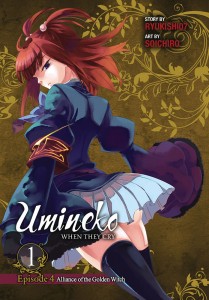
Aside from moving events around a bit, there are a few things I’m a little annoyed about with this adaptation. The fanservice which is never too far away from all of Ryukishi07’s works is shown off a lot here, possibly in celebration of the fact that this volume doesn’t have to deal with the adults at all. Right on the front cover we see a flash of Ange’s ass, and the stakes, particularly Mammon, are very fond of showing off their bodies to the reader. And while the sound novel has Ange discussing getting her family back quite a bit, the manga makes it seem several times as though it’s Battler who she’s really concerned with. This, of course, allows her to have a “brother complex”, one of Japan’s favorite motifs.

I haven’t mentioned the non-island adults in this volume, several of whom may surprise Higurashi readers. Okonogi is back, and this time he seems to be Ange’s ally… although, being Okonogi, he’s also Kasumi’s ally as well. Ryukishi07 enjoys playing with his readers like this, particularly as the Higurashi reader is inclined to mistrust everything he says, just as they’re drawn towards Bernkastel as “Rika”. Ange’s bodyguard was also spotted in the final Higurashi manga, though there he was working for the enemy trying to kill our heroes. Phew. Thank God he’s on Ange’s side now. As for Kasumi Sumadera, Kyrie’s younger sister, she’s shown to be almost completely insane from the get go. Which does at least lend itself to some amusing expressions.

As we wrap up this first omnibus, we’re about to start the game proper at long last, leading one to wonder if this one will finally let us see Kyrie the way the other three arcs focused on Natsuhi, Rosa and Eva? Will battler, with the addition of Ange/Gretel, be any better at figuring things out from the hints Beatrice drops? Will Beatrice and Battler continue to be an adorable love/hate couple? What the hell does Bernkastel want here? And can Ange, Maria, or Beatrice manage to escape the situations that have left them in despair? We’ll see next time around.

Soul Eater, Vol. 21

By Atsushi Ohkubo. Released in Japan by Square Enix, serialized in the magazine Shonen Gangan. Released in North America by Yen Press.

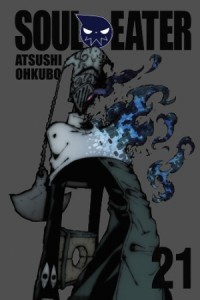
After the horror of the final chapter in Volume 20, I think readers needed a break, so it was nice to see the Spartoi out on a normal silly mission to help some Moby Dick-esque villagers harpoon a giant sky whale (ethics of this aside). It’s sort of a last hurrah for simple missions, and for that matter a last hurrah for Black*Star doing something dumb and silly. Because things are coming to a climax, and this volume’s cover is even darker than the grey of last volume, so we know things are going to get even worse, starting from when the group returns to find that an order has been given to have Crona executed.

souleater21

I like that the ethics of this are debated somewhat, and it’s clear that Maka wants a chance to talk Crona down from the insanity (this despite, as has been pointed out, by this point Crona has killed an ENTIRE CITY). And it’s a sign of Kid’s maturity that he allows them to do this rather than sticking to the strict letter of the law. (Speaking of Kid, it’s becoming more apparent that Shinigami-sama has been waiting for Kid to reach this stage of maturity, and I suspect that of all the characters who might die before the end, he’s near the top, if only so that Kid can inherit. He even implies as much to Maka’s father.

Speaking of Maka, she really gets to show off, albeit accidentally, when she finds the Kishin’s bolthole while searching for Crona using her soul sense. And naturally, given the prominence of it in art since the start, Kishin and his evil minions are on the Moon. And so, leaving Maka and company to deal with Crona, most of the older main characters (plus Kid, Liz and Patti) head off to the moon to go and stop Justin and his fellow insane believers. The latter half of the volume is very much an action-oriented scene, with lots of back and forth and signs of the unstoppability of the enemy being combined with hope for our heroes. The storyline has reached truly epic proportions.

Which is why I find it interesting that all my favorite moments in this volume were small things. Maka’s conversation with her father, where he gives her his wedding ring. The incredible sadness that is Liz and Patti, being forced to write their wills before they go off to a battle of almost certain death, discovering they have no one to leave anything to. The incredibly stupid “H-ey” pun that Yen sadly tries to translate and doesn’t quite pull off, though they at least point out the original in the footnotes. And Eruka Frog, hanging out in her cell at DWMA, realizing that Medusa’s snakes are no longer in her body and simply saying “She’s dead!”

Crona only had a brief role in this volume after the tour de force that was the previous cliffhanger, and I expect we’ll see a lot more of that plot in the future. But for the most part, enjoy the cast of Soul Eater, fighting on the Mountains of Madness on the Dark Side of the Moon.