Category Archives: reviews

Gakuen Polizi, Vol. 1

By Milk Morinaga. Released in Japan by Futabasha, serialized in the magazine Comic High!. Released in North America by Seven Seas.

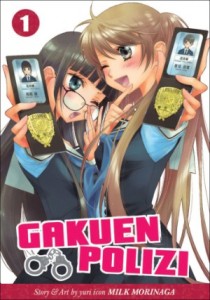
First off, this is clearly a series meant to be marketed to the same group that loved reading Girl Friends, and is touted as a top new yuri series. All I can say is, unless things progress a whole lot in Vol. 2, some folks might wonder what the fuss is all about. Midori occasionally blushes or wonders why she feels a need to connect with Aoba despite everything, Aoba sometimes reflects on her overly touchy-feely hijinx, but honestly, this is a high school comedy far more than it’s a yuri series. That said, everything ELSE people liked about Morinaga Milk’s manga is here – cute art, over the top characters reacting in funny ways, and a core of serious story underneath it.
gakuen1

Our hero is Aoba, a naive yet vibrant girl who grew up wanting to be a defender of justice and, since magical girls and sentai warriors are hard to come by in real life, has joined the police while still in high school to still defend what’s right. For her first assignment, however, she’s sent to a school that seemingly has no issues – the most that happens here is girls fighting over a diet. She runs into the seemingly stoic Midori, a stoic girl whose stoicness lasts about five seconds in the face of the overwhelmingness of Aoba. Midori has a tragic past where her partner was hurt because of her actions, and has been sent to this school to sit tight until she graduates (her dad is chief of police, so they can’t just fire her). Naturally, she’s a bit sour on justice, and wants nothing more but to sit quietly and draw her yaoi manga. Hands up, who thinks that’s going to happen?

There’s no real attempt to move these characters beyond their obvious stereotypes – Aoba in particular is cheerful, naive, acts before she thinks, mood swings wildly, etc. But that’s OK here, really, as this is a series where you want to watch Aoba do dumb stuff and slowly bring Midori out of her shell of tragic past. They’re supposed to be secret police – the school doesn’t acknowledge their jobs exist – which of course leads to Aoba whipping out her badge at the slightest provocation. It also allows the series to touch on the difficulties of reporting things to the *real* police – discussion of a train groper notes that since all the girls say the groper is a “ghost”, the cops wouldn’t do anything, and in a later story involving a stalker, Aoba feels that he got let off far too lightly. It’s noted that different officers respond to cases differently, and that’s certainly the case with our heroines.

By the end of this fist volume Midori seems to have taken it upon herself to ensure that Aoba maintains her idealistic demeanor, something that may be disrupted by the cliffhanger, which shows us that her old partner is returning to the school to reunite. (Please don’t be evil, please don’t be evil… she’s gonna be evil, isn’t she?) Gakuen Polizi is not going to win any awards for depth of yuri feelings. But it has more depth of character than I was expecting, and I hope its second volume continues to touch on how Aoba and Midori can bring out the best in each other as partners.

Seraph of the End: Vampire Reign, Vol. 1

By Takaya Kagami, Yamato Yamamoto, and Daisuki Furuya. Released in Japan as “Owari no Seraph” by Shueisha, serialization ongoing in the magazine Jump Square. Released in North America by Viz.

I’m always a little bit wary when I see more than two names on a book’s cover, particularly when it’s a manga and yet one of the names is credited for ‘storyboards’. I checked to see if this is based off of an anime or video game property, but apparently not. Its author does specialize in light novels, however, most recently Itsuka Tenma no Kuro Usagi, which got an anime. The artist seems to specialize in adapting light novels as well, having drawn Kure-nai for Jump Square as well. And now we get Owari no Seraph, which already has its own spin-off light novel focusing on the commander we briefly see being an ass to our hero. The manga itself, though, focuses on three core people.

seraph1

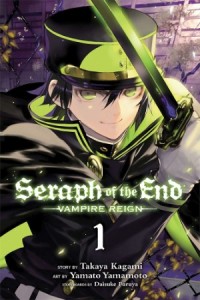
Of course, they aren’t the three people that you might expect when you pick up this volume. We meet our antisocial hero, Yu, as a young boy growing up in an orphanage along with several other children. They live in a world where vampires have taken over after a virus killed everyone over the age of thirteen. Together with his strategist best friend, Mika, and his likely love interest, Akane, he will find a way to fight back against those who… oh wait, everyone except him just died. Nevermind. What this is actually about is Yu four years later, forced by the military that he hooked up with upon escaping to attend school in order to cure his jerkass tendencies and make friends. And perhaps kill a few vampires along the way.

It’s hard to read this series and not be reminded a little of Attack on Titan. The vampires aren’t nearly as impossible to kill as the Titans, but that’s made up for by Yu’s berzerker rage whenever he sees them – he’s not quite as bad as Eren, but it’s a close thing. He’s also part of a friendship trio, though they don’t have the strong bond Eren, Mikasa and Armin do – at least not yet. Shinoa, who seems to be his minder, exists mostly to point out when he’s being stupid and watch him do it anyway. Yoichi is the stock earnest, bullied character, whose idealism will no doubt contrast with the cynical viewpoint of the other two. They’re all likeable, or at least will be once Yu sheds a lot of the walls he’s put up around him, which I suspect will happen soon.

Amongst this background, there’s some interesting worldbuilding (the world’s population has been decimated, so everyone is encouraged to repopulate the Earth – this is mostly an excuse to have Shinoa get away with calling Yu a virgin constantly), some well-choreographed fight scenes (perhaps this is where the storyboarder came in), and some disturbing horror, as you’d expect from a series where the vampires are, for once, the bad guys. Though the cliffhanger for this volume makes me wonder how long that villainy will truly last. If you like Attack on Titan, or maybe Blue Exorcist, another series which this seems similar to, give Seraph of the End a try – it’s a strong, solid first volume.

One Piece, Vol. 71

By Eiichiro Oda. Released in Japan by Shueisha, serialization ongoing in the magazine Weekly Shonen Jump. Released in North America by Viz.

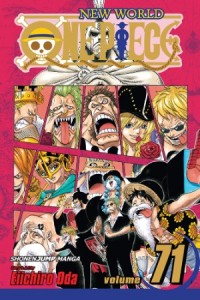
One Piece may go beyond the typical shonen manga most of the time, but that doesn’t mean it’s above many of the standard cliches. Being a Jump Manga, it is firmly in the cliche of “Friendship, training, Victory”. Oda is not above fanservice for fanservice’s sake either, as we see in the Gulliver’s Travels parody with Robin and the Tontattas. That said, when you read this volume and realize that Oda is beginning a Tournament Arc, it’s somewhat surprising to see that he waited this long. Technically, I suppose the Davy Back Fight may count as well, but no one really thinks of that anymore except to remember Afro Luffy. This one is clearly in it for the long haul, with dozens of named contestants, many of whom look to actually be important so we will have to try to remember them. Oh dear.

op71

Most major arcs in One Piece start with a lot of stuff all happening at once, but Dressrosa’s arc manages to top that, as we’re also dealing with fallout from the last arc. Law is bringing Caesar Clown to Donflamingo for a hostage negotiation, and decides the best way to do this is for the Straw Hats to split up. Naturally, it takes about two seconds for everyone to go off and do their own thing, but hey, he tried. By the end of the volume Zoro is running through town with a Tontatta, getting lost as usual; Sanji has hooked up with a gorgeous woman who will no doubt take advantage of him but I suspect he doesn’t care; Franky is busy actually findning out about the plot and backstory needed for this arc (there’s something very odd about this being an Island of Toys, some of whom seem far too human); Nami, Chopper and brook are back on the ship having little to do (I hope more happens next time)…

And then we have the other two groups, who get the lion’s share of what’s going on. Law, Robin, Usopp and Caesar are headed for the rendezvous point, and increasingly are becoming aware this is a trap. They get split off even more when Usopp and Robin are captured by Tontattas, the One Piece version of Liliputians, who actually manage to achieve something major by forcing Robin to have pop-eyed reactions at their naivete. It’s still within the realm of human normal, but for Robin it’s the most emotive we’ve ever seen her, I think. As for Luffy, he’s disguised (poorly) as Lucy, a gladiator taking part in the tournament. As I said, we meet dozens of competitors (I suspect the gorgeous female fighter will be relevant later), but the most interesting is the return of one of Luffy’s earlier enemies. Remember that jerk that Luffy one-shot KO’d in Volume 25? Yes, Bellamy the Hyena is back, and he’s matured – Luffy even roots for him! He doesn’t win, but it’s always nice to see characters at least go from villainous to less villainous.

If there’s a drawback to this volume, it’s that there’s almost too much going on – I suspect I will enjoy it more when the arc is over and I can go back and find all the foreshadowing that I’m not picking up right now. But even a chaotic overcomplicated One Piece is still one of the best titles out there. Don’t stop yourself from picking this up.