Category Archives: reviews

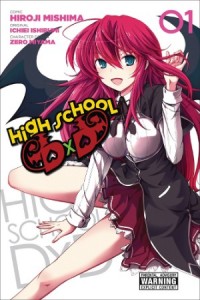
High School DxD, Vol. 1

By Ichihei Ishibumi, Zero Miyama, and Hiroji Mishima. Released in Japan by Fujimi Shobo, serialization ongoing in the magazine Dragon Age. Released in North America by Yen Press.

Given that the front cover of this new series features a cute young woman with bat wings, and the back cover features that woman plus another one hugging a slightly drooling young man, you can possibly guess not only the genre of this series, but also the plot. It’s your classic harem comedy, with lots of added fantasy this time, where the goal is to see how many different types of women you can have fall in love with the hero without any actual fornication occurring (as even Dragon Age would likely pass on that). So given that, what does High School DxD offer that separates it from Haganai, or Haruhi Suzumiya, or Zero’s Familiar, etc.?
highschooldd

Issei, our hero, seems fairly typical. He’s more at the lecherous end of the scale, constantly going on about breasts and talking about the fact that his dream is to one day have his own harem. Typical loser high schooler, which is why it’s something of a surprise to see him on a date with a gorgeous beauty as the story opens. Who then grows huge black bird wings and stabs him through the chest with a spear made of light, killing him dead. Luckily, he’s in the right series, as he manages to get resurrected and turned into a devil by Rias, the queen of the school and also, as it turns out, a devil. He’s now recruited to her team, along with several other stereotypes, in order to grant wishes for people in exchange for a price.

There’s a bit of discussion of Angels, Fallen Angels and Devils, and, as is typical with Japanese manga that discusses wars between Heaven and Hell, the narrative is firmly on the side of the devils. To be fair, our villains are all carefully chosen to be ‘Fallen’ – a Fallen Angel and an excommunicated exorcist – But I’m fairly certain that when the Angels themselves are introduced, we’ll be seeing them as the enemy as well. I was less impressed with the discussion of Sacred Gears, which is essentially the superpower that each devil has. Humans have them too, and it’s noted that all the really famous people through history are famous because of their Sacred Gear, rather than through, y’know, actual human effort. I’ve always disliked this school of thought, and didn’t like seeing it here.

There is a LOT of fanservice here, as you would expect. Rias is naked quite often through this volume, and does not appear to be remotely embarrassed about Issei seeing her naked body. We also have Akeno, a classic yamato nadesico type who turns out to be a sadist deep down (another common trait in hentai manga, and thus in this toned down harem variant), and Koneko, an Ayanami Rei clone. Interestingly, the last member of our team so far is Kiba, who is male, and reminds me of Koizumi Itsuki from Haruhi a whole hell of a lot, right down to Issei constantly denigrating him in his narration. I assume Kiba will NOT be joining Issei’s harem, though I could be surprised.

At the end of this volume, notably, Issei has not saved the day even once, and his power is shown to be so low that everyone boggles at it. This will change. It’s that sort of story. Not sure if we’ll add victim of the volume to the harem team (she’d fit right in, being a clumsy nun sort of character), but we will no doubt find out in the next volume. As for the series itself, it’s recommended to those who like harem fanservice series with a light fantasy tinge, though given the pages expended on worldbuilding here, the fantasy may be more important than I expect.

Also, I have no idea what the DxD is supposed to mean.

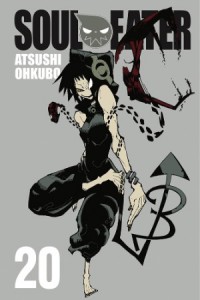
Soul Eater, Vol. 20

By Atsushi Ohkubo. Released in Japan by Square Enix, serialized in the magazine Shonen Gangan. Released in North America by Yen Press.

So much of what has gotten me addicted to Soul Eater comes to a climax in this volume. The discussion of madness and knowledge, and how the two sometimes interact. The artstyle, which lends an air of disturbing surrealism to any actual depiction of madness on the page, from Crona’s twisted grins of despair to a ball of black poisonous concentrated insanity. And of course we have the culmination of Medusa and Crona’s relationship, which has always been shown to be awful, abusive and toxic, but in the final chapter is given even more nightmarish proportions, to a point where there seems to be only one solution to the whole thing. Killing.

souleater20

Speaking of madness, though, I liked the battle between Justin and Tezca, particularly with Justin pounding on about faith in the Kishin, and Tezca wondering how strong a faith can be when it simply switches over to the next big powerful thing to fear/worship. There are a lot of terrifying things going on in the Soul Eater universe, so it’s understandable that one would want to ally oneself with the strongest even if it means sacrificing ideals. I’m not really sure Justin had any ideals to begin with, though – the confrontation loses something as it’s sort of obvious that Justin is never going to go back to the side of the heroes.

There is a scene with Sbhinigami and Kid where they argue about whether they should have gone into Baghdad to find the Kishin just because they knew there were anti-DWMA groups there, with Kid noting that they didn’t find anything, and Shinigami saying he was sure they’d find the Kishin there. I’ll just leave that here. Sometimes something is so blatant that even analyzing it would be overdone.

Maka and Soul get some nice stuff as well, with Soul managing to control the madness with in himself, but I want to talk more about Crona. Crona spends the first half of the book using black blood to destroy and drive insane anything that barrels into Crona’s path. Now in Russia, we see an entire city in the Ukraine where the populace are driven into madness and turn into a huge ball of madness. It’s especially chilling as it’s implied that those people can’t be brought back – that they are, essentially, dead. Like Justin, Crona’s last attempts at redemption seem to have come and gone. Unlike Justin, we still have some sympathy for Crona.

Let’s talk about the final chapter, ‘Just A Simple Story About Killing A Person’. It’s a two-hander between Crona and Medusa, who is at her most monstrous here. Crona’s backstory and childhood is every bit as bad as we feared, if not worse – from the stick-figure styled book about different ways to kill, to being starved to death unless Crona kills adorable baby bunnies, it’s all been designed to drive Crona to the very brink of madness, with Maka’s friendship being the only thing that ever held Crona back. And now Medusa needs to complete the descent, and does it in such a clever way, I almost have to admire her loathsome craftiness. She’s died in the series before, but I’m fairly certain that this time she’s died for good. But she got what she wanted – Crona is primed, ready to go, and completely insane.

As I said earlier, the art plays a major role in making this chapter as effective as it is – stick figures have never been so terrifying. And what’s more, it makes for a truly chilling cliffhanger. And next time, we start the final arc. An absolutely essential volume of Soul Eater. Even those who don’t read it should get it for the final chapter of the book.

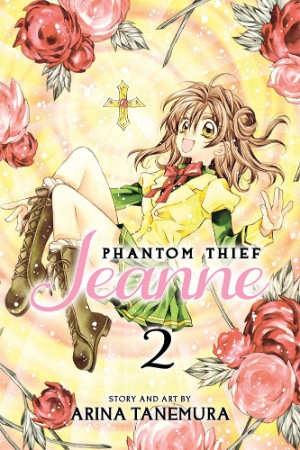
Phantom Thief Jeanne, Vol. 2

By Arina Tanemura. Released in Japan as “Kamikaze Kaitou Jeanne” by Shueisha, serialized in the magazine Ribon. Released in North America by Viz.

When I reviewed the first volume of this Tanemura magical girl title, I noted that her parents splitting up and suddenly moving out of the country looked ‘suspicious’. Well, it turned out to be more prosaic, as in this volume Maron gets notice from her mother that they are indeed getting a divorce, something that sends her running away from everything for a while. I will admit, despite one of those “didn’t you see that they built this amusement part because they love you’ moments, these are still two parents who are not going to be winning awards anytime soon. They’re lucky that Maron has survived with only minor ‘screwed up’ tendencies. The rest of the volume continues to show off Jeanne’s skills as a phantom thief, as well as the author’s skill for giving a touch of darkness to the standard magical girl genre.

jeanne2

Speaking of families, this volume seems to focus on them quite a bit. First Chiaki’s father is possessed by one of the paintings, causing him to kidnap young women and store them in glass cages in his basement (something that really gives maximum creep factor, particularly as his father is such a weirdo to begin with). Then Miyako comes to Jeanne for help, despite their rivalry, and asks her to steal a painting that has corrupted her scientist brother, who is now turning to mad science (complete with “they laughed at me at the academy” overtones). This is all done with maximum threats of peril and also allows Jeanne to show off her skills at being clever, particularly in the first part where she uses the realistic android-like ‘dolls’ to her advantage to pull a switch.

Miyako also gets a side chapter going further into her motivation for chasing Jeanne. I have to say that she’s probably my favorite character in the series, and most of the time she seems to understands how Maron thinks better than she does. There is the small matter of her being unable to connect Maron to Jeanne, but that’s a standard trope of this genre, so I’m inclined to let it slide. (Honestly, given how things are playing out, I would not be surprised if Miyako had figured it out at some point and is just going along with it by now. Particularly when Jeanne is being far too knowledgeable about her brother.)

There is a lot less of the heaven vs. hell aspect in this particular book, with the exception of the final chapter, where Jeanne finds herself in a deathtrap without her transformation abilities or her familiar and has to power up through sheer force of will. This is referred to as “Holy Power”, and seems to delight Finn (who we see far less of this time around, which pleases me as she’s annoying). There is one line that really struck me, however, and I suspect it will be followed up on in the next volume. She’s thanking Chiaki for helping her as Sinbad, and notes “I didn’t know followers of the demon lord used a cross as well.” As she toddles off, Chiaki stares and goes “what is she talking about?” To me this suggests that we’re not looking at a simple battle between heaven and hell. I can’t wait to see more with the next volume.