Category Archives: reviews

What Did You Eat Yesterday?, Vol. 1

By Fumi Yoshinaga. Released in Japan as “Kinou Nani Tabeta?” by Kodansha, serialized in the magazine Morning. Released in North America by Vertical.

This series has been demanded by the manga cognoscenti almost since it began serialization, and particularly since Yoshinaga’s other titles made it big over here (well, semi-big – no one’s comparing sales between Antique Bakery and Vampire Knight). The story of a gay couple and their everyday lives and eating habits, it’s an intriguing title if only as, unlike other BL titles released over here, it’s very much slice of life rather than oriented towards BL fans like many other series with gay men released in North America. In a couple of ways it reminded me of the Odd Couple, if you replaced Oscar with another, slightly different Felix and made them both gay.
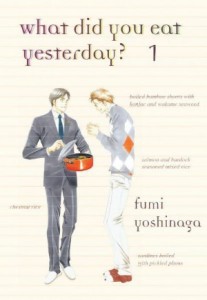
whatdid1

Our three lead characters are Shiro, a dapper lawyer who looks younger than his age and loves bargains; Kenji, a hairstylist who seems to live around the emotional extremes; and the food that they eat each chapter. Yes, trust me, the food is a main character, as loving attention is devoted to purchasing, cooking and eating it. Indeed, at times it seems the only thing keeping the characters sane and happy is delicious meals, as they (as well as the minor side characters) have a bunch of personal problems and neuroses that are equally on display here.

I must admit, while I found Shiro to be endearingly dorky at times, particularly when he’s fretting about bargains, I’m not sure I’ve really warmed to him, as he’s rather hard to like. He’s still in the closet at work, and takes pains to remain so. He and Kenji fight a couple of times here, but nothing is particularly resolved, it more or less just goes ignored or gets papered over with delicious meals. Which I admit is very true to life and absolutely what some couples are like, but it doesn’t make for entertaining reading. Shiro works a little better when he’s dealing with others, such as the housewife he befriends who shares his love of food bargains.

As for Kenji, he seems nice enough, but there are undercurrents there as well. He’s far too passive and accepting in his relationship, though he does show signs of jealousy when he sees Shiro shopping at a bakery owned by his ex-girlfriend from college (an attempt to ‘play straight’ that didn’t last long). On the whole, though, he seems to be a bit more at peace with his life than Shiro is, though I’m sure he’d appreciate being more open about their relationship.

And the food? It looks delicious. Some chapters get recipes after them, but not all – Shiro thinks aloud as he cooks, letting us know the details of exactly what he’s doing. Cooking and eating seem to be the one thing that relieves him of his daily stress. I wouldn’t call this a ‘foodie manga’, though – the food is a spice, giving you another reason to read the story about two men and their everyday lives together. It’s definitely a title worth checking out, and features a lot of what people love about Yoshinaga. Just be aware that sometimes you’re going to want to shake the protagonists and say “What are you acting this way? Stop it!”

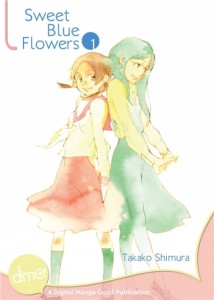
Sweet Blue Flowers, Vol. 1

By Takako Shimura. Released in Japan as “Aoi Hana” by Ohta Shuppan, serialized in the magazine Manga Erotics F. Released in North America digitally by Digital Manga Publishing.

DMP’s digital only line of books has been cruising along for some time, with a broad selection of BL, hentai, and obscure shoujo titles to choose from. Lately they’ve pulled a couple of fan favorites out of their hat, as they announced Kimagure Orange Road, the old-school 80s romantic comedy that was a huge influence on North American fandom (in both good ways and bad), and Aoi Hana, released here as Sweet Blue Flowers, which is a yuri manga by the creator of Wandering Son, Takako Shimura. It ran in the oddball magazine Manga Erotics F, and to a certain degree feels similar to Wandering Son – we’re introduced to a cast of schoolgirls, two of whom are clearly the leads, and discover their psyches, problems, and crushes.

aoihana1

Our two leads are Akira, who is bubbly, straightforward, and easy to get along with, and Fumi, who is tall, cries a lot, and starts off the volume devastated to find that her cousin, who had been sleeping with her, is getting married to a guy and hadn’t told Fumi as she’d have taken it badly. Which she does. Fumi tends to be an emotional wreck for most of this volume, but to be fair she’s going through many things that would leave a delicate persona an emotional wreck – besides her cousin, there’s the reappearance of childhood friend Akira in her life, and recalling just how much Akira meant to her as a child (I suspect these two are the ‘end couple’, but who knows?), and her tentative relationship with cool beauty Yasuko, who seems to be hiding a secret relationship from her past.

The fourth member of our ensemble is Kyoko, who has a fiance already picked out for her (male), but clearly has a giant crush on Yasuko. She’s also there so that Akira can bounce ideas off of, as Akira and Fumi are at two different schools, though the two schools quickly end up working together on a stage play. If Fumi is emotional leaning towards tears, Kyoko is emotional leading towards anger, and I do wonder if we’ll see her blow up at some point in the future. As for Akira, she’s not sure what to think, especially when Fumi comes out to her, but resolves to be supportive like a good friend. There’s no indication that Akira has any romantic feelings towards Fumi as of yet – she seems more the level headed older sister type, though a bit flakey to truly fit that role – but we’re only at Volume 1 of 8.

As with Wandering Son, Shimura’s manga is matter of fact about both its school life and its relationships. I’m not sure how much of this is meant to be the akogare ‘it’s just a phase’ type of teen girl relationship seen in many Japanese manga – certainly the three ‘Greek chorus’ girls we see with our heroes fall into that pattern – but Fumi’s past and present relationships are treated with seriousness and a depth of sadness – it’s really clear that Yasuko is not the true love she was looking for either. It’s easy to see why this series is beloved, and I look forward to seeing Fumi’s growth in future volumes.

Library Wars: Love & War, Vol. 11

By Kiiro Yumi, based on the novel by Hiro Arikawa. Released in Japan as “Toshokan Sensou: Love & War” by Hakusensha, serialization ongoing in the magazine LaLa. Released in North America by Viz.

While there are an unlimited amount of things that you can do when you write a shoujo manga, it has to be said that when a typical reader thinks of one, they tend to think of a basic ‘type’. Kids in high school, girl likes guy, guy eventually likes girl, will they get together, etc. Violence, if any, tends to be emotional brutality or done for comedic purposes. (I recall I Hate You More Than Anyone having to include a ‘note: genuine shoujo manga’ remark after one of its typical over the top gags.) Library Wars runs in LaLa, a magazine which has a large number of these sorts of shoujo manga. So it’s startling to see a full-scale military assault, with blood, casualties and a shaking up of our main cast, with a couple of people seemingly written out of the series.

librarywars11

This is not to say that the series subtitled Love & War is entirely devoid of love this time around. It’s just driven or inspired by the aftermath of the Ibaraki Art Exhibit. Things start off bad with one of the library team’s men getting his arm sniped so he can’t shoot, and get worse when a desperate frontal assault by the enemy means that Iku is forced to shoot them. No one is killed in that particular attack, but it still leaves her a complete wreck – and she’s not the only one, as Dojo points out. The battles we’ve seen before were not like this. It doesn’t even end there, as once everything settles down, a lone man coming in to destroy the exhibit finds himself stopped by Genda… who he them shoots multiple times through the chest.

Amongst this, we have the love. Iku has finally realized her feelings for Dojo are love, much to the satisfaction of Shibazaki, who has known this for ages. Shibazaki and Tezuka get into a brief fight over what his brother was planning, and how much she knew about it (it also has an excellent point about when to reveal info that could potentially devastate the troops – the answer is not before a major battle). Even Genda and his estranged lover have a sort of reconciliation at his hospital bed. There are warm fuzzies here to be found if you so desire.

But mostly what I take away from this volume is what it means to be a soldier, and how trying to defend your beliefs can lead to the use of force. The opinions given here are biased towards the library soldiers, of course – they’re our heroes. The ‘nonviolence’ protestors are papers tigers for the most part, serving mostly to get Iku really, really angry. As we reach the end of this volume (which finishes adapting the 3rd novel), you sense there’s a major shakeup in the works. Commander Inamine is forced to resign, and I get the feeling that the implication of Genda’s 2-rank promotion is that he won’t be back either. I’m not sure where this battle-filled shoujo manga is going, but this was one of its most gripping volumes. Readers who thought it started slow may want to give this a try.