Category Archives: reviews

Food Wars!, Vol. 1

By Yuto Tsukuda and Shun Saeki. Released in Japan as “Shokugeki no Soma” by Shueisha, serialization ongoing in the magazine Weekly Shonen Jump. Released in North America by Viz.

The initial reaction to a series is very important, even if it turns out later that it changes. And just like some people read one volume of a series and can’t get over the unlikeable characters, even knowing that their development is the purpose of the narrative, so sometimes I read the start of a new Jump series and am so appalled by a piece of fanservice that I debate whether I even want to continue. I am happy I did end up continuing for the most part, as once you get past the service this is a very good start to a comedic Jump cooking manga, with an engaging male lead. But were I in a bookstore browsing, I think I’d have hit that initial two-page spread and put it right back.

foodwars1

For those wondering what I’m talking about, the manga stars Soma, the boy pictured on the cover. He’s worked in his father’s small local restaurant his entire life, and has inherited his father’s ability to cook yummy food… along with his desire to experiment, even if that experiment turns out to be a taste disaster. And, like a lot of cooking/foodie manga out there, there are many shots of those eating reacting to the food that they taste in a metaphorical way. Indeed, this is not the first manga to have a girl taste something and imagine herself naked. But since the food Soma made is bad, and since the food Soma made has squid as its main ingredient, we get his childhood friend (who promptly vanishes from the narrative, by the way, despite being on the cover and getting a short story at the end) envisioning herself being tentacle raped by a squid.

This really put me off. I was assured by others on Twitter that the service dies down a bit as the series goes on, but we do get at least two other shots in this volume of women basically moaning in orgasm while being sexually assaulted by food, sometimes with bonus little SD-Somas gathered around them leering lasciviously. (The real life Soma, being a Jump hero, seems to have little interest in women.) It sets a tone for the series in general that I ended up disliking. (One might argue I read a lot of series with female nudity used constantly, particularly in Shonen Magazine. But those are generally ‘tee hee, look at the naked bodies in the bath/hot springs’. The reactions here all have a flavor of assault that simply discomfits me, even if it’s all meant to be reactions to food that’s in their head.)

And I wouldn’t have been so annoyed if the series itself had not been as good otherwise. As I said, Soma makes a great protagonist, being confident but not cocky, loving his food and taking offense at those who belittle it, and being generally nice even to the arrogant, haughty girl who seems to be the series’ main female lead (though that’s not certain yet; we do get another potential female lead towards the end, the polar opposite, of course). The food preparation looks fun and completely absurd, things you want in a cooking manga. The premise involves Soma attending an elite cooking school, and I’ve no doubt that much of this will involve class wars and “how dare you speak like that to one whose plate you are not worthy to lick clean”, etc. And that egg dish does sound fantastic. (There is a recipe, of course.)

So I’ll be continuing with the series, which is getting its digital release a few months before it hits print in August. But I still feel compelled to point out it has that unpleasant ‘fanservice assault’ element to it, so I’ll be reading it while keeping a wary eye out for more. Thus, cautiously recommended to fans of Jump comedies and hardcore foodie manga people.


UQ Holder!, Vol. 1

By Ken Akamatsu. Released in Japan by Kodansha, serialization ongoing in the magazine Weekly Shonen Magazine. Released in North America by Kodansha Comics.

It’s pretty easy to tell that this is a sequel to Negima right off the bat – Evangeline appears on Page 1, talking about the difficulties inherent in immortality. It’s the following page that’s the gut-punch for all those who were hoping that this new series would see a lot of the Negima cast making cameos throughout – a metaphorical shot of Eva and the Negima cast slowly parting from one another as she continues on a solitary journey (not even Chachazero?), it’s also Ken Akamatsu telling us that this is 80 years after Negima proper, and most of the girls we loved are now dead. Is this the world that the shippers fought and died for in the “who is Negi’s wife?” wars?

uqholder

Luckily, this is not a grim ‘n gritty story of how the Negima cast dies over the years – at least not so far. No, it’s pure shonen adventure, a Akamatsu has resolved whatever the issues were with Kodansha that caused Negima to end so abruptly and has finally won what he’d been working towards for years – pure adventure, no harem comedy whatsoever. Now, this is not to say we won’t have a few love triangles or fanservice scenes down the road – there’s at least two bath scenes with naked people in this volume alone. But Negima was always held back, at least at first, by Kodansha demanding Akamatsu try to replicate Love Hina, and it’s good to see that this new series is not going to be doing the same.

By the way, I had mentioned Evangeline, and she is the exception to the dead cast list above, being an immortal vampire. Indeed, immortality is the point of this entire series, as our hero is a young man, Tota Konoe (note the last name), whose parents died in a war, who has no memories before he as twelve, and who Eva, under the guise of a schoolteacher, has been raising for the last two years. It’s quite a burden for a young man to bear, but luckily Tota is very much a traditional shonen hero, complete with nonsense about a man’s dreams. (I am pleased it’s immediately pointed out as the nonsense it is.) As for Eva, she goes by Yukihime now, and it’s striking how much she has mellowed out and gotten nicer. The Eva of Negima would never, ever have gotten as close to Tota as Yukihime has – or at least would keep up a facade of disinterest.

The other main character we meet here is Kuromaru, who is an intriguing Setsuna clone. Given this is a sequel to Negima, I’m not entirely sure how much of the character’s looks are down to the fact that Akamatsu can only draw a certain number of faces and how much of it is deliberate, but I will give him the benefit of the doubt here. Tota is not too far off from Kotaro, and earlier we met a young person who was a dead ringer for Shinobu from Love Hina (which took place in the same universe as Negima). Kuromaru not only looks exactly like what Setsuna and Asuna’s child would look like, but also appears to be from the Bird Tribe that Setsuna had so many difficulties with earlier… and Kuromaru is having similar difficulties. Possibly the most intriguing thing, however, is how Kuromaru’s gender is being withheld – not only from the cast but also the reader. It’s clearly being done on purpose, and I’m wondering what’s going on here. Is Kuromaru trans? Or genderless? If so, kudos to Ken, though I suspect that will just open up a lot more questions.

We wrap up UQ Holder with a statement of the premise, which is to find aliens, time travelers and espers… wait, wrong series. To find immortal being like Yukihime and Tota and make friends with them! Luckily Yukihime seems to have her own personal yakuza to help carry this off. UQ Holder is an excellent start for both Akamatsu fans and fans of shonen manga in general, and I have no doubt will be filled with adventure and heart.

(Also, my guess on Tota is that Konoka and Setsuna’s son (via Negi helping out, so to speak) and Kotaro and Natsumi’s daughter got married and had Tota. Because forget diamonds, ship wars are eternal.)

Phantom Thief Jeanne, Vol. 1

By Arina Tanemura. Released in Japan as “Kamikaze Kaitou Jeanne” by Shueisha, serialized in the magazine Ribon. Released in North America by Viz.

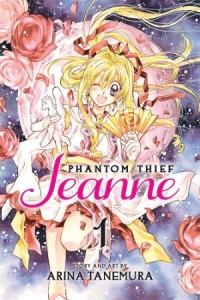
Having almost run out of Tanemura titles to release, Viz has gone back to the early days with this one and license rescued it from the clutches of CMX. And I’m very pleased that they did, because if you were to ask me to take only one Tanemura title with me to a desert island, this would be the one. Her first really big hit, Phantom Thief Jeanne is a magical girl manga that is not afraid to examine the core of darkness that lies at its heart – and yet still be a fun magical girl title for kids. Madoka Magica this is not.

jeanne1

The phantom thief subgenre of magical girls should be familiar to everyone by now – not only through Jeanne, but also via Saint Tail, which uses very similar stylings, and CLAMP School Detectives/Man of Many Faces, where Akira is the male version of this. Naturally, given the thief is a young girl, they are stealing FOR GOOD. Indeed, Maron Kusakabe, our heroine, is a descendant of Joan of Arc (hence the title), and the plot is set up as quite religious – she is using God’s Power to extract the evil from paintings, evil that is being used by Satan to gain human hearts. (This is definitely the French Joan of Arc – Shakespeare would stare in sheer horror at the myth of Joan Puzel today.)

It’s not just the religious themes that give this manga extra depth. Maron has more going on in her background than the usual chirpy magical girl. She’s living alone, her parents having split up and separately decided to leave for another country (suspicious), her magical familiar Finn dashes off her origin story in less than a page (suspicious… though it could just be I live in a post-Kyubey world), and while she does quickly fall for the boy destined to be her love interest (who is also a rival thief with a rival familiar), she absolutely does not want to deal with these feelings, her parents having convinced her that falling in love in a horrible thing to happen to someone. There’s a depth and solidity to Maron’s life that I really enjoyed here.

Of course, it’s not all sadness and broken homes. This is still a Ribon title. There’s lots of fun and silliness, mostly in the form of Maron’s best friend Miyako, whose father is a police officer and who is dedicated to capturing the thief who keeps stealing paintings (as always, the world itself is unaware of the supernatural part of things). There’s lots of love triangle shenanigans as well, with the shy kid in love with Maron leveling up due to demon possession, but amazingly staying leveled up afterwards and trying to become strong enough to court Maron properly. (He clearly doesn’t know what genre he’s in.)

Essentially, this takes the basic beats of the Phantom Thief genre and simply writes them really well. It’s paced well, the characterization is doled out at the right moments, and I can even get used to Tanemura’s trademark GIANT EYES. Anyone wanting to read this will find a cornucopia of details to enjoy, and it has excellent rereadability. Definitely worth buying, even if you already own the CMX version.

And, most importantly, the lead guy is a blond and the runner-up is a brunet! Do you know how little that happens in shoujo? More blond leads!