Category Archives: reviews

Dorohedoro, Vol. 11

By Q Hayashida. Released in Japan by Shogakukan, serialization ongoing in the magazine Ikki. Released in North America by Viz.

I’ll be honest, it can be pretty easy when you’re reading Dorohedoro to simply forget about the plot and characters and just let yourself be led along. Not that the plot and characters aren’t terrific – they are, even if 3 volumes a year means that ti can be hard to recall who is what much of the time. No, it’s just that Dorohedoro is possibly the most sensory manga being released over here now that Children of the Sea (also an Ikki title, you’ll note) has finished. Chapter 63 in particular would be hilarious or terrifying if it weren’t just so fascinating, watching these partial corpses go about their day inside the fractal dreams of Caiman and Nikaido – well, perhaps Caiman. We’re *really* not sure about him anymore.
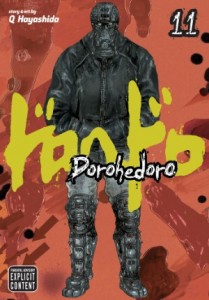
dorohedoro11

See, that’s Caiman on the cover – only it isn’t. He has a regular head, and is calling himself Aikawa. In fact, the similarities to Ai from flashbacks are unmistakable. And he seems to have some memories from before – he certainly wants to avoid Nikaido, and after she forcibly makes him show his face, promptly runs off again. As for whether he’s a good guy or a bad guy, let’s remember that this is Dorohedoro. There are no good guys here. I assume he will continue to be a major plot point.

As for other heroes, they’re not having the best volume either. Nikaido is back in En’s clutches, but seems determined to not help even if it means her death – her memory of her childhood past is still holding her back. It looks as if En is going to force the issue… but then comes the end of the volume. Remember last time when I said it showed off how overpowered En was? Well, he’s just run into Curse, and may be firmly dead now. Yikes. Fujita fares slightly better, managing to restore Ebisu to something resembling life… sadly, she has a lucky hairpin stuck in her brain, and so her mind is somewhat broken. Of course, that’s not really a big change from before.

In a series where no one is quite what they seem, and identities change from day to day (oh look, there’s Risu – whoops), that may be why I keep getting drawn back to the art. It seems more sinister and horror-movie than usual this time around, and even the gratuitous fanservice comes in the middle of a big action sequence. The artist recently revealed that she’s trying to end the series with Volume 20 (one volume more than planned by her publisher), so we’ve just passed the halfway mark. As such, if everything is accelerating downward, it should be no surprise.

There’s not even a lot of humor here, beyond the dark as pitch kind. As I said, the images of all the head and torsoless bodies wandering around the city, doing their daily business is sort of creepy-amusing in a Shintaro Kago sort of way. And there’s the thought process of Judas’ Ear, one of the few characters, along with Natsuki of the Cross-Eyed gang, who can still be described as innocent. (You could throw Fujita in there as well, but I find it hard to do so in a volume he spends trying to resurrect his dead crush.)

In short, reading Dorohedoro remains a head trip, and you have little choice but to let it drag you along. Even if it’s headed to hell, as is becoming increasingly apparent.

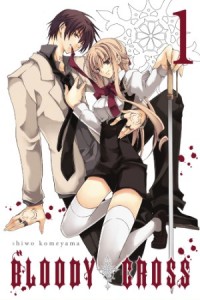
Bloody Cross, Vol. 1

By Shiwo Komeyama. Released in Japan by Square Enix, serialization ongoing in the magazine Shonen Gangan. Released in North America by Yen Press.

I was interested in what this title would be like the moment I saw it licensed. Shonen Gangan has a fairly high success rate for me – I am a big fan of Soul Eater, and of course Fullmetal Alchemist is one of the finest manga out there. And yes, it also had two things that made it almost inevitable that North America would license it: vampires, and religious imagery recoded in a fantasy world. (It does amuse me that a story where heaven is engaged in a bloody war of succession is absolutely fine, but Jesus and Buddha living in an apartment as best buds is something we are unlikely to ever see. Oh, North America, when will you learn…?) So after reading the first volume, I’m a bit disappointed that I wasn’t quite blown away.

bloodycross

Not to say that this is bad, and indeed it shows great promise. It’s worth noting that unlike most shonen manga you see these days, this one is totally fine with every protagonist, antagonist, and mook/minion being a self-serving, backstabbing, distrusting person. Our hero and heroine meet trying to kill each other, occasionally make a show of continuing to do this as the volume goes on, and while there is attraction between them it seems to be based on lust and desire more than the purer emotions. Which makes sense given that Tsukimiya is half-vampire, and she promptly infects Hinata with her cursed blood. That said, the angels we see in this book are, if anything, worse. I’d say it has an Angel Sanctuary vibe, except that had actual innocents in it. There’s nothing like that here.

There’s also quite a lot of action in this volume, which helps to pass the time between trying to build up the plot. Our protagonists start out looking for demon blood, then have to find a sacred book, then we move on to a sacred key, and finally can use the key and the book to try to break the blood curse. If it sounds a bit like a video game, well, the author’s only other major work was a Star Ocean spinoff manga, so she has that sort of feel to her writing already. The action flows pretty well, with a bit more gore than I’m used to from fantasy titles, but then this isn’t meant to be a fun or pleasant world. Everyone suffers fatal wounds here, except being combinations of angel, demon and vampire, these woulds are rarely genuinely deadly.

I suppose the main problem with Bloody Cross is that after only one volume, I don’t quite have a handle on it. I suspect this may become a series like Bleach, where it reads much better if you take in 5-6 volumes a year in one gulp rather than reading one every 3 months. It may also probably benefit from rereading. As it is, this is a Chapter One. It’s intriguing enough that I want to find out more, but it hasn’t quite grabbed me yet – possibly as there’s no one I’m quite willing to root for yet. Even Tsukimiya, who we’re clearly *meant* to be rooting for, seems like she hasn’t earned our favor yet. We shall see what happens next.

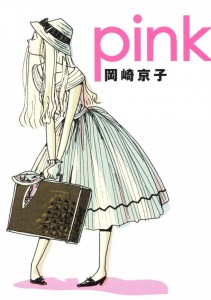
Pink

By Kyoko Okazaki. Released in Japan by Magazine House. Released in North America by Vertical.

It took me a while to get through reading Pink, and even after reading it I was somewhat confused at my basic reaction to the title. I’d enjoyed Helter Skelter, another josei work by Okazaki, but it was a walk through some very dark places, and the characters were ultimate very difficult to sympathize with. Pink is from a much earlier period in Okazaki’s career, but also deals with women who do a lot of horrible things to each other, and men who are unable to stop themselves from being drawn to said women. As for why I’m confused, well, it’s the fact that I found this title to be quite light-hearted and fun.

pink

I’m not really sure how I came away with that impression. Our heroine, Yumi, is an office lady by day (whenever she feels like she wants to work) and a prostitute by night (as that’s where she makes most of her money). She has a poor relationship with her step-mother, but a strong one with her little sister, who is a young tween who’s far too intelligent for her own good. Yumi tracks down Haruo, who is a college student and aspiring writer who is currently sleeping with her step-mother, but soon he’s also sleeping with Yumi. Oh yes, and she also has a pet crocodile, who she feeds dead animals to (she mentions several times feeding humans to it, but there’s no real sense she’s ever done that). As for her johns, some are sweet, some are nasty, some leave her huge piles of cash, and some just rob her. It’s not especially pleasant, but it gets her what she wants; cash to buy things.

Yumi’s attitude may have a lot to do with the feel of it. She’s constantly living in the moment, and tends to let bad news just pass her by bar the odd temper tantrum. She mentions at one point the close relationship she had with her mother, and how she found her body after she hung herself. So it’s a sort of calculated attitude, one that keeps people at arm’s length while allowing her to still have the benefit of their positive emotions. Despite her self-centredness and petulant actions, you never really see her as unsympathetic per se. Certainly you side with her against the stepmother.

But I think in the end I feel Pink is fun because of the way it’s written – it feels like fun. Even the ending, which could be considered suitably tragic, will affect our heroine only a little bit in the long run, I expect. The writing, particularly the narrative, feels very much like a Bridget Jones sort of work – I particularly liked the description of Haruo’s college classmate/lover as “shockingly skilled at cooking, skiing, and fellatio”. It’s not just Yumi – the author is also doing her best to make this a light, breezy work despite the content. The dissonance that provides is what will make it a good book for a reread. But on this first read, I felt it was a hell of a lot of fun. Even if that thought confuses me a bit.