Category Archives: reviews

Showa 1926 – 1939: A History Of Japan

By Shigeru Mizuki. Released in Japan as “Comic Shouwashi” by Kodansha. Released in North America by Drawn & Quarterly.

The one thing that will strike you as you read this manga history of Japan by one of its preeminent creators is how it should not remotely work the way that it does. This book is over 500 pages, and a great deal of it is simply laying out the facts – they’re about 2/3 of the book, with the other third devoted to Mizuki’s own autobiography. It should be dry, didactic and boring. And yet it’s utterly compelling. Partly this is simply due to what’s going on – this is a dark and chilling time in Japanese history, and the facts really don’t need embellishment or excitement, as presented by themselves they can carry a book. But partly this is due to the fact that Mizuki isn’t just famous because he talked about a lot of yokai – he is a genius craftsman, writing a cyclical narrative where we constantly spiral back to see what’s happening in the most concise way possible.

showa

The narrative starts out as third-person omniscient, but Mizuki quickly comes to realize that an actual character voice is needed to help explain some of what’s going on. (He also does this via conversations between two people on the issues of the day, many of which point out how much of a narrative device this is. “Let me tell you about this.” “I know about it already, but tell me anyway.) As a result, Nezumi Otoko from Gegege No Kitaro insinuates himself into this narrative, so quietly that it takes a good 20 pages before he has to introduce himself. As D&Q point out in their endnotes, not only does this allow any children reading to get their narrative from a beloved character, but Nezumi Otoko is essentially untrustworthy, shifty, and always out for himself. Thus the narrative voice is skewed so that we aren’t meant to be quite as trusting of the facts as we would be if it were still Mizuki narrating. (He also gets in a few slaps, which pleased me.)

We also, as I noted, get the story of Shigeru Mizuki growing up during Showa, which provides relief from the historical facts. Some of this narrative will be familiar to those who’ve read Nonnonba, but this continues beyond that, and the yokai that appear here are few and fleeting. What struck me most about Mizuki’s story is how harshly critical he seems to be of his boyhood self. We’re presented with a young boy who goes off to do his own thing, doesn’t like school, gets involved in gangs, and by the end of the volume seems to be unfit for even the smallest and most menial jobs. His artistic talent is mentioned, but it’s described as sort of a side hobby that interferes with his ongoing life. This is not a likeable Mizuki, and it’s a striking choice.

Then again, it also fits with the bleak narrative as a whole. Growing up in the period covered here in this book meant knowing poverty, and hunger, and endless fatigue. It meant repression, and being imprisoned or executed for having the wrong views. It meant a military buildup that seemed to happen without the permission of any of the government, and reading about assassinations and murders seemingly every day. Mizuki needed to include the scenes with his family, as even if they are bleak, they still remind us that there are still good people at heart in the country, even as they get swept up in a tide of nationalistic fury. By the time the book ends, Tojo is making speeches, and Mizuki notes that he “is a man who never smiles, and because of that he takes away the smiles of the Japanese people.” This is almost a cliffhanger ending, leading into the events of the 2nd World War that will be covered in 1939-1944, due out this spring.

Make no mistake, this book can be very dry and factual. And yet there was no time when I ever felt the need to put it down and do something else. Reality makes for the best stories, even if they can be scary and oppressive. This book shows once again why Mizuki is one of the best creators in all of Japan. Highly recommended.

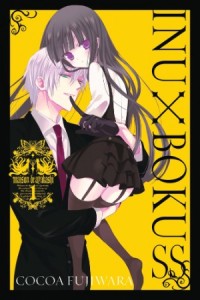
Inu x Boku SS, Vol. 1

By Cocoa Fujiwara. Released in Japan by Square Enix, serialization ongoing in the magazine Gangan Joker. Released in North America by Yen Press.

I hear there are spoilers for later volumes. Please don’t discuss them in comments.

A lot of times when there is a series that piles up a lot of cliches – be they plot, character, action sequences, or all three – you have to pick your tolerance level. I’m I’m going to be reading this, what’s the big draw that pulls me in and allows me to tolerate some otherwise generic stuff, even if it is well-written? In general, for me if a heroine is grumpy and sarcastic, I’m willing to forgive it a lot. And dropping such a heroine into a world of butler bodyguards is the basic premise of Inu x Boku SS, which also manages to be a yokai manga to boot.

inuboku

I have to say it – I kept thinking that the heroine was Rika from Higurashi. It doesn’t help that this began in Gangan Joker around the same time the final Higurashi arc was going. Rika was never quite as cutting and vicious as this, though. Ririchiyo simply can’t stop herself from saying what she thinks, and what she thinks is usually acidic and nasty. This has led her to have few friends. (Perhaps she should join a club… wait, wrong manga.) She moves to a high-rise complex, but finds that it comes with a loyal servant and bodyguard who will do anything for her. He’s nice and sweet to her, slowly coaxing her out of her shell of disinterest and loneliness, but he also has a dark secret which is hinted at towards the end of Volume 1.

See what I mean? The description of that bodyguard could fit any one of 2,000 shoujo manga. (This is shonen, but Square Enix has never quite been as caring about genre as the other companies, and I’d argue the pretty butler is as much a draw for female readers as Ririchiyo’s show of thigh is for the males.) We also get a goofy older brother guy, a perverse lesbian (well, faux-lesbian – because she’s perverse, nothing really ever happens. But one assumes…), and a quiet, shy girl. Also, one of the bodyguards is Walker from Durarara!! with bunny ears. (DRRR is also a Square Enix title… sometimes it’s really easy to notice the incestuous nature of the business as you read things.)

That said, this is quite competently drawn and written. You care about Ririchiyo, and want to both have her improve her social skills while not losing the biting retorts that make her interesting. The manga doesn’t take itself too seriously (at one point two of the male bodyguards flirt, and the yuri girl goes “eeew, disgusting”, a lovely hypocritical moment called out immediately), though there is also a hint that there is much darker stuff still to come. It’s just… there’s a lot of stuff here you’ve seen before in many other titles. If you enjoyed those types of works, Inu x Boku SS is definitely the manga for you. If not, I think it depends on how much you like Ririchiyo. I quite liked her, so will see what another volume brings.

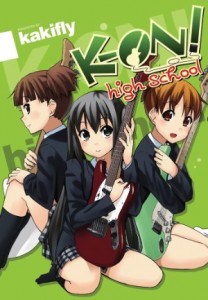
K-On! High School

By Kakifly. Released in Japan by Houbunsha, serialized in the magazine Manga Time Kirara Carat. Released in North America by Yen Press.

And so at last we come to the end of the K-On! gravy train, with the sequel that never really made sense. With the college series, at least we had several things going for it: it had the original characters we’d loved from the start, we could see their continued development and growth as a band, and they could finally stop telling school jokes. Well, that last one didn’t really happen, but still. But with the High School volume, we have one remaining main character, whose best moments came when she was interacting with Yui, who’s gone. She’s put together with a few of the supporting cast and two new girls. It’s not really that much of a surprise to see this is the less compelling of the two stories.

konhs

That said, Kakifly is making an effort, and this isn’t a total slog. Probably the best joke in the entire book comes right at the start, with Azusa deciding to ditch the pigtails to give herself a more mature, sempai-esque image. This doesn’t last long at all. Then Ui, who we all recall is identical to Yui despite not being a twin, takes her hair down and starts to glomp Azusa. The gag is then carried further when Ui announces she’s really Yui, who snuck back to high school just to snuggle some more. As Azusa herself notes, this makes perfect sense because Yui only thinks with her senses. Of course, it is still Ui in the end, having mastered the art of taking a joke to its logical conclusion. (I could do without the dumb bust-size capper, though.)

We get two new characters added to the threesome (sorry, did I forget to mention Jun? It’s because she makes that little impression on me), one of whom is there to emphasize similarities and one of whom is there to be different. The moment Sumire appeared we were going to compare her to Mugi just based on appearance alone, so it was a good choice to actually make her be Mugi’s maidservant. They’re both sweet and mellow, but Sumire tends towards the shy end of the spectrum, whereas Mugi… tends more towards the yuri end. As for Okuda, the quiet stoic girl is a type we hadn’t yet seen in the series, and it’s amusing to see her total lack of ability at singling or playing instruments, as well as seeing how she brings something to the club anyway.

Of course, this title was always going to be short-lived by virtue of 3/5 of its cast already being third-years. Azusa and company do their one big concert, it goes pretty well… but that’s it, it’s time for them to graduate. I’d hoped we’d get a better sense of whether Azusa would try to continue a band with Ui and Jun or just join back up with Afterschool Tea Time, But there’s not even that much closer, the series just sort of stops. There’s nothing actively boring or bad about this, and it was reasonably fun to read. But you forget most of it 90 minutes later, and the problem is that of all the K-On books, this one was the least necessary.