Category Archives: reviews

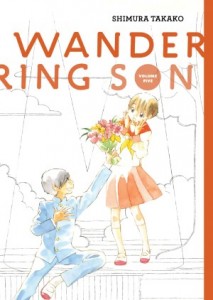
Wandering Son, Vol. 5

By Shimura Takako. Released in Japan by Enterbrain, serialization ongoing in the magazine Comic Beam. Released in North America by Fantagraphics.

Switching to a new environment can be crippling to a young person, particularly if they’re going through a lot of other things as well. So it is with the cast of Wandering Son and middle school. Nitori tries to continue to define himself while also discovering something he’s genuinely good at, Takatsuki discovers she’s no longer the only one in the room doing what she does, and Chiba finds that even if she’s gone from overly emotional to overly stoic, she still has difficulty dealing with anyone. So, in other words, it’s an excellent depiction of anyone’s life in middle school.
wanderingson5

We also meet some new cast members, who basically fly into Takatsuki’s circle of friends and explode like a bomb. Sarashina also sometimes wears male clothing, but it’s nothing to do with gender identity and more to do with her being an eccentric loudmouth who does whatever the hell she wants. Naturally, Takatsuki is drawn to her, as not caring about what people think is something everyone else in this book has trouble getting past. She also has a best friend, though, Shirai, who clearly is very close to her, and is very unhappy with this new girl making advances on her… um, friend. There are no yuri overtones here, really, but Shirai certainly exhibits all the classic signs of jealousy. She’s written a little flatly, so I hope we find out more about her later.

As for Chiba, you really want to reach out and give her a hug, but there’s no way she’d let you. She can’t get over her own feelings of hatred/jealousy towards Takatsuki, and attempting to suppress all emotion is not working out very well when everyone around you is giving you an excuse to go off like a rocket. So the answer, clearly, is to be antagonistic to *everyone* – even the girls in a higher grade than her, a definite no-no in Japanese society. I really hope Chiba can eventually move on past her repressed and upsetting anger, because right now she’s on a very dark road, and given she’s only 12 or so that’s depressing in itself.

Meanwhile, our hero and heroine are both facing the realities of puberty. Nitori and Ariga record their voices on tape, so they’ll be able to remember what they were like before they change. Nitori is a little upset at the idea that he won’t be able to dress as a girl anymore. Takatsuki is having an even worse time… her sports coach is demanding she wear a bra to practice, another reminder that her gender is trying to impose limits on her. The two of them finally make up, sort of, in a touching yet somewhat sad scene as they both worry about the future. Nitori, however, seems to get an idea for it, and begins to start writing a story based on his own experiences. I like the idea of Nitori’s insecurities and dreams fueling his creativity, and wonder if Takatsuki will be able to help in the process besides just having her life give him ideas.

All in all, this was an excellent transitional book in the series. As we settle into middle school, things are bound to get even more awkward, and I hope our cast finds the strength to make it through.

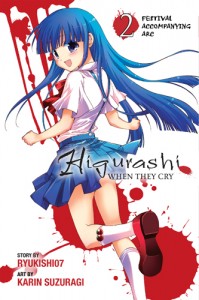
Higurashi: When They Cry, Vol. 23

Story by Ryukishi07; Art by Karin Suzuragi. Released in Japan as “Higurashi no Naku Koro ni: Matsuribayashi-hen” by Square Enix, serialized in the magazine Gangan Joker. Released in North America by Yen Press.

As I’ve been following the Higurashi manga, I’ve also been slowly going through the original visual novel, which MangaGamer has released here in North America (don’t look for their site – Higurashi is their token ‘not porn’ title). I just happen to be at the appropriate place in the novel as I am in the manga, so am able to compare them even more. It’s not clear how closely Ryukishi07 checked the content of the manga with the Higurashi artists – I know he’s very involved with the Umineko manga, particularly the final volumes, to correct certain issues with the novels – but certainly the manga glosses over a lot, being a sort of “greatest hits” compared to the deep immersion of the original. That said, where the manga does succeed is in the emotion. Be it heartwarming, sad tears, or dull horror, the manga delivers the goods here.

Ryukishi07_Higurashi_FestivalArc_V2_TP

Nothing better demonstrates the difference between the two than the fate of Rika’s mother. The visual novel has this scene from the perspective of Ooishi, who is at the Festival waiting to see if anyone is killed. He’s on hand for the death of Rika’s father, made to look like a heart attack, and tries to follow the group back to the Irie Clinic but is hamstrung by traffic. Thus, we only hear that the wife is later found missing, supposedly having drowned herself in the swamp with a suspicious letter left behind. The manga, on the other hand, follows Rika’s mother. Rika’s mom has always been fairly high-strung from what little we’ve seen of her. It’s not hard to figure out why… Rika must be an amazingly difficult child to bring up. And what with the clinic using her as a guinea pig, and her father basically going along with it, her nerves just stretch to the breaking point. As such, she is ill-equipped to deal with Takano.

Takano remains fascinating, and though I think the visual novel does a better job of showing that a lot of this is Hinamizawa Syndrome rather than “lulz, I’m evil like that”, there’s enough here to keep everyone happy. Notably, for the sake of her research, she grovels at the feet of Rika’s parents, and when that fails, seems genuinely at a loss until Okonogi suggests “taking care of” Rika’s parents. Murder comes as a surprise to her… but once it’s in her head, she doesn’t hold back, as Rika’s parents instantly make the transition from “people” to “research subjects”. As such, she can easily justify using Rika’s mother as a live test subject. The murder is terrifying, and does not remotely hold back, with blood flying everywhere and Takano’s insane rictus grin it’s straight out of an Italian horror film.

Later on, Takano faces an even bigger setback when her mentor dies, and it’s shown that he was basically the only thing keeping her project going. Higurashi has a very realistic and cynical take on the Japanese political system and how power-grabbing it can be, particularly in the early 80s when this takes place. Takano once again has everything almost crumble around her, and it becomes apparently that even though she’s the source of all of Rika’s misery, she herself is being manipulated throughout this story, not just by Okonogi, but also a new faction who wants to use her in order to facilitate their own rise to power. If it works, great. If she dies, meh. And it’s clear the Mountain Hounds work for them, not Rika *or* Takano. Honestly, those two really have so much in common. They should talk over a nice cup of tea when this is over.

The visual novel goes into great detail on the pasts of most of the characters, and the manga manages to include some of it – Okonogi’s mourning for his father, and meeting his mentor after WWII shows why things starting with that guy’s death have led to his own obsession, even if it’s misdirected at the Sonozakis. Speaking of the Sonozakis, we see Mion’s grief and anger over Satoshi’s disappearance (Shion is carefully absent here), and her grandmother doing her best to bring “new blood” into the town while still trying to look old and crotchety. That new blood is the Maebara family, with Keiichi trying to start over after the BB gun incident. Rika and Hanyuu are at their most blatant here, with Rika actively showing she knows who they are and relying on people not realizing she’s living the same life over and over again so they laugh it off.

We also see Hanyu’s past, several hundred years ago. She really is a supernatural being, and her earnest attempts to stop the violence between the two tribes occupying Onigafuchi is heartwarming. I do think the drama needed more time to develop – as it is, it’s not as effecting simply as it goes by so fast – Hanyu gets her own daughter to kill her with a giant sword, which should have been given more weight. But then, Hanyu in general is the most problematic character of Higurashi’s so this is likely appropriate.

There are a few other things I felt didn’t work. Given how much Rika is using her past knowledge to make events work for her, her memories “catching up” with her at the end isn’t explained well enough, and seems to be awkwardly shoehorned in so there can be a cliffhanger. Also, four years pass between the start and end of this volume, yet the kids – all growing like weeds, one would think – look exactly the same in 1980 as they do in 1983. (The visual novel has a similar issue – the sprites never change.) More realism, please.

So now, all the pieces are in place – even Akasaka is having memories of a past life where his wife died and Rika was slaughtered, and is prepared to make his way to Hinamizawa immediately. Will all this be enough to defeat Takano and the forces that are manipulating her? And will Shion ever show up in this again? We’ll find out in January. In the meantime, this is still a very good adaptation with a lot of tragic and emotional scenes.

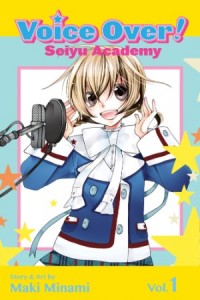
Voice Over! Seiyu Academy, Vol. 1

By Maki Minami. Released in Japan as “Seiyu Ka!” by Hakusensha, serialized in the magazine Hana to Yume. Released in North America by Viz.

Long-time readers of this blog will know that I am a huge fan of the Japanese shoujo magazine Hana to Yume. Sadly, I have been increasingly unable to rave about its style of shoujo recently, as CMX and Tokyopop went under, and Viz has licensed less and less from the title, preferring to concentrate on their own owners’ magazines. This makes me very happy when I see a new series starting up, specially one from an artist I’ve liked before, Maki Minami. Her prior series here was Special A, a romantic comedy with an emphasis on the comedy, which had all of Hakusensha’s usual strong point, as well as all its weak points. The text and art tends to clutter the page (Hakusensha shoujo packs the page, Shueisha shoujo opens it up), the plotting could be insanely frustrating, particularly in terms of how drawn out the romance was, and character’s growth ended as soon as their function in the story was complete. Now we have her new series, which has many of the same types of people we’ve seen before. Can it fix its predecessor’s issues?

voiceover1

Our heroine has the name Hime Kino, which already sounds like a pseudonym. She wants to follow in the footsteps of her inspiration and become a voice actress. There’s just one problem – she has a deep, husky voice, and she wants to sound like a cute girl. Nevertheless, the academy lets her in anyway, and it’s hinted there’s some deeper, behind the scenes reason. The solution, of course, is obvious – she should play sexy pretty bishonen, which female voice artists do in Japan ALL THE TIME. It’s such an obvious solution that we see it happening at the end of the first chapter, where she has to fill in as the prince in a Snow White dramatization. But Hime clearly wants to be cute, and girly, ad adorable. I imagine a large part of this plotline will be showing her how she should really succeed at what she’s best at.

Cute vs. cool is a classic modern shoujo trope. Usually, heroines want to be the former but end up being the latter, and Hime easily fits into that pattern. And naturally, she’s never more attractive than when she’s acting strong and powerful and masculine. This is a reverse harem manga, so we already have the obvious winner (a sullen brunet – sigh – named Senri Kuno), as well as a few obvious runner-ups. We have the traditional one female friend. I’m hoping for a second as time goes on. And, this being Maki Minami, we have a lot of incredibly goofy guys doing dumb things – there is some fun humor here.

There are some issues, of course. I am rather weary of bullying by teachers in Japan being a) accepted by the institution as good for students in the long run, and b) not called out because the student has to get stronger on her own. It *sounds* admirable, but I think teaches an incomplete lesson. Hime is also a bit aggressively clueless, though so far she’s not quite as bad as Hikari from Special A, who set new records for denseness. Lastly, as with a lot of mainstream shoujo, there’s nothing really original here – just a few old cliches given a new paint job. But I’m perfectly happy with that as long as it’s fun. And for the most part, Voice Over! is fun. I’ll be looking forward to Vol. 2.