Category Archives: reviews

Sherlock Bones, Vol. 1

By Yuma Ando and Yuki Sato. Released in Japan as “Tanteiken Sherdock” by Kodansha, serialized in the magazine Weekly Shonen Magazine. Released in North America by Kodansha Comics.

It’s a rather odd time here in North America, where we have had a series of Sherlock Holmes adaptations of various stripes over the last couple of years. JManga had a Holmes volume up that was sort of supernatural horror with bishonen Holmes. Young Miss Holmes pays close attention to the canon even as it welds in a precocious niece. And now we have Sherlock Bones, where Sherlock is reincarnated as a dog in modern-day Japan, and fights crime with the help of a young boy who gets to be his Doctor Watson. As you can imagine, this one is geared more towards younger readers, but certainly it’s not juvenile. We’re dealing with murders here.
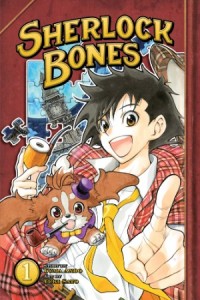
sherlockbones1

The author is used to this type of detective mystery, of course, being the creator of Kindaichi Case Files under another pseudonym. The story is the important thing here, and Sherlock’s presence is merely a vehicle for it (as well as for a few weak “Sherlock is a dog now” jokes). Unlike Young Miss Holmes, so far the creators seems to have very little use for the Watson canon, only using the broadest strokes such as Sherlock’s pipe. As for Watson, or rather Takeru Wajima, he’s a typical shonen protagonist, bieng fairly normal but with a stubborn stick-to-it-ivness that will serve him well in dealing with Sherlock’s whims.

The book starts us off with a fairly easy attempted murder where the clues are all laid out in the open, before moving on to the main story involving a crime where the murderer is fairly obvious, but we have to figure out motive, means, etc. Indeed, motive proves to be the key here, as we learn that the culprit isn’t just evil like that but has a deeply tragic reason for committing the crime. It helps that the victim isn’t that nice a kid – but he’s still a KID, so there’s not that much sympathy.

This runs in Shonen Magazine, so the mysteries aren’t meant to be all that hard to solve, and you can usually come up with the solution at the same time as Sherlock does. Of course, since it does run in Shonen Magazine, there’s also a bit of fanservice focus on boobs ‘n butts, though certainly less than you’d see in Fairy Tail or Negima. In the end, this is a mystery anthology series along the lines of Case Closed or Kindaichi, with “Sherlock Holmes is a dog” as the gimmick. We do see a girl who’s meant to be a love interest of some sort, though given the nature of the series she could easily be killed off in Volume 2 for all I know. But for the most part I expect this to be episodic, which makes it a good series to dip in and out of without worrying too much about missing anything. It’s cute and fun, if not all that gripping.

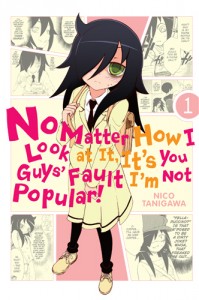
No Matter How I Look At It, It’s You Guys’ Fault I’m Not Popular!, Vol. 1

By Nico Tanigawa. Released in Japan as “Watashi ga Motenai no wa dō Kangaetemo Omaera ga Warui!” by Square Enix, serialized on the website Gangan Comics Online. Released in North America by Yen Press.

Despite a title longer than your arm, this new manga series is not, in fact, based on a light novel. It’s usually shortened to “WataMote” in fan discussions – indeed, I’ve used that tag for my Category on this review, rather than screw up the sidebar. Still, with a title like that, if you’re someone who’s been a fan of anime over the past few years, it comes with certain expectations even before you read it. High school slice-of-life, comedic misunderstandings, discussion of otaku interests. And indeed, all that is true. But it’s the heroine who drives this title, and Tomoko Kuroki is not going to simply lie back and be cute and moe.

watamote1

Tomoko gives new meaning to the term “socially awkward”. In her head, she’s got it all down – she’s starting high school, will make new friends, get a boyfriend, and her life will be wonderful. In reality, not only is she a cripplingly shy girl who can barely manage the most basic interaction, but she’s not even cute and adorable like most manga heroines with those issues. Tomoko can be hard to like. She emotionally manipulates her brother, is crass and opportunistic, and has an inability to see even basic human interaction and understand what it means.

Notably, she’s not bullied or picked on at all by any of her peers – they mostly just ignore her, but it’s not in a ‘she’s creepy’ way, she simply rarely registers on their radar. When occasional peers do speak to her, it tends to be friendly, and mostly the only time they rear back in awkward horror is when she says or does something incredibly inappropriate. Honestly, that’s a little unrealistic, but the mangaka doesn’t really want to go in a bullying direction here – Tomoko makes her own problems. We can’t even blame a poor family life – her mother and brother seem to be perfectly fine with social interaction, though her brother regards her as incredibly annoying and exhausting. And, well, he’s correct.

An anime adaptation of this aired over the summer, and many people kept asking themselves whether the intention of the work was to laugh at Tomoko’s foibles, feel pity for her attempts to bond with life and other people, or just feel incredibly uncomfortable at watching her existence? The answer, of course, is all three. We don’t want to be seen to laugh at someone like Tomoko, but honestly, some of the behavior here is pretty hilarious, and her snark is also pointed and amusing. That said, there aren’t real punchlines here, just a setup that goes off the rails. Instead of a punchline, we see Tomoko sitting on a park swing, looking miserable, as her brother silently stares at her. Or in a bathroom, ripping a pair of panties to shreds in a terror-stricken bout of mortification.

This manga seems to push against its own audience, which is otaku-oriented males. At one point, Tomoko talks to her one friend (who I hope we see more of), and is asked about the new anime season. Tomoko blithely responds that it’s all moeblob shows this year. This may be slice-of-life, but it’s no K-On! I do want to read more, but I am very grateful that it’s only coming out here every three months, as Tomoko is as exhausting and frustrating to read as she must be to live with. Definitely recommended, but be aware that this title pulls in several different directions at once, and deliberately doesn’t resolve any of them.

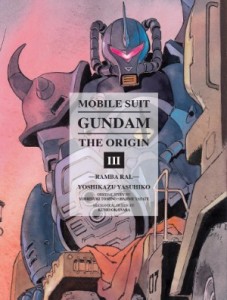
Mobile Suit Gundam: The Origin, Vol. 3

By Yoshikazu Yasuhiko; Original Story by Yoshiyuki Tomino and Hajime Yatate; Mechanical Design by Kunio Okawara. Released in Japan by Kadokawa Shoten, serialized in the magazine Gundam Ace. Released in North America by Vertical, Inc.

In the first 2 volumes of this Gundam manga it’s been fairly easy to root for our heroes. They’re fighting against an empire with fascist tendencies, and the two main antagonists we’ve gotten so far are a smug schemer and a daddy’s boy who looks to be in over his head and is dispatched fairly easily at the end of the last volume. Char will no doubt continue to be a headache, but Garma is no more. Of course, this means we need a new minor villain, and it’s not going to be Char, as he’s too busy smirking. And so we get to the title character of this book, Ramba Ral.

gundam3

Make no mistake about it, Ramba Ral is exactly what this book needed at this point. Even if Char is a very popular character with fans, the fact is that the heroes and villains have been more black and white than they needed to be. This is particularly evident at Garma’s state funeral, which Gihren quickly starts using as a political rally to mobilize the troops. This, combined with the funeral choreography and the uniformed fascism, makes the Principality of Zeon look like Nazi and the Naztones to a degree. Ramba Ral is different, and reminds you that this isn’t “fighting aliens” – all of these people are ultimately human beings with human flaws and human virtues. He’s a captain who loves him men, loves to fight, and is very good at it. His wife is second in command and clearly much of the brains behind the operation. It’s a shame that the plot decrees his fate at the end of this book, as I’d much rather he have been the main antagonist.

And counterbalancing Ramba Ral being a villain who is easy to respect and admire, our heroes are having a very rough time of it. Amuro has always been a petulant teenager, but here his temper tantrums get dealt with in detail, and he runs away. Bright, meanwhile, is doing his best to try and think like a commander, but making decisions that are the right thing to do is proving to be unpopular… not only with his men, but with Mirai. As for Sayla, she’s finding that being a double agent is a lot harder than it looks, particularly when you’re not working for the villains. All three of these characters make somewhat dumb decisions, pay for them, and later learn to read people’s hearts to see what the better option is.

There’s still lots of what makes everyone love Gundam in the first place. The battles are taking up more and more space in the book, but are still very exciting. And the political back and forth and constant attempts to get the upper hand is even better. Char excels at this, of course, even when captured for insubordination. He’s just a man who wants his sunglasses. That’s all. Add in an afterward by Shimoku Kio, who draws the female cast, and has the Genshiken meet Amuro, and you have absolutely no reason not to pick this up. An excelletn volume.