Category Archives: reviews

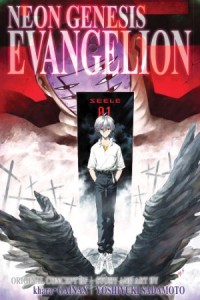
Neon Genesis Evangelion Omnibus, Vols. 10-12

By Yoshiyuki Sadamoto and GAINAX. Released in Japan by Kadokawa Shoten, serialized in the magazines Shonen Ace and Young Ace. Released in North America by Viz Media.

This fourth omnibus from Viz will be the last for a while, as Japan hasn’t even announced when the final volume is coming out yet. I assume it will be released simultaneously here and Japan, as Vol. 13 was, and that there will be a gap between that any any 5th omnibus. That said, there’s more than enough here to keep Evangelion fans busy. So much happens in this omnibus that it’s a bit difficult to know where to begin. One thing is for certain, though, and that’s the ongoing massacre of everyone Shinji loves and holds dear is still going to happen. Business as usual, folks.
evangelion4

Kaworu was introduced far earlier in each successive adaptation of Evangelion, probably as fans took him so quickly to their hearts. That doesn’t mean that he gets to be all warm and fuzzy, though he’s trying. I think it’s clear he wants to comfort Shinji and make him feel better, but he has no idea how people deal with grief – or indeed, emotions in general. He tries to make up for that by physical closeness, but Shinji, who’s already somewhat sexually confused due to simply being a teenager, lashes out at him. The manga makes things bigger – both Shinji’s rejection of Kaworu’s advances of friendship (or something more), and of his admitting how close Kaworu really got to him. In the end, Kaworu wanting Shinji to kill him manages to be rather heartwarming and sweet, in an Evangelion way.

And, in the opposite direction from heartwarming and sweet, we have Ritsuko, who has realized all along that Gendo is using her like he uses everyone else, but has been too wrapped up in her desire for him to really try to do anything about it. Gendo throwing her to the wolves of SEELE seems like it was a wake-up call, and she proceeds to give him the biggest ‘fuck you’ that she possibly can, with Misato and Shinji as witnesses. The idea of Rei being a clone is something that we’ve basically accepted, particularly given we see her get killed early on in this volume and then show up with the same body but without the emotional attachment to Shinji she had grown over the series. Despite that, the scene showing all the Rei bodies in the vat, waiting to be the next one, has not lost any of its power. It’s almost a relief that a suicidal and self-loathing Ritsuko destroys them all.

I talked last time about how Asuka gets much less to do in the manga, and that’s still true in this volume – until the end. Sticking her in her Eva may have been a safety precaution, but it was also the best possible thing for her psyche, as she manages to come to terms with what her mother was to her – and then goes to town on SEELE’s invading Evas, in the most glorious battle sequence we have seen to date in the series. Seeing Asuka, who has spent her entire life overcompensating for feeling useless and unwanted, take out these fakes with strength and purity of heart, is a beautiful thing, even if she can’t quite save the entire day. Mostly as it’s questionable as to whether there will be a tomorrow to be saved.

Because the JSSDF is invading NERV, and the orders are to kill everyone – even people who surrender, even people begging for their life. This we see, and it’s absolutely terrifying. It comes to the point where only Shinji in his Eva can save the day, but he is absolutely emotionally dead after everything that has happened to him (and remember, the timeline for the manga seems to be far faster than the anime one). Luckily, he has Misato,who gets her finest hour in the final part of this volume at the same time that Asuka is getting hers. Misato has always sort of straddled that line with Shinji between feelings of a mother, of a sister, and of a woman. It fits well with the rest of the series, where Shinji can’t tell if he loathes or is attracted to Kaworu, Ritsuko’s desire merges with her anger, and Gendo imprints her dead wife onto a clone that is both her and not her at the same time – something that she gets but he may not. All of these things are what makes up humanity – and that’s what Misato has to convince Shinji to save.

Has she done that? Well, you can get Vol. 13 right now and see for yourself, but whether we manage to get an ending that isn’t covered in orange goo is another matter. The manga has ended in Japan, so it’s a matter of Kadokawa scheduling the final volume. either way, it’s been an amazing ride. The manga world of Evangelion is still my favorite.

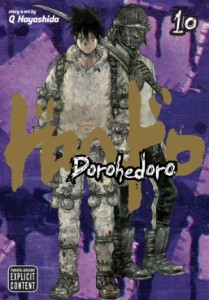
Dorohedoro, Vol. 10

By Q Hayashida. Released in Japan by Shogakukan, serialization ongoing in the magazine Ikki. Released in North America by Viz.

It’s worth noting, in case people have somehow forgotten it amongst all the gyoza and goofiness, that this series is incredibly terrifying at times. Everyone’s pasts are brutal and horrific, and it’s made almost all of them into morally ambiguous killers. The corpses that litter Dorohedoro are almost uncountable. And one of our good guys has a flashback in this volume showing that he collected these corpses and experimented on them. Meanwhile, Ebisu is learning the hard way that you can’t go home again.

dorohedoro10

Actually, the Ebisu plotline was probably my favorite part of this volume, if only for the 80 shades of wrong it contained. For one, the entire plotline with her parents is just nightmarish. Their daughter disappears, they are distraught, broken… so they pay a sorcerer to bring her back. And he… is a man with a paint tube mask, something that sounds much funnier than it is given that’s also how he recreates Ebisu. Only it isn’t Ebisu, to the point where her own parents fled their home. And now Ebisu returns to find herself under attack by her own doppelganger. Of all the disturbing art and violence that we get in this volume (yes, even the final scene), Ebisu having her head slashed open is the one that will stick with me. Just… urgh.

Meanwhile, we continue to get flashbacks to the guy that I think is Caiman’s past. His name is Ai, and he’s a sullen teen, all right. He also goes and gets himself killed fairly fast, or so we think. As it turns out, when Shin and Noi dig up the grave, there is a distinct lack of Ai there. It has to be said that Dorohedoro is a very dense manga, and its hints, when they arrive, are not necessarily very revealing. Caiman’s past in particular is difficult as we’re given the fakeout of his being connected to Risu, which turned out to be not quite true (but also yes, it is totally true).

And finally, En wakes up again, and boy is he pissed off. It’s worth noting just how overpowered En is in comparison to everyone else in this manga. He arrives and just completely owns everyone, even Caiman, who is immune to magic… which really doesn’t help when mushrooms are erupting from all of your internal organs. Now En has Nikaido again, and Caiman appears to be dead. He’s appeared to be dead before, but this time he has his own head (maybe) back, and the lizard head is a thing of the past. Maybe.

Leaving aside the batter-fried shrimp sorcerer at the end of the book, this was a fun, if a bit confusing, volume of Dorohedoro. Yes, explanations are thin on the ground, but the story never suffers from the lack of them. I suspect that the story is going to switch back to the cross-eyed gang for a bit given that cliffhanger (and we also get a really sweet/disturbing scene of the cross-eyes reminiscing about their completely insane leader, who I think is also Ai? Caiman? Whatever…). Wherever the story goes, though, I’m right there with it.

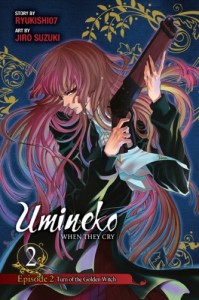
Umineko: When They Cry, Vol. 4

Story by Ryukishi07; Art by Jiro Suzuki. Released in Japan in two and 1/2 separate volumes as “Umineko no Naku Koro ni: Turn of the Golden Witch” by Square Enix, serialized in the magazine GFantasy. Released in North America by Yen Press.

The Turn of the Golden Witch concludes, and takes a turn for the grotesque and humiliating. The cover chosen (at the last minute, if advance solicits are to judge) by Yen for the omnibus features Rosa, the last remaining Ushiromiya sibling, glaring suspiciously at the reader with her Winchester at the ready. Open the cover flap, however, and you’ll get a far more appropriate image: Beatrice leering in triumph at a naked Battler, bound in chains and with his naughty bits covered by golden butterflies. Until the very last minute, what happens here is nothing less than Battler’s complete defeat by the magic of the Witch and the power of fantasy.

Umineko4

The choice of Rosa as the adult viewpoint character, which was uncomfortable enough in the first omnibus, gets even more tortuous here. At least with Natsuhi in Vol. 1 we had someone we could root for and sympathize with, even if her haughty pride was all too visible at times. Rosa may be trying to protect Maria and the children, but it’s not nearly as noble. (Indeed, one has to be suspicious of why she alone survived, given all seven siblings and spouses were seen in the chapel the night before the “Happy Halloween For Maria”.) Her use of the ‘wolves and sheep’ puzzle is more or less an excuse to scapegoat the servants. It’s actually oddly surreal at the very end when she finally starts attacking the fantasy “goat butlers” who arrive to destroy everything in order to save her daughter – the scenes of her and Maria reaffirming their love for each other as everything goes to hell seems even more unrealistic than the flying stakes and light swords bandied about earlier.

As for the ‘meta world’ battler and Beatrice, Battler sometimes seems to gain an advantage – the Red Truth is rolled out in this volume (which Yen, like the Japanese tankobons before it, uses a different font on – colored inks cost money), and he’s very quick to figure out how to make it work for him. But the trouble is that his ‘proof’ is simply denial. There are no witches because I say so. Whereas the answer he’s avoiding is “There are no witches because someone I know and care about is guilty instead.” If you choose to treat Umineko as a mystery and not a fantasy, you have to assume that someone is killing everyone, and try to figure out why they’re doing it. Battler, who won’t even bother to find Who, certainly is nowhere near Why. This is why Beatrice subjects him to the ‘naked furniture footstool’ punishment, and parades him past an array of butlers (and a disgusted Bernkastel). It’s his low ebb.

This brings us to this arc’s Tea Party, which this time involves Rosa waking up and not realizing what’s going on. It has to be said, this is easily the most grotesque scene in the series to date – yes, it’s even worse than the Happy Halloween candy corpses – and reminded me a bit of the horror splatter films of Mario Bava. It’s easy to see why Rosa may say she hates her siblings and her daughter – she was physically, mentally, and emotionally abused as a child, and Maria is quite the handful. But much as she’s an abusive mother, and a spiteful sibling, deep down she really does love her family. This is why Beatrice’s waving their fates in her face is so grotesque – and why Battler is able to find the gumption to stop it. (Though I could do without his asking Maria to say ‘eat me’ to him in 10 years time – why does he always fall back on being a pervert?) Indeed, you’d almost think she did this on purpose just so that they could play another game…

Like Battler, the reader, to a certain extent, is rooting for the fantasy. The scenes with Kanon and Shannon battling the stakes (even if the stakes are, sigh, moe teenage girls) are really cool, and the entire sequence plays out in various ways as dramatic, tragic, and heartwarming. Reaffirming love and choosing to go out with a smile… there are some of our very best story cliches come to life here. That said, if the reader wants to continue to say ‘there is a realistic explanation for what happened’, this arc drops the most obvious way of figuring out what that is: don’t believe everything you see or read. Clearly, if this is realistic, some of what we saw here has to be imaginary. It didn’t really happen. So, what did happen? Did Rosa murder her siblings? I doubt she could kill all six of them without a fight. Perhaps the servants, who are highly suspicious throughout this? Aw, but they’re so nice! I don’t want Shannon or Kumasawa to be a killer!

This feeling of pleasure, intrigue and discomfort is what drives the Umineko series, and it drives Battler (and us) to play another game, so we can get closer to the truth. Even if that truth involves a witch. (Also, I want to read further to find out where the hell the Battler/Beatrice fans all came from… is it all hateship? Certainly Beatrice is at her most loathsome here…) Yen are taking a break until January, but then we’ll have two more omnibuses, and focus on a new family member – get ready to get inside Eva Ushiromiya’s head.

Oh yes, about the hidden tea party: 1) Lambdadelta seems to have the body of little Miyoko Tanashi (aka Miyo Takano) and her personality of Satoko Houjou. What a horrible combination. 2) Bernkastel basically doing Rika’s “mew” line further makes the listener raise an eyebrow at Ryukishi07 when he insists she’s not Rika. Certainly SOMETHING in her is Rika…