Category Archives: reviews

D.Gray-Man, Vols. 1-3

By Katsura Hoshino. Released in Japan by Shueisha, serialized originally in Weekly Shonen Jump, currently ongoing in Jump Square. Released in North America by Viz Media.

I’ve often felt that the most popular Jump series in the West, the ones with the most fanatical followings, are ones where no one noticed them until 10 volumes in, when they hit a groove. Suddenly, word of mouth is telling everyone “Oh man, you have to read this awesome series! Don’t worry, it gets better!” With that relief in mind, the reader powers through however many volumes are at the start, secure in their knowledge that they will reach the really good bit. Kenshin has its Kyoto arc, One Piece has Arlong Park, Bleach has Soul Society. This even applies to unlicensed titles, such as Medaka Box and the Student Council Battle arc (notably, most fans were frustrated as this is exactly where the anime stopped).
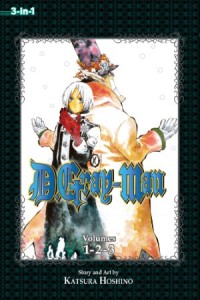
dgrayman

I bring this up because D.Gray-Man seems to be falling into the same groove as most other popular Jump series, in that it’s a slow starter. There’s nothing bad or boring about this omnibus; I found it quite entertaining. But there’s nothing in it, aside from maybe the pretty young men, that makes you go “Oh, that’s why it has a big fanbase here.” Indeed, it’s not even the most popular exorcist series in Jump Square, its current home – Blue Exorcist has that won hands down. The series starts the way most do in Jump (where it ran for years before the author’s health caused it to move to the monthly title) – with a series of one-shot battles followed by a couple of brief, volume-long arcs that introduce us slowly to each member of the main cast, particularly our hero, Allen Walker.

I’ll be honest here – it’s hard for me to read this series and not see Hayate Ayasaki in the lead. Shonen Sunday’s Combat Butler shares many traits with D.Gray-Man’s Exorcist, be it a similar appearance, tremendously tragic backstory, heroic self-deprecation, a desire to save everyone, or just the ability to do one-fingered push-ups. Allen’s rather mild-mannered compared to the loud boisterous Jump heroes we’re used to, and the series itself also seems to run in more muted tomes. That said, the quieter nature of this series does help to emphasize the series’ biggest strength, and the thing I ended up enjoying most: the horror.

This can get quite scary when it wants to. The art is grotesque and bishonen in almost equal amount, and the villain is straight out of the “monster clown” handbook. but it’s not just scary images; the first chapter points out how absolutely horrific an Akuma is, and how its creation and ongoing life involves the eternal torment of an innocent soul. Allen, indeed, feels this torment more than his colleagues do, which can sometimes put him at odds with the standoffish Kanda or the matter-of-fact Lenalee. (Lenalee, sadly, was one of the weaker parts of the book for me, partly as she’s quite similar to Allen in temperament and partly as she didn’t do much but kick things and get captured. I hope that improves.)

D.Gray-Man has been running since 2005, and is up to 23 volumes, so it seems odd to come at it from a newbie perspective as I am. But that’s how I’m seeing it. It’s a promising new series to me, with some good characters, some characters who could be good with more effort, a diffuse plot that could use more direction, some decent goofy humor, and some very nice art. Oh yes, and a BL fandom that is one of the largest of all modern BL Jump fandoms, up there with Reborn! and Prince of Tennis. It didn’t reach out and shake me by the shirt, but I will definitely try a 2nd omnibus.

(Dull cover, though. That black border does it no favors at all.)

World War Blue, Vol. 1

By Anastasia Shestakova and Crimson. Released in Japan as ‘Aoi Sekai no Chūshin de’ by Micro Magazine, serialized on a mobile service. Released in North America by Seven Seas.

I wasn’t quite sure what to expect of this series going in. Its author is supposedly Russian (though that feels like a pen name), and it originally ran in Japan, as far as I can tell, as a cellphone manga. Those are a lot bigger there than they are here, and it’s gotten up to nine volumes. The gimmick, as it were, is that this is a shonen fantasy re-imagining of the console wars between Sega and Nintendo in the 1980s, with our heroes on the Sega side battling the evil Nintendo Empire. (I do admit this does not look good for our heroes, if we stick to established history…) I know a little bit about gaming, but not much. So how confusing would this title be to me?

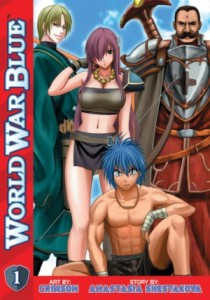
worldwarblue1

The answer is not very. Honestly, if it weren’t for the obvious Kingdom names – “Segua” vs. “Ninteldo” – and the author’s interspersed notes giving a brief history of gaming in the 80s, I may not even have noticed the metaphor. The leads are supposed to represent a different game – Gear, the hero, is Sonic the Hedgehog; his childhood friend Nel is Phantasy Star 2; his tsundere love interest Opal is Fantasy Zone, etc. I didn’t know this until the notes told me. More importantly, these are stock shonen characters – the author even admits she created Gear to be a shonen manga role model, and that he is.

Because when it gets right down to it, this isn’t really for fans of computer games as much as it is fans of Fairy Tail. Gear is a fast fighter who wants to avenge the death of his friend. He goes to the capital city and joins the army by means of simply defeating everyone in it. Opal is even more stock character, immediately hating and challenging the young man who appears out of nowhere, but falling for him the second she is defeated. Even the perverse mentor who shows our heroes how to get stronger while constantly making suggestive remarks feels right out of Dragon Ball.

This has the feel of a Magazine title more than Jump, mostly due to the sexual overtones. There’s actually very little fanservice so far (much to my surprise), but the aforementioned perverse mentor (who’s meant to be Tetris, I think) keeps talking about plugging the gaping holes in everyone’s defenses with his rod, and also gropes the heroine to teach her a lesson after she’s magically exhausted. And the army commander, Ramses (she’s meant to be Columns, I guess?) gets sexually aroused seeing Gear fight (we see her naked, in the one piece of fanservice in the volume) and is describes as having ‘unspeakable hobbies’. But again, these types of sexualized ‘guy jokes’ would not be out of place in Magazine or Champion.

In all honesty, this is pretty generic shonen. I’m interested in seeing how Ninteldo (which is, of course, led by Mario) looks once we see them in action as more than just evil guys. That said, I am totally behind Seven Seas licensing this and putting out more of it, for one very good reason: it’s nothing like anything else they publish. Seven Seas is trying to expand a bit away from their mainstay market of ‘otaku fanboys’, as we’ve seen with the female-oriented Alice spinoffs. This is another step in that direction, showing off a series that appeals to the shonen boy in all of us; a young man vowing to fight for his country against the bad guys, using powerful moves. Let’s see how Gear can differentiate himself from Luffy or Natsu.

Mobile Suit Gundam: The Origin, Vol. 2

By Yoshikazu Yasuhiko; Original Story by Yoshiyuki Tomino and Hajime Yatate; Mechanical Design by Kunio Okawara. Released in Japan by Kadokawa Shoten, serialized in the magazine Gundam Ace. Released in North America by Vertical, Inc.

When we last left our heroes, they’d finally gotten back to Earth. Of course, this proves to be only the beginning of their troubles… they’re in enemy territory, and are being told by their allies in South America “get here first, then we’ll tell you what to do next.” Their ace pilot is having a bit of a PTSD attack, and wants no part of all of this. The refugees they picked up are resorting to taking hostages just to be allowed to leave. And our man in charge, Bright Noah, just can’t seem to get any respect. But then, this is what happens when your enemies call your ship the “Trojan Horse”… you have all the luck that Troy did.

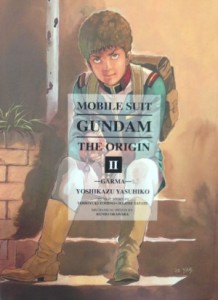
gundam2

To get the obvious out of the way first, most of what you enjoyed about the first book is present and correct here in the second. The battles are done very well, with lots of attention to detail and realism (given that these are robot wars), but don’t take up so much of the book that you get bored with all the combat. The overall tone is serious, but there are some very amusing dashes of humor, including Lieutenant Reed’s ulcer, Fraw Bow’s jealousy (and a flash of the same thing from Amuro), and every exasperated face Noah makes. But overall, the message continues to be what Gundam does best: war is a horrible thing that destroys entire cities, and one should never revel in it.

I think my favorite party of the volume was watching every single interaction between Char and Garma. After all the earnestness that our heroes fall into, it’s great seeing two people who clearly despise each other attempting to one-up each other in how politely smug they can be. Char’s needling of Garma, and manipulation as the story goes on, really shows of his people skills, albeit not in a good way. He spends much of this volume simply watching things develop (well, that and taking long showers so that he can properly show off his fantastic naked body to the reader). This makes his arrogant sneering at Garma right at the end all the more startling, and reminds you once again that he may be the bad guy you love to hate, but he’s still the bad guy.

As for Amuro, he gets the bulk of the second half of this volume, as he reunites with his mother. I’ll be honest, I totally expected him to return and find his mother dead – all the signs were pointing that way – but then, this series has pointed one way and gone another before, so I shouldn’t be surprised. What we got was even better, though – his mother has no context for what’s happened to Amuro at all, and all she can see is that her little boy has become a killer. This is far more visceral than most stories of this time, given Amuro has to lethally fight his way out of the encampment his mother is living in. It’s the emotional heart of the story.

And then there is the titular Garma. The Gundam story makes sure that we don’t simply see the Zeon enemy as “space Nazis”, and Garma’s desire to be worthy of his name, as well as his romance with an Earth girl, is part of this. I was never quite sure till the end how invested he was in Icelina, but it seems to be more genuine than I thought, and I wonder if she’ll return at some point down the line. But in the end, this is a story about war and the prices that one pays during it, and the final images we see are a father brutally gunned down in front of his daughter, and a father stunned to hear of the death of his son.

I admit I would perhaps have slightly fewer mech battles if I were plotting this, but oh well. Gundam is still a riveting and fascinating series, and fully justifies why it has endured all these years. And the presentation, again, is fantastic – a real coffee table book. It’s hard to wait three more months to see what happens next.