Category Archives: reviews

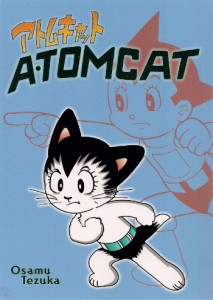
Atomcat

By Osamu Tezuka. Released in Japan by Sekai Bunkasha, serialized in the magazine Nico Nico Comic. Released in North America by Digital Manga Publishing.

I have been noticing, around the internet, a lot less enthusiasm for this particular title as opposed to other Tezuka titles. Usually the comment will start by saying “Well, any Tezuka is good Tezuka, BUT…” and then moving on to note its fluffiness and lack of deep, tragic history. This is a marked contrast to the other type of Tezuka fan, which is the “we must have every single Tezuka work ever created translated into English as soon as possible!” sort. I have sympathy for both camps. Tezuka wrote a TON of stuff, and not all of it is going to be on the scale of Apollo’s Song or Buddha. At the same time, I do want to see his lighter comics that are just moments of everyday life or dumb humor. And that’s why I’m quite pleased to see Atomcat, which is both.
Atomcat

The story of a young boy and his Astro Boy-themed superhero cat, this manga actually intersperses moments from the actual Astro Boy manga (redrawn by Tezuka) as contrast and compare. Usually Tsugio reads about another aspect of Atom’s fairly crappy life, and sympathizes, then has to deal with his own issues, such as an eccentric father, overbearing mother, and the ever-present school bullies. He tries to take home a stray cat as a pet, but the cat is an absolute disaster, destroying everything in the house in a great comedy sequence. Taking it away so he can abandon it, he and the cat and struck by a car… driven by Princess Diana. Only not really, she and Prince Charles are actually ALIENS. The boy is fine, but the cat is dead, so they fix him using the boy’s memories… with are filled with Astro Boy. So now the cat is intelligent and has superpowers. This doesn’t help quite as much as you think, although he’s a few levels above Doraemon.

This is a very 1980s manga – leaving aside Charles and Di the space aliens, we also have the school bully being named Gaddafi. It’s also very much for kids – Unico was too, but it had an undercurrent of melancholy at its core that Atomcat simply doesn’t possess. This is broad comedy with lots of funny faces. Our hero’s father is an absentminded freak, and his wife is the typical cartoon wife – all she needs is a rolling pin to beat her husband with. Atomcat and Tsugio fight mummies and gangsters, search for island treasure, and plunge through the sewers of Japan.

There’s no real character arc here – Tsugio starts the series as a bit of a wimp, and ends that way as well, and the series does not so much end as stop. But it’s fun! The dialogue is snappy, the Astro Boy inserts work well with the themes of the stories, and there’s lots and lots of comedic slapstick, which Tezuka was very good at indeed. I read this title and thought of Mitsuru Adachi’s Cross Game, or Rumiko Takahashi’s Ranma 1/2. Everyone says they’re influenced by Tezuka, but we tend to look for it in series like Ayako. In reality, these manga artists were more likely to grow up reading stories like these – and these are the stories that influenced a future generation. Fluff, but IMPORTANT fluff.

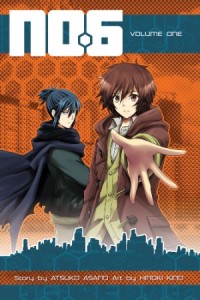
No. 6, Vol. 1

By Atsuko Asano and Hinoki Kino. Released in Japan by Kodansha, serialization ongoing in the magazine Aria. Released in North America by Kodansha Comics.

Dystopias are, as a general rule, not my cup of tea. Those who read this blog on a regular basis already know that I’ll forgive a lot of a story if it has a happy ending; likewise, if a series is just unrelentingly grim, all I really feel is exhausted. But that isn’t to say that a series can’t still win me over with enough interesting things going on. No. 6 is indeed one of those series. It takes place in a supposed elite utopia that turns out to have many deep, dark secrets, and our hero quickly finds out how fast events can turn against him. It’s also shoujo – it runs in Aria, Kodansha’s upscale magazine that’s competing with titles like Asuka and Wings to get the teen “not quite BL” market.

number6

Our hero’s name is Shion, a stoic and reserved young man who is on the fast track for the elite school (and this is among a city of elites) until he lets a young fugitive, who seems to be called Rat, briefly stay at his place, and sews up his wounds. This causes him to lose that elite privilege, something which… really doesn’t bother him much. Several years later, he’s working part-time jobs and staring blankly at his female best friend, who blatantly says she wants to sex him up but is just not registering on his radar, when he comes across a hideous government conspiracy that is killing people by aging them to death. He’s rescued by Rat, and is forced to abandon his life and go on the run, where he’ll find out what the city is really like.

Passive characters like Shion have to be handled very carefully not to be boring. Luckily, these creators are doing a good job so far. Shion may be reserved, but he’s not unemotional, and I like his youthful enthusiasm (which sadly wears down as the volume goes on) and bluntness when he first meets Rat. The scenes with Safu, the aforementioned best friend, are also both quite funny and very telling. It’s not entirely clear if he’s uninterested because he’s not into girls (certainly he bonds better with Rat than he has with Safu) or if the concept of sexual love has simply never occurred to him, but it’s another thing that serves to make him watchable. (By the way, Safu will be dying at some point in this series, sacrificing her life for Shion. I don’t know any spoilers, but bank on this happening anyway, because DUR HEY.)

Rat is less successful, being more of a standard smug pretty boy who has learned not to trust anyone but can’t help but be drawn to our hero. Likewise, the government conspiracy itself, along with its Orwellian officers who administer it, are very much out of the school of Dystopias 101. The aging-to-death thing is pretty horrific, but we don’t know either of the victims long enough for it to really sink in. And the art is serviceable, but doesn’t really pull you in much.

That said, I’m interested to see what happens with Shion, who’s an intriguing enough character that I’ll try another volume of this. The genre isn’t my cup of tea, but the lead may be. And it’s a definite must-buy for anyone who likes conspiracy thrillers with overtones of possible BL romance.

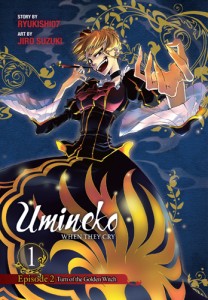
Umineko: When They Cry, Vol. 3

Story by Ryukishi07; Art by Jiro Suzuki. Released in Japan in two and 1/2 separate volumes as “Umineko no Naku Koro ni: Turn of the Golden Witch” by Square Enix, serialized in the magazine GFantasy. Released in North America by Yen Press.

(In case there are any Umineko obsessives reading this, please avoid any future spoilers in comments. No need to Yasu this up till we have to.)

We’ve had our first go-round, and now Umineko begins its second arc. Surprisingly, for most of this volume Battler isn’t the protagonist, either. I was expecting, as with Higurashi, a few arcs that are simply “Battler is dumb” before things really got going. Here, though, we get a wider view of the cast. The fist half of this has the servants Shannon and Kanon as the dual protagonists, showing Shannon’s love for George and how she got a chance to make that love happen, as well as Kanon’s combination of jealousy and self-loathing that balance this out. Between the two of them, Beatrice has a lot to manipulate, and that’s exactly what she does here – though Shannon, at least, is starting to see through Beatrice’s motivations. Certainly more than Battler is.

RYUKISHI07_UminekoV2E1_TP

The second half of the “island story” (more on the meta world later) focuses more on Maria and her mother Rosa, and oh dear I worry about the fandom just dropping this like a hot potato. Parental abuse is not unique to anime and manga, certainly, but it’s rare in a protagonist, and I think that’s what Ryukishi07 is trying to set Rosa up as here – particularly after the events of the first Twilight that remove the other potential adult protagonists. Her bipolar tendencies are simply hard to read, and we definitely see why Umineko fandom has sarcastically nicknamed her “BEST MOM EVER”. Maria’s not exactly helping her case, either – she’s just as hyper-annoying and creepy as she was in the first arc, and it’s easy to see (though not justify) why she would grate on every one of Rosa’s nerves. Basically, this is a horribly broken family, and putting them in a situation like this is just mean.

Which brings me to Battler and Beatrice. No, not the Battler who’s on the island, or the Beatrice who’s showing up doing magic things and dressing in stockings and short skirts; I’m talking about the Beatrice and Battler from the first arc, who are sitting over a gameboard watching as Battler tries to prove that the murders are human-caused, and Beatrice tries to prove they’re all due to magic. The arcs certainly tie together more than they do with Higurashi, and even more than that series, this one rewards re-reads – and is harsh to those who don’t pay attention. I have to say that I think Beatrice’s ‘move’ here is excellent – Battler could easily deny witches in the first arc when she was just portraits and butterflies, but now Beatrice is everywhere, flouting Battler by simply existing and doing supposed magic.

No one really reads this to identify with or bond over the characters, I hope – leaving aside the fact that they always die, these folks are simply far more unlikeable and broken than even Higurashi’s broken cast, and they’re explicitly compared to “game pieces”. No, we read this to try to figure out what’s actually happening here – particularly now that we have multiple realities stacking up with the ‘meta’ gameboard. I’m pretty sure that this arc isn’t going to give us any answers – in fact, as with Higurashi, I’m not expecting anything concrete till at least the 5th arc – but it does have a lot of pointing and shouting, and over the top faces (sometimes too over the top – I think the artists overdo it in Umineko based on the fan reaction to Higurashi’s faces), and grand guignol horror.

A manga that requires you to think about everything that’s happening, while also trying not to overthink things, seems very contradictory. But that’s Umineko in a nutshell, and if you don’t mind horrible things happening to horrible people, it’s still a great deal of fun. Especially now that Beatrice, who is pure evil on a stick, has made her grand debut.

(By the way, for those curious, Yen didn’t leave out any extras – the 2nd volume in Japan also lacked the extras Vol. 1 had.)