Category Archives: reviews

Unico

By Osamu Tezuka. Released in Japan by Sanrio, serialized in the magazine Lyrica. Released in North America by Digital Manga Publishing.

Here’s an unusual one: a Tezuka title that read left-to-right originally. Unico was apparently written for a magazine that was going to come out in the West, so was drawn in the Western way. It’s also full-color, and (given it’s Sanrio) features an adorable, thoroughly marketable creature on the cover and throughout the story. But it’s also Tezuka, so you know there’s going to be some darkness in there, even if it’s for kids. The question is, how does the story hold up?
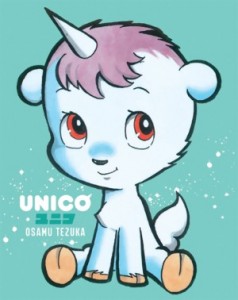
unico

The main plot is basically a MacGuffin to let Tezuka tell whatever story he wants, as the goddess Venus, pissed off as usual that she isn’t the fairest in the land, banishes Unico for basically being too adorable and awesome. He’s whisked all over space and time, and whenever he shows signs of being happy or achieving something, the West Wind whisks him away again. He’s also mindwiped so he never remembers anything. It’s really pretty horrible if you swell on it. Luckily, Unico is nothing if not earnest, and knows enough about himself to help others with his unicorn magic… though occasionally that help goes sour.

The stories themselves are basic children’s fairy tales, with talking animals and mythical beasts, a place where Unico will not have much trouble at all fitting in. The saddest is the first one, a tale of a forbidden love between a young Native American boy and a white settler girl, who become older via Unico’s magic so they can experience adult passion. The concepts behind that are staggeringly fascinating (and creepy), and it’s no surprise that everything goes wrong. Honestly, I was pleased that the rest of the volume didn’t get quite that morally ambiguous… or political.

The rest of the stories are slightly less ambiguous. The longest one is about a cat who yearns to belong to a witch, and I believe it was adapted into a movie. It features a man who is so over the top evil that I had to laugh. All he lacked was a mustache to twirl. That said, the shots of him massacring the animals of the forest are quite dramatic, and small children might find them quite scary. Other highlights include a young girl being kidnapped by a sentient factory that has fallen in love with her (didn’t Demon Seed come out around the time Tezuka wrote this?) and a young Russian thief who secretly wants to be a shy princess, but can’t quite pull it off as she’s simply too awesome.

As you’d expect, the translation is quite good, being simple without sounding childish. There are footnotes for the few culture references in here, most of which have to do with the band Pink Lady, who were becoming superstars at the time Tezuka was writing this. And a few of Tezuka’s ‘star system’ characters can be glimpsed in here, in different roles. But even if you aren’t a Tezuka fan, Unico is worth checking out. it’s family friendly, straightforward, and cute. It doesn’t have much of an ending, but that’s what you get when your lead character drives the plot but isn’t really the plot himself.

A Certain Scientific Railgun, Vol. 7

By Kazuma Kamachi and Motoi Fuyukawa. Released in Japan as “Toaru Kagaku no Railgun” by ASCII Media Works, serialization ongoing in the magazine Dengeki Daioh. Released in North America by Seven Seas.

First off, in case I forget to actually review the book, this was a fun volume of Railgun. The Sisters arc was wrapped up, we started a new one about the city-wide athletic festival, and there’s lots of awesome, heartwarming, and funny.

Now, let’s talk continuity, aka “Wait, when the hell did Kuroko get put in a wheelchair?!?!”

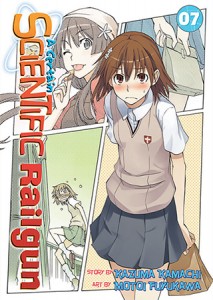
railgun7

First, a brief timeline:
1) A Certain Magical Index Light Novels: April 2004-present. The “Sisters” book came out in September 2004, and the “athletic festival” books (which didn’t focus on Misaka entirely) in April-May 2006.
2) A Certain Scientific Railgun (manga): April 2007-present. It runs in a monthly magazine.
3) A Certain Magical Index (manga): May 2007-present. Also in a monthly magazine.
4) A Certain Magical Index (anime): October 2008-March 2009. This includes the “Sisters” arc, from Touma’s perspective.
5) A Certain Scientific Railgun (anime): October 2009-March 2010. Note that the manga had only just barely started the Sisters arc (from Misaka’s perspective) when the anime began. Which is why you didn’t see it.
6) A Certain Magical Index II (anime): October 2010-April 2011. This has the athletic festival from Touma’s POV, but likely won’t crossover with the Railgun storyline much.
7) A Certain Magical Index (film): February 2013.
8) A Certain Scientific Railgun S (anime): April 2013-present. Judging by the OP credits, this *will* have the Sisters arc, including the battle with ITEM.

For the most part, the Railgun manga has been pretty good about letting casual readers follow along, and explaining things as they go. The only time the storyline ever really connects with index is during the Sisters arc, and other than that, Railgun has its own plots and its own problems. There are, of course, little bonuses for those who follow the books. ITEM are given a major role in the Sisters arc as the child soldiers Misaka battles, right around the time they were becoming very important in the Index books proper. (This is why Rikou, who really wasn’t all that active in the battles, gets a larger picture on the cover than Frenda, who was. She’s more important later.)

Around Vol. 7 is where the continuity starts to snarl, though. First of all, the anime, needing to fill up episodes since they couldn’t animate the Sisters arc (as the manga hadn’t finished it yet) introduces Mitsuko Kongo much earlier, and gives her different plotlines to play around with. Not that the manga is ready to introduce her, it doesn’t really have the time to. So Mitsuko’s introduction takes about 2 chapters, where she sets herself up as the rich rival character and is very quickly humbled. (This actually has the added benefit of making her more likeable, and I thought she was pretty cute.)

And sometimes the manga simply has to abandon even explanations, and just trust the reader will go “OK, something happened.” The athletic festival takes place about a month after the Sisters arc ends, and somehow Kuroko is now in a wheelchair (and Uiharu is blaming herself for the injuries.) What happened? Well, the 8th Index novel, in which Kuroko, as a member of Judgement, goes after a fellow teleportation expert who is trying to steal valuable plot macguffins. In the midst of this, she nearly gets killed, and thus is now in said wheelchair for the duration of the festival. Unfortunately, the series is not called “A Certain Perverse Teleporter”, so Kuroko’s story is just elided away.

There’s also lots of other little things: Accelerator appears again, and seems to be crippled (from Touma’s beating? Actually, no.) and also not, apparently, in any trouble for the experiments. Actually, the manga does a nice little flashback showing how Accelerator was manipulated by scientists just as much as Misaka was, and makes you ponder if “I was only following orders” might be a valid excuse for someone so young. It gets to the point where when we see characters who actually ARE appearing for the first time (such as the “Queen”, or the Aztec girl at the end of the volume), we wonder if they’ve been in the main source and we missed it.

More accurately, I wonder this. Most casual readers likely are fine with reading this typically exciting and fun Railgun volume. But Kuroko’s injury and its out-of-nowhere appearance has been mentioned as confusing, so I thought I’d talk about it a bit.

Oh yes, and Saten is still awesome. But you knew that.

Tiger & Bunny, Vol. 1

By Mizuki Sasakibara, based on the franchise created by Sunrise, Masafumi Nishida, and Masakazu Katsura. Released in Japan by Kadokawa Shoten, serialized in the magazine Newtype Ace. Released in North America by Viz.

I will admit up front that I haven’t seen the anime series this is based on, which Viz is obviously selling hard. I am familiar with Katsura’s work via Video Girl Ai, DNA^2, etc., but aside from Blue Rose looking a bit like Karin Aoi (naming her Karina doesn’t help), there’s not really much influence here. As a result, for once I can ignore all the other variations and alternate continuities I’m familiar with and enjoy this for what it is – a goofy Japanese take on superheroes and mass media, with a very compelling lead duo.

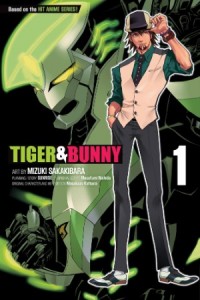
tigerbunny1

The artist for this manga seems to have worked for Marvel Comics before, and it shows – this is a Japanese take on American superheroes that knows what it’s doing, and can get behind the ridiculousness of people in spandex running around as well as the awesomeness. But as much as it’s a take on superheroes, it’s also examining the state of mass media and marketing in the modern age, with the superheroes being sent out at precisely the right time to grab ratings, and having to work together in pre-scripted ways… while still actually trying to capture the bad guys, who aren’t (so far) pre-scripted. The fact that they’re actually trying to do good helps this title avoid the cynicism of, say, a Max Headroom, but it’s still all a bit false.

Naturally, Tiger, aka Kotetsu Kaburagi, is an old-school hero who doesn’t hold with all this televised ratings crap. Not that he doesn’t actually go along with it… after all, a hero’s gotta work. His working-class superhero attitude not only contrasts with the rest of the superheroes we see, but also with his new partner, Barnaby Brooks, Jr. Barnaby looks to be the classic insufferable genius, who regards ‘teamwork’ as a dirty word and fights crime with a sneer on his face. Actually, this doesn’t seem to be the case, as when he’s in action he seems to be quite friendly and smiling to those he rescues. He just dislikes Tiger. I have no doubt he will have a horribly tragic past.

I was rather surprised that both Tiger and Bunny have the same power – an unusual thing for a superhero team-up, but one that helps to show why they don’t get along at first. As for the other superheroes, we don’t see much of them here, but they have moments where it seems they’re chafing against the script as well. The sooner we get away from heroes-as-wrestling and into serious character drama, the better. As for the fights, they looked fine. The action was easy to follow and exciting, and definitely showed some Marvel influence.

This is a very good first volume, leaving you wanting to go hunt down the anime to find out more. Even the character bios intrigue me – Tiger having a daughter means his tragic past can war with Bunny’s. (How sad is it that my first thought on seeing “guy with daughter” is “how did his wife die in the backstory”? Heck, maybe he’s just divorced. But I doubt it.) I’ll admit I was expecting this to be just another tie-in, but it’s quite worthy on its own. Recommend it to friends who want to try manga but have never ventured beyond the X-Men.