Category Archives: reviews

Love Hina Omnibus, Vol. 5

By Ken Akamatsu. Released in Japan by Kodansha, serialized in the magazine Weekly Shonen Magazine. Released in North America by Kodansha Comics.

When I reviewed the first omnibus of Love Hina, I noted that one of its major faults was that, compared to the pacing of the end of the series, it seemed glacially slow. Now we’ve gotten to the final volume, and I’m starting to see the opposite problem. Akamatsu has discovered he can do fast chases well, so after an entire volume spent chasing Naru to the north of Japan, we get another one devoted to chasing Keitaro around the MolMol Kingdom, with all the wacky hijinks that entails. Indeed, reality, which always had a tenuous hold on this series anyway, seems to mostly go out the window here.
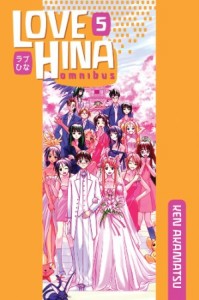
lovehina5

As you can see, Kodansha spoils the entire volume on its cover (I have this image of Angry Naru haters replacing her head on the cover with Motoko or Kitsune or whoever and giggling). Yes indeed, the series does end with a wedding. But before that, we have to run through the pick of the best of some of Love Hina’s Greatest Hits, Vol. 2. Which means archaeological ruins, chase scenes, the girls all trying to stop Keitaro and Naru simply because the plot requires it – indeed, Su basically admits she’s only doing this for fun. Speaking of Su, turns out she’s MolMol’s princess, which probably gives some justification as to why she acts the way she does. Motoko gets a lot of stuff to do at the start of this omnibus, even if most of it is a repeat of a previous volume (notice a pattern?). Shinobu less so, but at least she gets out a confession. And Seta and Haruka get married, in one of the fastest weddings you’ll ever see, barely giving Haruka a chance to turn red.

As for Keitaro and Naru, well, life continues to conspire against them. A popular fan theory is that the universe LITERALLY does not want to see them together, and constantly sends disasters their way just to prevent it, and you see a glimpse of this sort of thing here. Things aren’t helped by Naru, who clearly loves Keitaro, wants to become more intimate with him (she takes him to a love hotel here)… but still has issues that lead to disaster and Keitaro getting whacked. (I’m a huge foe of the “Naru is insane and needs therapy” fandom block, mostly as it rarely comes from sympathy, but I will admit I do wonder if something in her childhood happened that led her to be this twitchy.) As for Keitaro, by now he’s accepted his lot in life, freely admitting his supposed immortality and going with the flow provided the flow takes him back to Naru.

The title ends with an epilogue showing the Hinata Inn four years later, with the arrival of a new girl who’s heard it’s legendary for helping hopeless students get into Todai. She’s essentially a female Keitaro, so it’s no surprise that she runs into the residents of the inn (now older) naked, accidentally screws something up, and ends up in a giant chase scene. And if she’s Keitaro, then who does Keitaro get to be? I think most of the “Keitaro turns into Seta Mk. 2!” fan displeasure came from this epilogue, where admittedly he pretty much does act like Seta. But then again, a relaxed Keitaro who’s resolved his Todai and love life issues may very well go in that direction… we’ve seen how Seta and Haruka parallel Keitaro and Naru to begin with. More likely, he was Seta’d up to make the situation funnier, because this is still a manga.

And so in the end I think I have finished unleashing all my inner fandom demons at Love Hina, and can appreciate it for what it is; an intermediate work of Ken Akamatsu’s, filled with memorable characters, sweet moments and a lot of humor, but also poorly paced, about 5 volumes too long, and over-relying on physical comedy. His next series, Negima, gets better at all of these, but still has the same essential weaknesses. Luckily, his strengths also get even stronger there. So let’s leave Keitaro and Naru, married now, living at the Hinata Inn and no doubt spawning a new generation of comedic misunderstandings that could be worked out if only anyone would stop for two seconds.

Mobile Suit Gundam: The Origin 1

By Yoshikazu Yasuhiko; Original Story by Yoshiyuki Tomino and Hajime Yatate; Mechanical Design by Kunio Okawara. Released in Japan by Kadokawa Shoten, serialized in the magazine Gundam Ace. Released in North America by Vertical.

If you’re going to rewrite one of the most renowned and influential anime of all time, you have a lot of difficulties ahead of you. You have to tell the same story but add your own spin on it, making sure it’s not just a word-for-word copy. You need to draw the audience in by showing things that you were unable to the first time, for either budget or time reasons. And of course you need to remind everyone why the original was so legendary. It helps, of course, when you’re actually one of the architects of that original vision. And that’s what we have here, as one of Gundam’s creators has decided to tell the original story from the 1979 anime as a manga, adapting, expanding, and illuminating its plot and characters. And so far, I’m impressed.

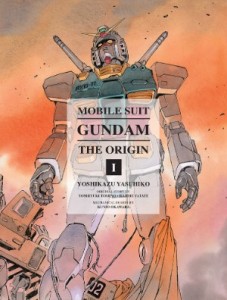
gundam1

I must admit, I’ve never gotten into the Gundam phenomenon – as a kid, Battle for the Planets was more my speed, which is about a generation earlier in mecha shows, and I didn’t really follow the Wing/Seed phenomenon. That said, I do know a few things by fandom osmosis. Giant robots, only serious. War is bad. Char Aznable. Lots of tragic deaths. Colony drops. And everyone hates Turn A. That pretty much sums up my knowledge. So I was looking forward to delving into this to see what made it so compelling. The story begins in media res, as we follow a platoon of commandos trying to get into on a secret new weapon the enemy ship has… which turns out to be a Gundam, as we realize the enemy ship is actually Our Heroes.

This feels very much like an epic motion picture, and at times it almost felt like I was reading storyboards rather than a manga volume. Events slide smoothly from one to another, with little to no chance for a breather in between. The lead character, Amuro Ray, is somewhat sullen and teenagery, but not as hard to like as I’d thought, and clearly shows compassion when it’s in his sphere of things he cares about. (There’s a beautifully drawn shot of his childhood friend Fraw running towards him as a huge explosion bursts behind her, and I was sure this would be the first of many deaths, but amazingly no; the “named character” body count in this volume is pretty low.) As for Char, it’s immediately apparently why he is the breakout character from this series. Cool and cocky, but lacking the evil arrogance of some of his friends (like the guy we see right at the cliffhanger), he’s a bad guy you love to hate. Also, his mobile suit is named the Red Comet, which just makes me imagine that the Zeon base is at Cedar Point.

On the presentation end, Vertical has produced possibly its most impressive book to date, with a gorgeous hardcover with thick pages (many color), suitable for any coffee table. It really goes above and beyond the call of duty; kudos to the designers. That said, the main reason to get the Gundam manga is probably the same reason the original anime became so legendary; you can’t stop wondering what happens next. These people and their struggle to survive are amazingly compelling, and everything about this manga adaptation – the plot, the artwork, the characterization – makes it justify its existence. I am very happy to see it coming out here, and can’t wait for more.

Oh yes, and red makes things go three times faster. I remember that as well.

Higurashi: When They Cry, Vol. 21

Story by Ryukishi07; Art by Hinase Momoyama. Released in Japan as “Higurashi no Naku Koro ni: Minagoroshi-hen” by Square Enix, serialized in the magazine GFantasy. Released in North America by Yen Press.

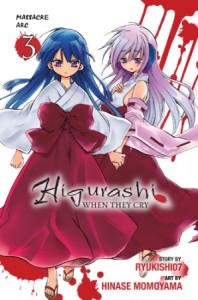
And so we come to the end of the penultimate Higurashi arc, and – no surprise here – everyone is dead. And I do mean everyone, as this volume, having finally given away most of the secrets, goes into great detail how the “disaster” that wipes out the village actually occurs. Things are not particularly improved by Takano, who is waving her arms around during all this as if she’s a conductor, and has a final face that is perhaps the template for all “crazy Higurashi faces”. But let’s jump back a bit and see how we got here.

massacre3

Rika and Hanyuu both feature on Yen’s chosen omnibus cover art (sorry, Takano, you just aren’t cute enough), with Rika having a resolved, determined face and Hanyuu looking depressed and dead inside. Most of this volume is showing us how Rika gets that determined, as getting the news about Tomitake’s death just seems to take all the fight out of her. Especially when she hears Oishii’s theories about who did it. A lot of fans have gotten on Rika’s case about being unable to figure out the killer, who seems really obvious in retrospect, and that she should have pieced it together after so many worlds in a row. Of course, as we see here, this is the first world where she’s not drugged up at the time of her execution. More to the point, she may have a hundred worlds of experience, but they’re the experience of a girl who only gets to about 12 years old. Rika has years, but not maturity, and it shows clearly here, when she resolves to hide everything from her friends so they don’t get killed.

That’s hardly going to work, however, given what happened with Satoko just a few days ago. Indeed, Satoko points this out to Rika directly, and Keiichi and the others make it clear that they’re not going to sit there and let Rika be sacrificed. We even have Rika quoting one of Bernkastel’s poems – usually reserved for the start and end of each arc, and indeed we get one at the end as well – which talks about who has a right to happiness. It’s easy to stand up against someone when it’s for the sake of others. When you do it for yourself, it can seem selfish, especially if it will put your friends in danger. Rika has to break through that barrier before she can accomplish anything.

We are – finally! – starting to get answers here, and indeed most of the pieces are together now. Not only is Takano the villain, but so are the “Wild Dog” bodyguards, who have always resembled a militia a bit too much for my taste. (I like how they are mook enough to have Keiichi and company take them out in order to rescue Rika, but not actually mook enough to have that last more than a few minutes – in the end, the kids lose.) And Hinamizawa Syndrome, the disease that causes the paranoia and killing impulses, is explained as well. This leads to why Rika keeps getting ritually slaughtered on an altar – Takano has gone mad and believes that if she kills the Queen Carrier, she’ll gain godlike powers.

And then there’s Hanyuu. We still don’t know much about her. She’s the incarnation of Oyashiro-sama, but strangely powerless, except for her ability to reset the worlds. She’s also even more worn down than Rika, and is also terrified that if she loses Rika this time she’ll be alone again… as she was for about a thousand years. Rena calls her out on this, as she too has the reoccurring theme of the Massacre arc – fighting back hurts too many people, it’s best not to have any hope. We’ve just proven how wrong this is, even if it did end badly. What’s more, we don’t really have much background on why the hell Takano is doing this, aside from “She’s insane”.

Luckily, we have one more arc – the longest yet, 8 volumes/4 omnibuses! – that should tell us about them, and will hopefully finally give us something that the characters and readers truly deserve after all this tragedy – a happy ending. Stay tuned for Vol. 1 of the awkwardly titled “Festival Accompanying” arc, where we meet a young girl named Miyoko Tanashi, and find out what makes her tick.