Category Archives: reviews

Umineko: When They Cry, Vol. 2

Story by Ryukishi07; Art by Kei Natsumi. Released in Japan in two separate volumes as “Umineko no Naku Koro ni: Legend of the Golden Witch” by Square Enix, serialized in the magazine Gangan Powered. Released in North America by Yen Press.

And so the first arc of Umineko: When They Cry is finished, and even more than the first Higurashi arc, it shows us that what we’ve been reading for the last 1100 pages is simply a prologue for everything that is to come. It shows us the main players, allows us to see the family drama at the heart of everything, and of course has a number of gloriously gruesome murders, but you keep expecting the last page to be, with apologies to The Goon Show, Wallace Greenslade announcing “And this is where the story REALLY starts.”
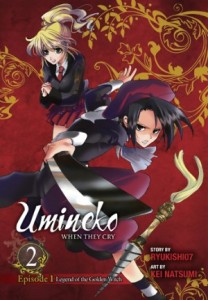
umineko2

There’s a lot more emphasis on the mystery itself than there was in the Abducted by Demons arc, with each new killing propelling the remaining cast to desperately try to figure out how in God’s name they’re happening. This is made possible by the deliberate closed-in locked-room style of the series, which does not allow much in the way of escaping or trying to forget about everything. Thus Umineko is a more oppressive series than Higurashi, but it’s also more focused. Character allegiances shift rapidly, as Eva, one of the more sensible character in the first volume, proves to be incredibly nasty at trying to pin the crime on Natsuhi; Maria’s split personality is genuinely looked into as possibly being a product of her mother’s resentment; and Natsuhi herself finally takes control of the family at the expense of… well, a whole lot.

Jessica and Kanon are on the cover, but they really don’t get much of a look in beyond the fact that Jessica clearly has a crush on Kanon. (I understand the second arc focuses more on Jessica and George’s relationships.) But the inside cover tells the real story of this book, showing a frustrated and enraged Battler and a smug, grinning Beatrice wielding chess pieces at each other.

Then there’s the tea party. I’ve been reading through a couple of the Higurashi Visual Novels (available legally from Mangagamer, by the way – one of the few non-porn things they’ve done), and each of them ends with a short ‘tea party’ set in the cafe where the cast, out of character, go over what happened in the book and whether it was due to demon or human elements. That said, it’s totally independent of the VNs themselves, and was dropped from the manga adaptation as being irrelevant. Is was therefore a big surprise to me to see the tea party actually adapted for the manga… and it proved to be the biggest plot twist as well. It’s all very well and good to deny the existence of a witch who appears as shafts of light or butterflies, but her physical presence really throws Battler for a loop. And when he continues to deny her involvement… let’s just say things don’t end well for our heroes.

And so we seem to have a plot and a meta-plot, as Battler and Beatrice are now in competition to find the best explanation for the events at Rokkenjima (note that actually trying to stop the murders doesn’t seem to be an option anyone brings up this time). And then at the very end there’s a meta-meta plot, as Beatrice has her own tea party with another witch named Bernkastel… who we’ve seen in the Massacre arc breaking down the Higurashi plot with Rika. Indeed, Bernkastel looks exactly like Rika… and while Ryukishi07 has apparently said that the two are not the same, there’s clearly enough similarities that they’re connected in some way.

The balance between mystery and horror is what drives this series, as the author himself notes at the end. And while events may be more dramatic, gestures more declamatory, and events far more hopeless than Higurashi, the key is whether a reader wants to read on and find out more. I certainly do, especially since I want to find out more about Beatrice, who insists she’s behind everything, but hasn’t really given a reason why beyond “cause I’m evil like that”. I’m going to guess that’s not the real reason.

Hayate the Combat Butler, Vol. 21

By Kenjiro Hata. Released in Japan as “Hayate no Gotoku!” by Shogakukan, serialization ongoing in the magazine Shonen Sunday. Released in North America by Viz.

I’ve given every volume of Hayate since I began this blog a full review, so want to keep up the tradition. Of course, that tends to mean I have to keep finding new things to say. Should I talk about how the North American audience views harems… no, wait, did that already. What about the relation between gags and serious… no, did that too. It doesn’t help that Hata is very slowly putting all his pieces into play for what promises to be an epic storyline… but it isn’t yet. As a result, we get a lot interruptions here, including some characters who haven’t appeared in so long that Hayate and Nagi have to direct readers to the appropriate volume.

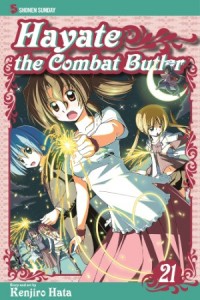
hayate21

For those who like Maria, enjoy that cover, she’s barely in this volume. (To be honest, aside from one-shot chapters, she’s never really going to be relevant again, unless Hata comes back to her if/when he wraps this up.) The two major events in this book are a beach volleyball game challenge given by Gilbert, the aforementioned character who no one remembers anymore; and Sonia, the nun with a crush on Wataru, trying to steal the Ougyoku Stone. This Stone has come up once or twice since the series began, but here is where it starts to really play a major role, in that Nagi’s Machiavellian grandfather states if Hayate allows anyone to steal or destroy the stone for more than an hour, Nagi loses her inheritance. And there’s a lot of people who want that to happen, including Athena, now 10 years older and living in Greece. The stone is the gimmick that will drive the next few volumes.

The beach volleyball game is the funniest part of this volume. Gilbert immediately shoots himself in the foot by demanding Hayate partner with Hinagiku, as she’s so “weak and frail”. Unfortunately, Hina is dealing with her usual self-image and tsundere love for Hayate, so she decides to pretend to be as weak as Gilbert says she is. Complete with monotone “Eek” noises. Thankfully, Gilbert is *such* an ass that this only lasts for a couple of pages before she decides to kick his ass. (By the way, I note that now that Hata has revealed that Miki is in love with Hina, he’s allowing her to be a lot more open about it, demanding Hina wear a bikini and essentially lusting after her.)

The most romantic part of the volume is the one with Sonia, though she isn’t the reason why. She’s stealing the stone so that she can help Wataru get his *own* family fortune back, and therefore return Sonia’s love. Hayate is absolutely not the best person to figure this out, given that he has all the sensitivity of a hammer. Luckily, Ayumu is there with him, and once again makes you wonder why she isn’t the heroine of some other manga. She calms Sonia down, points out Wataru wouldn’t like her just for money, gets the stone back, comforts Hayate, *and* gets to kiss him (on the cheek) to boot. She would be the clear winner of any other harem manga, but is only a long-shot in this one. Which is a sign of how balanced Hata keeps his harem… and his readers.

Due to the typical low sales of almost all harem manga these days, the next volume will not be out till August. But Hata, for the most part, delivers what readers want – some fanservice, some laughs, some romantic tease, and a few sweet moments. If you read Hayate scanlated, get over the fact that your pairing may not win and buy the manga. As for new readers… why are you buying Vol. 21?

Knights of Sidonia, Vol. 1

By Tsutomo Nihei. Released in Japan by Kodansha, serialization ongoing in the magazine Afternoon. Released in the United States by Vertical, Inc.

I will admit to being one of the few people reviewing this title who has not read either Biomega or Blame, the author’s previous series released here. As a result, I wasn’t quite sure what I was getting into, except that the series looked vaguely Gundam-ey. And I have to admit, after finishing the first volume, I’m still not quite sure what’s going on. That said, it’s the sort of manga that rewards trying to find out, and there’s lots of little things here and there that make this well worth a read.

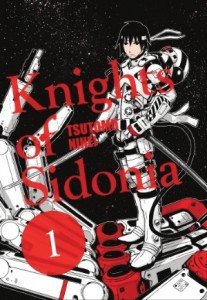
sidonia1

This takes place somewhere in the future on a World Spaceship, a la Heinlein’s Orphans of the Sky. Much of the plot is not told to us via exposition or narrative, but simply by immersing us in our hero’s day-to-day life and expecting us to figure it out as we go along. Our hero, Nagate, has been living secretly underground for years with his grandfather (I think), practicing blowing things up in a flight simulator. When he runs out of food (is his grandfather dead? And for how long?), Nagate goes to find some, and accidentally falls into the processing machine (one of the more morbidly funny scenes in the entire volume). After being discovered, he’s quickly indoctrinated into the military and added to a team whose mission is to battle the Gaunas, alien life forces intent on destruction.

Our hero is not much for words (or indeed facial expressions), so getting some battle scenes almost feels like a relief. My favorite part of the entire manga is probably the cruelest: we meet a new girl, Eiko, who is standoffish and avoiding all the superstition that the other pilots perform. Given she’s in the chapter title, we naturally assume she’ll be like Izana and come to befriend our hero, though given how prickly she seems it may require him to show initiative. But no! They go out to battle Gaunas, and she’s not only killed off immediately but her form is used to become a hideous monstrosity that almost kills off Nagate too. This fakeout was well-played, and I applaud the author for it.

Towards the end of the volume we get a few more new characters, who are a bit too new to really grasp on to, as well as an indication that Izana seems to have fallen hard for our hero. Clearly this is meant to be a series with a few volumes to it, and I imagine all will become clearer as I go along. I’m left, however, with a sense of distance about the whole thing. Nagate has difficulty emoting due to his upbringing (at least, that’s what I imagine), Izana seems naturally repressed, and through most of the volume I kept wishing that I could get closer to our heroes’ mindset while being unable to. I did enjoy Nagate defending Izana against a hotshot egotistical jerk pilot (who then breaks Nagate’s arm), and hope that we’ll see more elements like this. Knights of Sidonia as a series is cool rather than warm, but it’s still fascinating, and I look forward to working out what’s going on in future volumes.