Category Archives: reviews

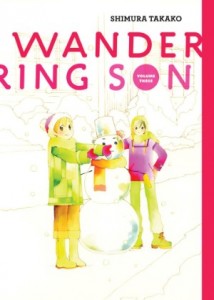
Wandering Son, Vol. 3

By Shimura Takako. Released in Japan by Enterbrain, serialization ongoing in the magazine Comic Beam. Released in North America by Fantagraphics.

One of the things that impresses me most about this manga is how much everything seems to be in flux. Nitori and Takatsuki’s gender identity disorder is the most obvious, but nothing else seems to be clear-cut at all, just as kids feel right around middle school. In this volume we see their secret get revealed to the class, and though a majority of the fallout focuses on Nitori and Takatsuki’s feelings, we also get to see how it affects people like Sasa, who’s just concerned that her friends are all pulling apart, or Seya, who’s falling for Nitori without really knowing the truth, but whose feelings continue to be an issue even after he finds out.
We also meet a new character, Makoto, who takes a surprisingly large role in this volume. He’s surprisingly mature, being a bit more confident in his desires, more ‘intellectual’ in his speech and manners (watch his cutting remarks to Maho when she’s about to insult him), and no doubt also far more emotionally fragile than he lets on. He reminds me a bit of Saori, but she still wears her heart on her sleeve. He’s also shown to be quite attracted to Nitori, which is something we haven’t really gotten into given the age of the protagonists, but no doubt will as the manga advances. What will happen when sexuality starts to come up?

I was pleased to see us moving beyond the school in this volume, with Maho dragging her brother along to her modeling audition. I continue to enjoy reading about Maho, a very ‘bratty big sister’ character whose head you can nevertheless easily get inside. Loneliness and lack of self-confidence lead to some of the more impressively awful scenes in the book, as she sets up Seya on a ‘not date’ with her brother dressed as a girl. That said, after Makoto dresses her down, I think she’s starting to think more about what she’s doing. The final scene, showing her and Nitori defending each other against the overly pushy modeling crowd, is quite heartwarming.

Then there’s the scene with Takatsuki and Yuki. This is a manga that takes place in a slightly lighter, fluffier world than reality, so things don’t turn too dark, and there’s a sense of ‘easily forgiven’ to the whole thing. At the same time, though, Takatsuki’s panic and fear is palpable on the page, and reminds you once again that these are just *kids*. Yuki’s behavior also ties in with Maho’s earlier, and the modeling girls at the end, in that they’re treating Nitori and Takatsuki as objects, even if it’s unconsciously. Takatsuki, who’s already upset that they both got found out but that Nitori is taking the brunt of the class’ reaction, is especially upset by this. Neither she or Nitori are dolls that people can play with as they please, or substitutes that they can live vicariously through.

It took a while for me to get around to reading this volume, but as always I was immensely impressed when I finished it. As I said, this isn’t quite ‘reality’, but it still handles everything realistically, and shows the emotions that everyone goes through. The middle school years are a giant state of flux, and therefore a great place to examine the gender issues that Wandering Son does. Roll on, Volume Four.

Limit, Vol. 1

By Keiko Suenobu. Released in Japan by Kodansha, serialized in the magazine Bessatsu Friend (“Betsufure”). Released in North America by Vertical.

Keiko Suenobu is a name that might be familiar to those manga readers with long memories. Tokyopop put out several volumes of her shoujo manga Life before Kodansha took their licenses away, and it was a decidedly different shoujo manga from the usual fare. Not that it didn’t feature high school girls, dating, rivalries and bullying, etc. But it also discussed topics such as suicide, self-mutilation, body hatred, and rape, and did not try to give us the usual ‘you will defeat the bullies if you get emotionally stronger!’ message that most manga do. It was quite popular in Japan, winning awards and spawning a live-action drama. And now Vertical has licensed her next project, which takes high school popularity and tosses it into the middle of the unknown wilderness.

If there’s one big issue I had with Limit, it was this: I feel the accident that causes the plot to happen should have been on Page 175, rather than Page 45. We’re introduced to a class and get a quickly sketched out plan of who’s popular and who’s unpopular, with the main characters briefly touched on. But given how much of what happens focuses on Morishige and her feelings of hatred and revenge, I wanted to know more about the class dynamics and in particular about the class’ ‘queen’, Sakura, and our heroine Mizuki. As it is, being thrown into the deep end along with Mizuki helps give a feeling of uncertainty and fear, but it also makes her rather flat. If we’d had a couple of chapters that faked us into thinking this would be a typical coming of age (albeit serious) shoujo, I think the added depth would have helped.

That said, there’s a lot to like here. Teenage drama is something that Suenobu specializes in, and it’s all over the place here. The manga manages to give us the overly dramatic histrionics we’d expect from privileged teens caught in a disaster without making it too annoying or causing it to get bathetic. One might argue, given this is a manga dealing with the ‘strata’ of Japanese classrooms and bullying to a degree, that making the bullied school outcast the main villain is helping to contribute to the ‘blame the victim’ mentality that kids constantly deal with. But this story doesn’t seem to be about bullying per se, nor does it seem to have only one antagonist.

Where the story really shines is in the relationship between Mizuki and Haru, and how quickly group dynamics can change when the catalyst of the group is removed. Even close friends don’t know everything about each other, and here Mizuki finds that her peer group is just as rife with self-doubt and paranoia as she is. Being a popular girl is a two-edged sword, and what may seem to Mizuki like trying to blend in and bond with all the different girls is seen by others as switching sides deftly to avoid getting singled out. Which, as we see in a flashback, is exactly what Mizuki was doing. If you don’t open up or take a stand, you don’t get hurt.

This series looks to be six volumes total, so we’ve only just begun to see how it’ll play out. And I’ll be honest, I have a feeling that some cast members will soon be joining the rest of their classmates in sweet death (coughChikagecough). Hopefully we’ll see more development from our heroine, and more broken social dynamics driving the plot. Mostly as now that it’s broken, I want to see how it gets put together again. Will we get to see the girls work together and forge new friendships? Or is this just six volumes of slowly killing each other?

School Rumble, Vol. 1

By Jin Kobayashi. Released in Japan by Kodansha, serialized in the magazine Weekly Shonen Magazine. Released in North America originally by Del Rey, now released digitally by JManga.

Way back ages ago, I reviewed Del Rey’s omnibus release of Vols. 14 through 16, and noted it left off on a nasty cliffhanger. And there it sits, as Del Rey became Kodansha and Kodansha decided its sales were not sufficient to release more. But now JManga is picking up some of Del Rey’s old abandoned series, and have put all the prior Del Rey volumes up on their site, with more apparently to come. With that in mind, I decided to go back and review Volume 1, and see just how different things were back at the start.

Well, for one, that huge cast is not quite so huge. School Rumble starts off as being very much a two-hander, with the point of view switching back and forth. Our heroine, Tenma Tsukamoto, has a hopeless crush on stoic weirdo Karasuma, but is unfortunately hopeless at romance… and studies… and athletics… and pretty much life. Well, except for cosplaying. She is, however, a happy girl with lots of spirit. Contrasting this is our hero, Kenji Harima, a former biker who is trying to turn over a new leaf, mostly as he’s fallen head over heels for Tenma. Harima is strong and good at athletics, but otherwise is in the same boat as Tenma – he’s not all that bright, and his attempts to woo her are laughable. Add wacky situations and stir.

The comedy is all important here, as it would be through most of the early days of this series. The chapters have a lowered page count compared to most Shonen Magazine series (about 9-12, as opposed to 16-18), a sure sign that the editors consider it one of the funny manga rather than a romantic harem manga. There isn’t even a harem yet, really. Just a love triangle. Harima loves Tenma, Tenma loves Karasuma, and Karasuma… we have no idea what he thinks. This is also an unusual series in that it ran simultaneously in two magazines. The main Tenma and Harima plot ran weekly in Shonen Magazine, while the chapters at the end dealing with ‘side characters’ (the ones with a flat note as opposed to a sharp) ran in the monthly Magazine Special. In this volume they’re focused on Yakumo, Tenma’s younger yet more mature sister.

Ah yes, Yakumo. As I said earlier, there’s a large cast coming, and we see glimmers of it here. Tenma, for all that she is lovable and hyperactive, is pretty much exactly what she seems. Yakumo has a lot more to give us. She’s also a great cook, and pretty, and athletic – her perfection is noted by the boys at her school. When otaku who should know better talk about ‘waifu’ type characters, nine times out of ten they mean someone like Yakumo. Her one fault is her seeming obliviousness to guys. And I say ‘seeming’ because we know something about Yakumo that they don’t – she can read minds of anyone who likes her! (School Rumble has occasional fantasy content – Tenma is telekinetic once – but except for Yakumo, it’s always for the sake of a gag.) And given the typical minds of teenage boys, this has likely served to make her even more shy and retiring than she already is.

As for the other main characters, we do meet Eri, Mikoto, Akira, and (briefly) Hanai, but for the most part they look like they’re just going to be generic best-friend type classmates. Eri is stuck-up, Mikoto is tomboyish, Akira is deadpan. They haven’t been brought into the story, mostly as the story i still just about Tenma and Harima. But as their attempts to confess their love explode outwards, others will be drawn into the web. Especially Eri.

For a first volume, this is big, dumb goofy fun. Both leads are histrionic and over the top, and there’s lots of silly here, with an understanding that no one is going to be confessing their love anytime soon. What’s more, Tenma is still the focus of almost every chapter. As the series goes on, and as the popularity polls start to come out, this will begin to change…