Category Archives: reviews

Paradise Kiss, Vol. 1

By Ai Yazawa. Released in Japan by Shodensha, serialized in the magazine Zipper. Released in North America by Vertical, Inc.

I had already done a review/overview of this series for a Manga Movable Feast a while back, but now we have Vertical’s new re-release with larger trim and a new translation, so it’s time to give it another look. Which I honestly don’t mind, as this is such a terrific series. I won’t be talking too much about the technical details – the larger size makes the asides much easier to read, I do note. As for the translation, it’s definitely different, and there are pluses and minuses to both. I do prefer Arashi not sounding like Johnny Rotten, though.
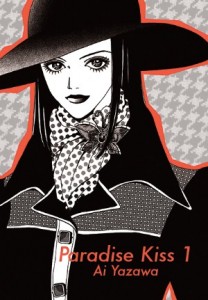
The cover and chapter pictures, by the way, might give away a bit of the plot: Yukari becomes a model. But then, most of you probably guessed that as it’s the premise. Yazawa has an eye for fashion and posing, and it all comes to the fore here, with many long, lingering shots of outfits and fabric, and even the rudimentary drudgery of sewing beads is made to look glamorous. Paradise Kiss is a colorful, vibrant place. By contrast, Yukari’s life is as stark and black and white as the manga itself – we barely get to know anyone besides Hiroyuki at her school, and her attention is so quickly distracted by George and company that her diligence to study is in doubt. (Notably, the entire PK group urge her to keep studying, and constantly ask if she has to hit the books. They’re all good students, and don’t want to be seen as the reason she isn’t. It’s Yukari’s own fault that she winds up blowing everything off all the time.)

I’ve said this before, and I’ll say it again – I really like Hiroyuki, and I’m glad to see how he interacts with Yukari and the others. The sequence where Yukari drags him to meet Miwako is painful but very well done – and Yukari, as many ‘well-intentioned’ folks seem to do, immediately realizes she’s made a mistake. That said, it worked out well in the end, even if what we mostly get from the story of Miwako. Arashi and Hiroyuki is of things left unfinished – by forcing a choice onto Miwako, Arashi has unwittingly left everything more open-ended than it should be. This will come back to haunt him in future volumes…

A word of warning to those who hate it – this manga is rife with metatextuality. The non-Yukari cast constantly talk about chapters, page placement, etc., reinforcing the fact that Yukari is not only entering the fashionista world of Paradise Kiss, but the manga ‘world’ as well. There are also several references to Yazawa’s shoujo manga Gokinjo Monogatari, which starred Miwako’s older sister, Mikako. Mikako makes a cameo, and a few other characters also show up. Don’t worry if you’ve never read the (unlicensed) prequel; the references actually serve to better flesh out the characters, and show that this isn’t just a story that began once Yukari entered the scene.

Did I forget to mention George? I did. Hi, George. I’ll have more to say about him in my next review. In the meantime, Paradise Kiss has attractive, vibrant characters, gorgeous and striking art, and a wonderfully wicked sense of humor. I’m incr3edibly happy that it’s back in print.

Barbara

By Osamu Tezuka. Released in Japan by Shogakukan, serialized in the magazine Big Comic. Released in North America by Digital Manga Publishing.

This is one of those mature Tezuka titles that a lot of fans had been waiting to hear about. So much so that when DMP decided to start a Kickstarter project to get enough money to license it, it was an obvious choice. And I must admit, it does seem like the sort of manga you’d like to verify you have enough money to cover costs before you publish. Unpleasant, flighty, and just plain annoying at times, Barbara is fittingly very much like its main character, a muse who is various things to various people, and ends up being an alcoholic hipster when she’s inspiring our “hero”, the writer Yosuke Mikura.

You’ll note I put the word hero in quotes. Even using the term protagonist seems wrong for Mikura, who does not really inspire much sympathy throughout this book. Right off the bat we get two chapters which show him not only abusing Barbara (he beats the crap out of her the entire book) but also has serious psychological problems, leading to hallucinations. It requires a certain amount of sang-froid to trust that Tezuka will lead you through this and tell a satisfactory story, especially as the first half of Barbara seems to be composed of mostly disconnected life scenes with Mikura and his drunken companion.

Things pick up considerably when we are introduced to Russalka, an African writer and political activist who comes to Japan for a conference. It turns out he has a past with Barbara, and was not particularly happy to see her go. This is when Mikura gets the full explanation of what Barbara is, which he stubbornly doesn’t really understand at all – at least not consciously. But they don’t really have a relationship, just occasional inspiration – as muses are to writers most of the time. When he decides to marry Barbara at one point, most readers will be groaning and going “You idiot!”. If they weren’t already.

Mikura continues to spiral downward, committing murder multiple times (even if it’s sometimes only implied) and his marriage to another woman who is genuinely real seems to only make things worse for both of then. The last third of Barbara reads like an elegiac car crash, as you watch a man who was already deeply disturbed when the book began go off the deep end. In fact, that may be a fault with the book – Mikura was *so* creepy and deluded right from the start, there’s very little surprise or sympathy in seeing him get run off the rails like that. It’s less of a tragedy and more of a “well, that’s just life.” Which, given this is the early 1970s, may have been what Tezuka was going for anyway.

The artwork is excellent, with many striking scenes. He’s especially good at depicting Mikura’s hallucinations. At one point Mikura meets a woman who looks like Barbara but insists she’s a real woman named Dolmen, and Tezuka actually manages to have her look slightly different. Sometimes the art is a bit sexualized (there is much focus on Barbara’s rear end), but that’s what you’d expect from a book about a seductive muse. And the scenes in the end in the sewers and field are fantastic action sequences.

I wouldn’t say I enjoyed Barbara the way, say, I enjoy Ranma or Sailor Moon. It can be an unpleasant experience, and its lead is loathsome much of the time. If you can get past that, however, this is a striking tale well-told, and made me curious to find out more about the Japanese literary scene of the early 1970s. And hoping that if I ever get a muse like Barbara, I don’t end up the same way. But, that’s writing for you. So fickle…

Angelic Layer, Vol. 1

By CLAMP. Released in Japan by Kadokawa Shoten, serialized in the magazine Shonen Ace. Released in North America by Dark Horse Comics.

Angelic Layer comes at a turning point for CLAMP, one where they had already shown how well they could succeed in the shoujo market and were trying to branch out and expand. And while they were still drawing X at the time they started this (and just wrapping up Card Captor Sakura), they clearly wanted a new challenge. Unfortunately, I’m not sure how well they succeeded – certainly this work is a decent enough diversion, and there’s never any desire to put it down or move on. But it doesn’t really grip you the way their best series do – and indeed, the way that their more successful series for a male audience, Tsubasa and xxxHOLIC, would later on. Angelic Layer is shonen, but it’s fluffy shonen.

If I want to be honest, there’s not even a whole lot about Angelic Layer that HAS to be shonen. Yes, the plot involves what basically amounts to a fighting tournament, but the fighters are mostly female, and they’re fighting using cute dolls, albeit technologically advanced fighter dolls controlled through willpower. But Magic Knight Rayearth was basically a series of ever-increasing battles as well. (Speaking of which, Rayearth apparently exists as an anime in this universe – Misaki’s Angel is clearly meant to be based off Hikaru from the series.) But the cute female lead who’s plucky but always optimistic, the vague romantic possibilities, the jealous rivals who want to take her out as soon as possible? This could easily have run in Asuka, except X already was taking its place.

The series has its heart in the right place, and clearly wants to be liked. Perhaps that’s why I’m not enjoying it as much as other CLAMP offerings – at times you feel it’s trying too hard. There are two wacky, comedy characters – Icchan, the mad scientist inventor of the Angels, and Misaki’s new female friend Tamayo – who are wacky! And funny! Oh so funny! Let us show you how wacky and funny and loud and funny they are! And it can be exhausting. The quieter, more sedate supporters of Misaki work much better.

That said, it also feels like I’m finding faults where I shouldn’t bother. As a light, fun comedy with lots of cool fights and amusing scenes, this fills its function perfectly. CLAMP are at the point in their careers here where they couldn’t really ruin a story if they tried. (That will change later – indeed, Angelic Layer gets made far more depressing retroactively if you read Chobits – but for now, it’s all smiles.) Misaki has enough things going wrong for her that we feel a need to see her win and be happy, but not so much that it verges into Pollyanna territory. And honestly, sometimes the wacky characters *are* funny, particularly Icchan and his sublime awareness that he gives the appearance of a creepy pedophile.

But there’s no depth to Angelic Layer at all, and depth is something that we’ve increasingly come to rely on CLAMP for (and get frustrated when it goes wrong). It’s a step forward into a new genre, but it’s still keeping too much of itself held back. If only it had an anime adaptation that took its good points and expanded on them? Hrm, that would be awesome…