Category Archives: reviews

Twin Spica, Vol. 12

By Kou Yaginuma. Released in Japan as “Futatsu no Spica” by Media Factory, serialized in the magazine Comic Flapper. Released in North America by Vertical.

In Japan, this was released in two volumes, but it’s probably best for my heart that they came out here in this thick book. After seeing these characters bond and grow over the course of the series, we finally get the fruits of all their labors. After so much tragedy and blame and heartbreak… Japan is returning to space, and our heroes are graduating.

So much of this volume deals with the joy and sorrow of parting – even though they know that they’ll always be friends, the nature of the space school, and the fact that there will be only one student advancing to the final year, means that the idyllic school life that brought them all so close together is gone. We see everyone – even Marika – struggle with this, and trying to see how to go forward in life while still treasuring what they have. This includes, of course, Asumi, who is the student that gets chosen. (Sorry if that spoils you, but come on – she’s the heroine.)

This is not to say that Marika, Kei and Fuchuya don’t get a lot of attention. Not getting one’s dream does not necessarily mean abandoning it, and they all need to find a way to move forward on different paths while still remaining true to their desires to go to space. Whether it be Fuchuya’s preparing to take over the family business and trying to find ways to do fireworks in space; Kei’s love of photography and her pictures of the stars; or even Marika simply trying to find a cure for herself and others like her, this is a cast that has grown tremendously since we started. (The teacher talking about how much Kei’s enthusiasm meant to the class was possibly my favorite moment of the entire volume – that ogre!)

And so Asumi goes to space. And it’s as amazing as it sounds, so I won’t dwell too much on it. Surprisingly, the manga does not end there. Or rather, it’s not that surprising after all – the emotional climax of this series has never been ‘will Asumi get to space’, but about the relationship between Asumi and Mr. Lion. And now that she’s returned and has decided on a teaching career while waiting for the next mission (it’s not like they send a rocket up every 2 weeks, you know), Mr. Lion has realized that at last, there’s nothing really keeping him here. It’s a tough realization – we see a lot of Mr. Lion just sort of bumming around aimlessly here, even more than usual. But he says goodbye to Asumi, and it’s as heartwrenching as it sounds. But beautiful. Like the majority of this series.

In the end, things don’t necessarily end happily ever after for everyone – because this isn’t an ending, their lives will continue. Marika is still struggling with her illness, and we’re not sure if she’ll be able to discover a cure. Fuchuya still hasn’t really confessed to Asumi (who, as a time capsule towards the end reveals, was pretty much hung up on Mr. Lion anyway) so there’s no romantic resolution. But it’s still a great ending. In this cast we have hope not just for their own futures, but for the children of Japan. Seeing all the kids wanting to join the school after seeing Asumi go to space just puts a big grin on your face.

Twin Spica has been quite the journey, and I’ll miss it. Combining realistic depictions of what a space school might be like with the fantastic realism that comes with Marika and Mr. Lion (well, OK, Marika is merely sci-fi extrapolation, but…), and of course the gut-wrenching emotional tugs that are the core of this series. Every time you read it, you want to tear up – both happy tears and sad tears. It’s wonderful to see a series this affecting in North America. I wish Asumi and her friends the best on their outward journeys.

One Piece, Vol. 61

By Eiichiro Oda. Released in Japan by Shueisha, serialization ongoing in the magazine Weekly Shonen Jump. Released in North America by Viz.

There was a joke going around fandom when Chapter 597 first came out in Japan that on the last page it would say “One Piece – end of Prologue.’ It’s not quite that ridiculous, but the timeskip we see does give us a lot to talk about – and finally, FINALLY reunites Luffy with his crew and his ship. It is appropriate that the cover of this volume is a mirror to Volume 1’s cover.

Before the timeskip comes some nice stuff, though. Having seen the crew bolt from their rescuers in order to reunite with their captain and console him after Ace’s death, it’s somewhat odd to see them immediately turn around and go back. It’s handled beautifully, though, with each crew member getting a flashback that shows just how much Luffy impacted their lives. They really would do anything for their captain, and it shows. Luffy, meanwhile, gets to train with Rayleigh on the island of amazingly dangerous animals, and we learn a little bit more about haki – though really, it still amounts to ‘magic charisma’ when you get right down to it.

(I was vaguely irritated that, in the shot of the Supernovas all encountering danger in the new world, Bonney is the one that’s captured and subdued (twice!). Oda is miles ahead of other Jump authors when it comes to his female characters, but they still tend to get into peril when the situation calls for it. Still, I suppose Akainu and Blackbeard menacing, say, Apoo wouldn’t have had quite the same feel.)

Then, as noted, we jump forward two years, and see what our crew is up to as they reunite on Sabaody. This leads us, inevitably, to the Fakehats. It’s not particularly surprising that someone would be trying to imitate Luffy and friends given their amazing reputation – in fact, it’s a wonder we hadn’t seen it before now. But I wasn’t expecting it to be as funny as this is. The Fakehats are gloriously awful, amounting to not even a bad parody of the people they’re trying to imitate. (Naturally, Luffy, Usopp and Chopper are taken in right away – just because there’s a timeskip doesn’t mean that the characters are THAT different. Everyone keeps their comedic flaws.)

As for the actual crew, so far they seem mostly the same. Which is reassuring. Franky has modified his body to look even more ridiculous. Zoro is missing an eye. Luffy has a scar on his chest. Nami has long hair. Usopp is more muscular. Robin has a new hairstyle. And then there’s Sanji. Who now has his hair… covering his other eye! Oda is delightfully deadpan about this in comments, but it’s also a good sign that he’s still enjoying One Piece more than anybody else.

As the Straw Hat Pirates prepare to go to Fishman Island at last, the Marines are coming out in force to stop them. But hey – allies of the pirates (many of whom are former enemies) come out to help, as we get some more great cameos. Hancock was a given (and is still a glorious parody of shippers – Luffy’s constant “I’m not marrying you” is a stitch), but it was a surprise to see Perona show up to lead Zoro to his crew. And hey, she is all grown up! (I totally ship Zoro/Perona, in a ridiculous way.) Luffy and company are ready to pave the way for a new age of pirates – and everyone wants to see them to it. It’s very heartwarming, especially when compared with Rayleigh’s flashbacks of Gold Roger.

And so – at last – we’re headed for Fishman Island and a new arc. Will it top Impel Down and Marineford? Probably not. But that doesn’t really matter. Just having the crew back together again is enough. We’ve seen how Luffy survives without his crew. Now we’re ready to see them work as a unit again. Bring on the next 60 volumes.

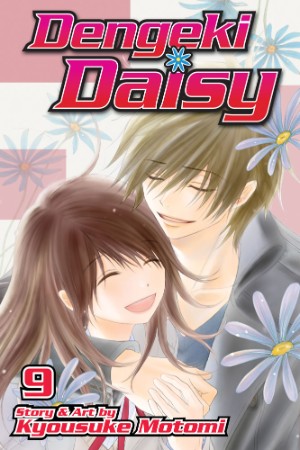
Dengeki Daisy, Vol. 9

By Kyousuke Motomi. Released in Japan by Shogakukan, serialization ongoing in the magazine Bessatsu Comic (“Betsucomi”). Released in North America by Viz.

I haven’t done a full review of Dengeki Daisy in a while. It’s been a very rough stretch recently too, as Kurosaki’s past has finally come out and things have taken a relatively dark turn. It may be disquieting for those who were enjoying this manga for its wacky romantic comedy and physical and verbal abuse of the leads. Luckily, this volume not only wraps up the dramatic arc (while leaving room for more in the future, of course), and gives us plenty of laughs.

Sticking with the dramatic for a moment, I liked how this was resolved. The dramatic thrust wasn’t “how will Kurosaki stop the bad guys all by himself”, it was “how will everyone get Kurosaki to stop destroying himself with guilt”. I was therefore not particularly surprised when I saw that a deus ex machina (or rather, deus ex Akira) had taken care of most of what they had to do. This allows Kurosaki and Teru to return to some form of normalcy. In particular, their reunion is pitch perfect, bringing some comedy back to the series at last, and giving some real heart – you really wish Teru was older so that these two lovebirds could finally get together.

As Teru notes, she *can’t* forgive Kurosaki – because right now, he can’t forgive himself, and as long as he can’t, there’s no point in other people doing so. However, he at least now knows that separating himself from everyone is not the answer, and if anything his love for Teru is even stronger. (In a purely platonic sense, of course – this is lampshaded by Riko, who tells him to give Teru physical comfort without giving her physical comfort, if you know what I mean.)

This leads to the second half of the volume, which might be fairly frustrating for those who were expecting that we were nearing the end of the series. After a brief fight/misunderstanding regarding Teru’s emails, the two decide that they will email each other as themselves from now on, and ‘retire’ Daisy – while at the same time realizing what Daisy did for both of them. It’s really sweet. However, when Riko notes that Kurosaki still hasn’t confessed to her, he notes that after everything that happens, it feels like they’re starting over, and he wants to take his time and get closer to her again. This is known as the “your series is very popular, let’s find some new subplots to add” syndrome. Still, I’m not opposed to it when the cast is as fun as these guys are.

I’ve occasionally compared this series with Black Bird, which also features a heroine who seems to be in constant peril, but could not be more different from Teru. Here in North America, you’d have to actively seek out both series to compare and contrast them, so the chance of a crossover audience is smaller. In Japan, though, both run in the same magazine – Betsucomi. This might make it easier to read both of them – you get Black Bird’s sensuous guilty pleasure for 40 pages or so, then you can flip to Dengeki Daisy’s more dynamic heroine as an antidote. (And then they can read We Were There for crushing despair! Though that ended this month.)

Dengeki Daisy is a riveting romance, with lots of emotional rollercoasters, a great sense of humor, and a heroine who rises above her peril to be strong and likeable. Not to mention a handsome, admirable (if grumpy) hero, who is only called a lolicon about 6 times in this volume, which may be a record low. (It’s in fun, trust me.) Highly recommended.