Category Archives: reviews

Reborn to Master the Blade: From Hero-King to Extraordinary Squire, Vol. 9

By Hayaken and Nagu. Released in Japan as “Eiyu-oh, Bu wo Kiwameru tame Tensei su. Soshite, Sekai Saikyou no Minarai Kisi ♀” by HJ Bunko. Released in North America by J-Novel Club. Translated by Mike Langwiser.

Sometimes I tend to dramatically overthink things. This even applies when I’m reading a series like Reborn to Master the Blade, where I know that the main motivation behind the author writing it is “have fun and cool fights”. So when Inglis had her body aged down that of a six-year-old early in the book, I started to theorize about what would necessitate this change in the book. Was it related to the engagements that Inglis and Rafinha are apparently going to face at the start of this volume? No, that’s not it. Is it to make Inglis less powerful so that she actually loses a fight and ends up learning an important lesson? Hardly, though there is one fight here where the records a draw. Then, by the end of the book, I began to realize the real reason: it’s because the author thinks that a 6-year-old Inglis is cute as a button, and wants more art of her than the first volume could provide. Fair enough.

Inglis and Rafinha return home to find that they have a bevy of suitors now, both being hot commodities. They both write to the royal palace to ask them to stop this; Rafinha because she only wants Inglis to marry Rafael, and Inglis because she doesn’t want Rafinha to marry ANYBODY. Before any suitors arrive, though, an experiment Inglis is trying goes wrong and now she and Rafinha are back in their six-year-old bodies! And bad timing there, as there is a Highlander who has heard about Inglis and is there to have a really good fight. He’s basically Inglis as a man, and the fight the two have is indeed epic, and takes up a big chunk of the book. Unfortunately, Inglis was using Eris as a weapon during the fight, and Eris got a little broken, so to fix her, they’re going to need to… well, need to wait till the next book, but the back half of this sets us up for that.

Not gonna lie, for all that he is a walking cliche, Jildegrieva was easily the best part of the book, finally giving Inglis the fight that she’s wanted since the series began – a fight that, admittedly, ends in a draw, but she is in a much smaller body now. Other than that, though, the other main plot of this book is basically introducing zombies to the story, and showing that someone is making it so dead assassins become zombies. This leads to mental trauma in some cases (Leone) and showing off to family in others (Lieselotte). But, as with Inglis becoming a child or Eris getting damaged/injured, it’s a plot point that is not going to be resolved this book. As a result, like a lot of books in this series, how much you enjoy it depends how much you like straight up fighting.

We’ve also caught up with Japan, so that next volume that explains everything may be a while. Ah well. Inglis is pretty cute as a kid (and there is thankfully a minimal amount of lolicon shtick that comes with it).

Modern Villainess: It’s Not Easy Building a Corporate Empire Before the Crash, Vol. 3

By Tofuro Futsukaichi and Kei. Released in Japan as “Gendai Shakai de Otome Game no Akuyaku Reijou wo Suru no wa Chotto Taihen” by Overlap Novels. Released in North America by Airship. Translated by Emma Schumacker. Adapted by Jack Hamm.

I want to be more mad at this series than I am. It’s ludicrously pro-capitalism and pro-cop. Our heroine builds gated communities for people in the previous book, then in this one seems to be absolutely shocked that racism exists in the United States. The bulk of the middle third of this volume involves her trying to prevent 9/11 from happening. She fails. But then you also see that 9/11 has been enhanced by a deadly nuclear train almost wiping out Denver, and you think to yourself, “Wasn’t that the movie Atomic Train?”, and you realize that the author really does not have a hidden message or meaning to this book at all. It’s not trying to use its heroine to show you that right-wing politics is good, actually. It’s an author playing with toys, and when there’s a section of the plot where, say, you can work in a Tom Clancy book’s plot, in it goes. It’s hard to get mad at a Tinkertoy novel.

Even the author admits that this volume’s “plot” is scattered. It’s basically events that happen before and after Runa’s 10th birthday. This includes the aforementioned 9/11, which happens DURING Runa’s birthday party. We get school adventures, like Runa doing sports and club activities, and also a mountain climb and a trip to Kyoto. We also get more of Runa being the hidden power behind most of Japan, and start to see the beginnings of a rift between her and Prime Minister Koizumi. But other people are finally beginning to realize that this little girl has her fingers in a LOT of pies, and they’re trying to stop her. Not necessarily for reasons of “I want to control what she has”, but also for upright reasons like “this 10-year-old girl is killing herself trying to do everything”. How much longer can Runa get away with this?

I was very amused at the new character in this book, a “high roller” type who, like most of the capable people in this world, ends up becoming one of Runa’s employees. Unlike the rest of her staff, who likely realize something is wrong but don’t say anything out of politeness, he straight up asks Runa how the hell she is doing this. Runa still has not quite admitted “I’ve been reincarnated into an otome game”, but there’s just no way to accept any of her decisions without thinking that she has supernatural powers. Hell, her friend Hotaru has them, why not Runa? As for Runa herself, I think the book’s weak point remains her “villainess” part of it. She seems torn to the point of tears about whether she can change her fate, but she’s not trying to make herself a better person, she’s just trying to make sure her financial empire is not ruined. She’s still sort of evil. Work on that.

I don’t really recommend this series to anyone but economics majors, but I still find it rather fascinating in a morbid way. The webnovel version of this has 11+ books of material, but the 4th volume is the latest published in Japan, so we’re mostly caught up.

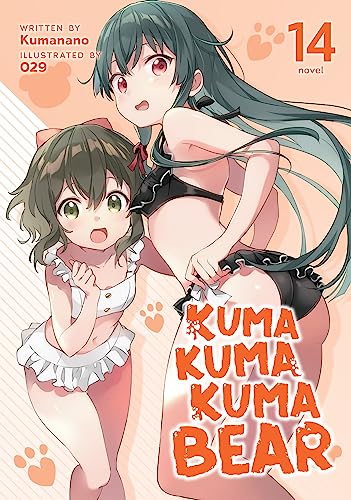
Kuma Kuma Kuma Bear, Vol. 14

By Kumanano and 029. Released in Japan by PASH! Books. Released in North America by Seven Seas. Translated by Jan Cash & Vincent Castaneda. Adapted by Lorin Christie.

No series has quite managed to make me eat my words quite as much as Kuma Kuma Kuma Bear, a group of books that is about an overpowered shut-in who wanders the land defeating powerful monsters and acquiring a string of little girls to follow her around and hero worship her. The start of the series balanced out the “cute girl doing OP things” vibe with some truly dark and weird plot points, with young girls being abducted, raped and killed, or Yuna having to repatriate a group of women whose families were murdered and who were *also* raped. To no one’s surprise, as this series got an anime, almost all of this was thrown out the window in favor of “let’s watch Yuna finance a bakery” and similar things. But it still occasionally dips its toe in darkness. Last time I was grumpy about Yuna’s pathological avoidance of praise being treated like a quirk of her personality rather than a genuine problem. In this new volume, it’s clear the author knows that, and is sending us to dark places again.

It doesn’t really seem that way at first. The majority of the book is Yuna coming back home after her trip to the land of giant scorpions. She presents a “Mission Accomplished” to the King, then relaxes in her bear house, only just remembering to tell Fina and the others that she’s back. She then prepares for the massive vacation to Mileela, which by the time it starts has about fifty people going (mostly the orphanage who are Yuna’s main child labor force… let’s not go there right now) and requires Yuna to create not only a big bear bus but two bear minibuses, powered through her mana. This requires her, on the journey there, to switch from her normal black bear outfit to the reversed white bear outfit, as she’s going to be using mana like a sieve. This leads to people not recognizing her at first, which merely irritates her… for now.

So yeah, once they get to the ocean and the beach, Yuna has to give in and remove the bear costume. She’s done this before at a palace function, but that was mostly filled with people who had no idea who she was anyway, so it was mostly her own personal safety that worried her. Same with the school festival. Here she has a bigger existential crisis: when she walks around as Yuna, dressed in a swimsuit and without her bear things, almost no one recognizes her. Literally, they stand next to her and ask Fina where she is. Fina, bless her, seems to be the exception to this rule. (Note that everyone, once they DO see it’s Yuna, immediately praise her pretty and petite body, but Yuna being Yuna, she doesn’t take this as praise at all.) At first Yuna is merely annoyed, but as it goes on and on, and as she attempts to do normal things (like teaching girls to swim) and failing as she has NO STAMINA without the bear suit, she gets more and more depressed. As she states to herself, no one is friends with Yuna, they’re all friends with “the bear”. The bear is the one that does everything. The bear is their savior. The bear is their friend. Yuna? Yuna is just an out-of-shape shut in.

Frustratingly, the book goes from Yuna’s spiral of depression to the usual end of book side stories, so we’ll need to wait till next time. Fortunately, as this book ran a bit late, next time is next month. Join me then to see if we get to see Yuna on the verge of a nervous breakdown, or if she simply shrugs everything off. Again.