Category Archives: reviews

Dahlia in Bloom: Crafting a Fresh Start with Magical Tools, Vol. 6

By Hisaya Amagishi and Kei. Released in Japan as “Madougushi Dahlia wa Utsumukanai” by MF Books. Released in North America by J-Novel Heart. Translated by Osman Wong.

There’s a lot going on in this volume of Dahlia in Bloom, but the most important part involves a conversation that really should have happened ages ago. This series began with Dahlia’s fiance, Tobias, being SUCH trash that he gained an almost memetic reputation as a trash man, and several volumes in we’re still piling on the humiliation for him, his family, and his company. But there’s also a backstory here. One of Tobias and Dahlia growing up together and knowing exactly how the other works. One of their marriage being one of convenience rather than romance, something that even Dahlia’s father is aware of. And it also helps show exactly why Tobias did what he did, and so rapidly: he’s never remotely felt romantic love before, and certainly not with Dahlia. It was a bolt from the blue. As such, when a crisis unfolds that requires Dahlia and Tobias to work together again, they’re finally able to sit down and have a conversation about what happened, and begin to move past it.

The crisis takes up the first half of the book. What was thought to be an illness turns out to be that her friend Irma is pregnant. Unfortunately, this is one of those worlds where magic is biased against the lower classes, and Irma’s husband turns out to be a noble’s illegitimate child, so he has far more magic than she does. As such, the pregnancy might kill her. To solve this, there’s a complex enchantment of a bracelet that needs to be done, and when Oswald and Dahlia find their magic is not compatible enough, they’re forced to turn to Tobias. Who, to be fair, helps immediately, and is quite chastened the entire time. We also see Dahlia’s influence and creativity inspiring others, either to expand on her inventions or expanding into their own companies. And, rest assured, food is eaten and alcohol is consumed.

I will admit, one thing in this book really surprised me, and that was the presence of Emilia in it. Emilia was not really a character so much as a macguffin, there to jump start the plot, and I have to admit that I was expecting, after Tobias was disgraced and everyone in town started to shun him, that she’d have simply vanished. But it actually works better for the book that she and Tobias really ARE in love, and that she’s still with him even after all that’s happened. And even though the two are very bad at talking with each other – she’s mostly convinced herself that if Dahlia tried to win Tobias back from her, it wouldn’t take much. I still don’t like either character, but I respect their poor choices. I also want to note that I hate the “nobles have stronger magic” system. We also see it in Bookworm, and I hate it there too. It’s an excuse to keep the common folk where they are. Dahlia’s inventions help a bit, but she has a ways to go before she’s Princess Anisphia.

Dahlia in Bloom continues to be one of the best J-Novel Heart titles, even if those waiting for the romance to happen must be groaning at another volume where neither party get any closer to admitting their feelings.

My Daughter Left the Nest and Returned an S-Rank Adventurer, Vol. 7

By MOJIKAKIYA and toi8. Released in Japan as “Boukensha ni Naritai to Miyako ni Deteitta Musume ga S-Rank ni Natteta” by Earth Star Novels. Released in North America digitally by J-Novel Club. Translated by Roy Nukia.

It’s been a long time coming, getting to this part of the plot. This is the seventh book of 10, but they’re pretty chunky books. And we’ve had a few flashbacks before to Belgrieve’s time as an adventurer in the past, but now at last we actually get to see the scene where he’s lost his leg, and really see how it affected everyone else. Including him, of course. He’s finally away from the comparative safety of his hometown or the big city where his daughter is based, and it shows almost immediately, in that he’s out of his depth. This is not to say that he falls behind or ends up being a liability – the opposite, in fact. But this is a series that has, as its main plot point, a daughter talking about how awesome her daddy is, so it’s nice to end up in what is essentially a Hellmouth so that we can see what he left behind.

Having finally left the village, the first three-quarters of the book is the journey, as Belgrieve and company set off to find Percival, who is rumored to be at the Earth Navel. Fortunately, the rumor turns out to be true, as Percival is there, but he’s a far cry from the happy-go-lucky lunkhead we’ve heard Belgrieve talk about before. As the group get clover and closer to the Earth Navel, the area gets hotter and more dangerous. In addition, Belgrieve is not the only one who has to confront his past, as Kasim runs into the guild master of a city they pass through, who not only has a clear crush on him still but is very bitter about this “:Bel” Kasim was always obsessed with. As they get closer to the Earth Navel, will things really resolve so easily?

There are times when I can feel the hand of the author on the plot a bit too much, such as when, just before arriving at the Earth Navel, Belgrieve is struck by a bad illness, so that he can look at death’s door when he finally meets Percival and cause even more angsty trauma. That said, I did laugh at the way that their past is resolved – Bel hits Percival till he feels better. I also really liked seeing Yakumo and Lucille again, especially Lucille, who still tends to slip old song lyrics into her speech (Bob Dylan’s “Don’t Thing Twice, It’s Alright” is the most obvious here). I also enjoyed Percival and Angeline bonding over killing monsters, even as Angeline is starting to slowly realize something she has been ignoring – spending years traveling around adventuring with her dad is probably not in the cards.

We’ve only got one more “past” character to reunite with, which I suspect will happen in the next book. Till then, of all the “Daddy and Daughter who really loves her daddy” series from Japan, this is probably my favorite.

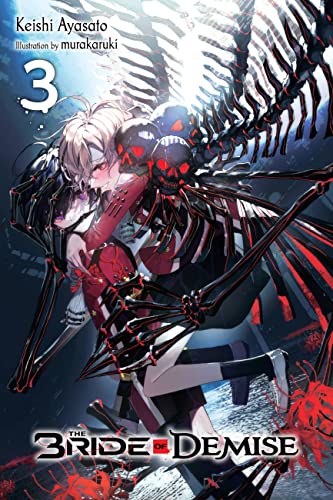
The Bride of Demise, Vol. 3

By Keishi Ayasato and murakaruki. Released in Japan as “Shūen no Hanayome” by MF Bunko J. Released in North America by Yen On. Translated by Jordan Taylor.

When I reviewed the second volume of this series, I noted that the first was a fantastic stand-alone, but the second volume was not nearly as good as the first. It would appear that most of the reading public agreed with me, as apparently the series’ sales were so bad the author was allowed to comment in the afterword that this third volume is the final one because of low sales. Unfortunately, I am here to say that this third volume is not nearly as good as the second. It has big Shonen Jump “please look forward to the author’s next work” vibes. The first half, at least, looks like it’s setting things up for future volumes down the line. But about 60% of the way through, you can almost see the point where the author was informed by the editor that this is the last book, and the rest is just a race to a finish line. Not the best finish line, but one that will have to do.

Things are back to normal with Kou… relatively. After the last go round of getting murdered over and over again, and rewinding time over and over again to fix it, Kou’s powers are no longer an immediate ‘get out of jail free’ card, and he can’t always use them when he wants to. That said, he’s also got to deal with more teenage boy problems. Let’s remember the warning that Asagiri was the only one who murdered him last time WITHOUT being mind controlled. And now she has been told – by someone unknown – that he has White and Black Princess, and so decides to go all out in confessing to him. And is rejected. Adding to this teen drama, their fried Isumi is in love with Asagiri, knows she’s in love with Kou, and is busy trying to keep himself from having a complete breakdown. That’s right about when Asagiri completely disappears.

This book didn’t help itself by having a couple of things I really don’t enjoy in my fiction. I’ve never liked the “yandere” trope in general, especially since it tends to be overused by fans to describe any girl who gets angry at all, but it’s definitely in place here, and I still don’t like it. There is a new character introduced here whose role is very obvious almost immediately, and especially when the author starts trying to wrap everything up all at once. On the bright side, the overall message of “you can’t always protect everyone equally, you have to prioritize those you care about” is a good one well handled, even if this also involves abandoning an entire school of students to their inevitable deaths.

The author said that if the series had continued, more of the regulars would have had to tragically die, so this is a decent place to end it. If I’m honest, two volumes ago was a decent place to end it. But if you’ve read the first two, this is here, I suppose.