Category Archives: reviews

Yuri Tama: From Third Wheel to Trifecta, Vol. 2

By Toshizou and Kuro Shina. Released in Japan as “Yuri no Ma ni Hasamareta Watashi ga, Ikioi de Futamata Shite Shimatta” by Overlap Bunko. Released in North America by J-Novel Club. Translated by Tristan K. Hill.

“Sean,” my readers say to me. “I’m happy that we’ve gotten a lot more yuri titles in the last few years, but what about fans of incest? Is there a book out there that looks closely at younger sisters who love their older sister and tries hard to do a deep analysis about whether it’s OK or not?”. OK, no. My readers never say that to me. That said, if that’s what you want, I have good news, the second volume of Yuri Tama is all about said feelings, and whether Yotsuba will decide to dump her new girlfriends for her sisters, or just have all of them in a giant polycule, or what. So yeah, good news for fans of that. If, on the other hand, you read the above and said “what the actual fuck?”, then you are like me and stared at this volume with dull horror. The author can certainly write. It’s just what they write that’s the problem.
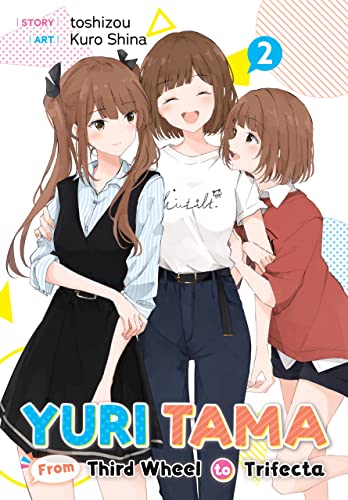
Yotsuba has managed to pass all but one of her exams, despite possessing the worst self-loathing of any light novel protagonist ever. This means she has most of her summer break free, and she plans to spend it dating her two girlfriends (separately). Unfortunately, each date is seen by one of her younger sisters, and now they’re both furious. Yotsuba is sure they’re upset that she’s “two-timing” the girls she’s dating, or they’re upset that she didn’t tell them she was dating at all. They’re not. They’re upset because they’ve been in love with Yotsuba since they were little children, and the idea that two other hussies have snatched her away is appalling. Can a family trip to a hot spring allow Yotsuba to explain? Or will it just make things worse?

So, let’s tick off the things I didn’t hate. 1) The author is somewhat self-aware that they are writing ridiculous shit, and it gets lampshaded a few times. 2) There is an attempt at discussing the differences between sexual attraction, familial love, and close friendship. It’s an attempt that is somewhat steamrollered by the plot, but the attempt is made. OK, I’m done with good things. Yotsuba remains the most annoying narrator ever, not being able to go more than three paragraphs without reminding us how awful and pathetic she is. Her sisters are, not to put too fine a point on it, creepy, and Yotsuba seriously considering loving both of them sexually boggles the mind. And unfortunately, because of this plot, Rinka and Yuna are sidelined. The dates may be the best part of the book, both because they’re not incestuous and also because Yotsuba shows an odd confidence that she doesn’t seem to be aware of herself. I want to explore that, not whether incest is OK.

I wish I could say that the series ended here, but a third volume of this came out last month in Japan. If you are really really desperate for yuri… please read something else anyway. Also, please use the word “two-timing” correctly! It’s consensual! They both know! Explain that!
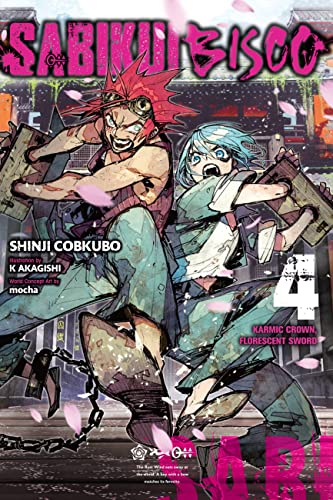
Sabikui Bisco, Vol. 4

By Shinji Cobkubo and K Akagishi. Released in Japan by Dengeki Bunko. Released in North America by Yen On. Translated by Jake Humphrey.

This review really cannot happen without spoiling the end of the book, so beware if you do not want to be spoiled, though I will try not to exactly spoil. Throughout most of this volume, this has the feel of a “makework” volume in the series, as events happen but it lacks the striking imagery of previous books, which was one of the major reasons we read it. It also is not as gay, which is the other reason we read it, mostly as Bisco and Milo spend most of the book separated from each other, and there’s only one or two moments, such as brief princess carry, or Milo staring in what is clearly jealousy at one point, that makes you realize the writer knows what they’re doing. But it’s all right. It’s got some really cool fight scenes, Bisco is funny at times, we have a new waif who needs to be guided/rescued, and we get a little more development of the post-apocalyptic works with a slave race. OK, that last part is questionable.

We open with a teenager escaping from what appears to be a maximum security prison, only to be caught almost immediately, and their rescue/medical treatment by Bisco and Milo, and we then backtrack to see why they’re in a prison in the first place. They arrive at what is supposed to be a mushroom keeper’s village only to find it nearly deserted, covered in sakura flowers. The tribe have been arrested and thrown into a maximum security prison by the warden, who is very big on justice in a “Shonen Cop Gone Bad” sort of way. Shishi is part of a tribe called the Benibishi, an artificially engineered plant-based species designed as slaves. All the Benibishi are ALSO in the prison, and Shishi’s father, their King, is due to be executed. Now Bisco and Milo have to get into the prison and try to resolve things… except that they’re promptly arrested and thrown in there anyway.

Starting off with the one really great part of the book. The third volume ended, to the surprise of most readers, with Pawoo marrying Bisco, and she’s come along in this book as well. Then, a third of the way through the book, the prison warden grabs her and simply throws her out of the book and back to her home town. We never see her again. It’s jaw-droppingly funny given the novels’ BL tendencies. Well, that’s the good out of the way. Shishi is briefly presented as trans, but it’s unclear if that’s gender-based or just has to do with the idea of “prince”, and the book uses female pronouns for Shishi throughout. The Benibishi all are jailed because there is a worry that they will go mad with revenge and try to kill those who wronged them. Their plant nature means they run the risk of getting caught up in murderous rage, and the King warns Bisco and Milo about it, so they help his daughter calm down and not choose violence.

And then comes the ending, which is like the author giving you a nice warm hug and then stabbing you in the back. Now, I will grant you there’s certainly a plot for Book 5 now, and I wonder if the only reason this happened is the author ran out of things to do in this series. But man, Shishi’s actions in the last three pages or so leave SUCH a bad taste in my mouth that I can’t really recommend this anymore. A merely okay volume of the series till the ending brings it down to bad.

High School DxD: Lionheart of the Academy Festival

By Ichiei Ishibumi and Miyama-Zero. Released in Japan by Fujimi Fantasia Bunko. Released in North America by Yen On. Translated by Haydn Trowell.

Generally speaking, harem series rarely have to ask the question “why is the guy not understanding that all these girls who are literally naked in his bed saying “take me now, big boy!” kinda like him?”. The reason for that is that in most of these stories the answer is the same. It’s a variation on “don’t be silly, no girl will ever like me.” Harem protagonist never comes without a heaping helping of self-loathing, it would seem. Fortunately for High School DxD, it can actually give Issei a real reason for all that self-loathing beyond “because the plot requires it”. His first girlfriend, the one who he finally thought would be the girl that did not see him as a creepy pervert loser (which, sorry Issei, he is) rejected him bluntly multiple times. Oh yes, and turned out to be evil, tried to kill him, and was murdered in front of him. So when you ask “why does he not understand why Rias is so mad in this volume”, the answer can be, frankly, “trauma”.

We’ve had the sports festival and the school trip, so clearly it’s time for the culture festival. Maid cafe? Haunted house? Why not do both? As the Occult Research Club prepares to pull out all the stops, they also have a fresh new Rating Game, against an up and coming team whose leader, Sairaorg, has no demonic powers, but has to get by with his charisma and his brute strength. He is, frankly, a perfect opponent for Issei, and the fight takes up the entire second half of the book. Unfortunately, there’s trouble in paradise: After being as subtle as a truck and failing to get her feelings across to Issei, Rias spends most of the book miserable and thinking that he doesn’t actually love her. He’s not helping things by not understanding why calling her “Prez” feels like distance. Can they make up in time to win the match?

I haven’t mentioned breasts at all yet in this review, so I want to sadly reassure fans of the series that they’re still ridiculously essential to the plot, with the funniest fight in the book revolving around a woman taking off her panties before her bra, something that absolutely infuriates Issei. As for he and Rias, frankly, the two are more similar than you’d expect, and of course are the main couple of this series. And yes, finally we can say “couple”, given that we get an incredibly overdramatic and public confession (it’s High School DxD, where everything happens in front of the biggest crowd imaginable) which, more importantly, is followed by a quieter but just as firm confession when it’s just the two of them. It doesn’t take a genius to realize that this is a “marry everyone” kind of series, but it has to start with Rias, and now it has.

That said, haven’t things gone a bit too well for our heroes lately? (Well, except Akeno, who got annihilated in about ten seconds. Sorry, Akeno.) Gosh, I hope nothing absolutely tragic happens in the next book…