Category Archives: reviews

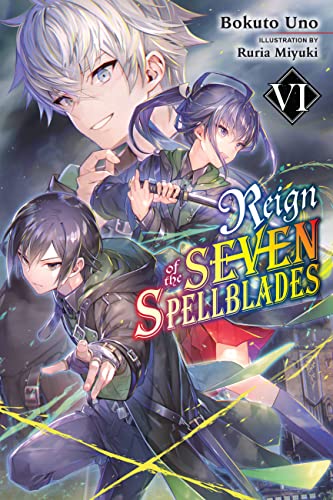
Reign of the Seven Spellblades, Vol. 6

By Bokuto Uno and Miyuki Ruria. Released in Japan as “Nanatsu no Maken ga Shihai suru” by Dengeki Bunko. Released in North America by Yen On. Translated by Andrew Cunningham.

It has to be said, when your goal is to kill a bunch of teachers and get away with it, it will become harder and harder as time goes on, mostly because the other teachers are starting to investigate. That’s the dilemma that Oliver and Company (I’m so sorry) find themselves in here, as the headmaster is starting to get very annoyed about these deaths, and is investigating absolutely everyone. That said, our conspirators do seem to have the next victim chosen, and their plan may very well be to upset her so much she spontaneously combusts in rage. That said, this book mostly deals with two things: 1) Oliver’s recovery from the last book, which is much harder than he expected and needs a drastic solution, and b) the tragic but triumphant story of Diana Ashbury, and a reminder once again that Reign of the Seven Spellblades as a series is likely to end with Nanao the sole survivor walking away from the smoking corpse of a campus.
First off, let’s get the one terrible thing about this book out of the way: there’s a creeper who is defined by a) his desire to rape another man, complete with lascivious grin, and b) his enormous erection, which is described far more than I would really like. He’s a massive negative stereotype, and it’s something of a relief that he doesn’t show up much more in this book. That said… this series is really, really horny. We recall Oliver’s magical handjob from two books ago, and now we get his burgeoning relationship with Nanao, where they’re not having sex but everyone assumes that they are. So honestly, when Oliver was having his soul problems I was expecting our sextet to come up with a more AO3-fanfic sort of solution. That said, their actual solution – a game of hug tag – is adorable and sweet.

And then there’s Ashbury. One of the things that this series hammers home over and over again is that much o the cast is obsessed with one thing or another, and with Ashbury it’s speed. She’s head and shoulders above anyone else, and the faculty have their eye on her to break the world record for speed on a broom… without the inevitable death that comes along with it. But even in this part of the book things are tied together in a shipping sort of way – Ashbury’s catcher (and, it’s implied, romantic partner) has been missing for the last two years, and so while she’s amazing, she’s not the amazing she wants to be. The final quarter of the book is absolutely stunning, and I also loved the bond that develops between Ashbury and Nanao, and wish we could see more of it. Still, this ending was pretty much the series in microcosm.

I haven’t even mentioned the student council elections, but that’s OK, because I suspect they will take up a lot of the next book. Till then, this is absolutely terrific to read, but can also be very painful. In a good way.

Modern Villainess: It’s Not Easy Building a Corporate Empire Before the Crash, Vol. 2

By Tofuro Futsukaichi and Kei. Released in Japan as “Gendai Shakai de Otome Game no Akuyaku Reijou wo Suru no wa Chotto Taihen” by Overlap Novels. Released in North America by Seven Seas. Translated by Alexandra Owen-Burns.

Oooof. I’m starting to suspect that having villainess books with modern ties is a mistake. Give me a villainess who’s in fake nobility land with some magic and a few broken engagements and I’m golden. But I’m remembering Villainess Reloaded, the story of the young woman who decided to solve everything by bringing a bigger gun. I had to drop that one as I was starting to get the sense that the heroine was morally bankrupt. There’s far less doubt here – Runa is appalling. In the game her life was destroyed because of the modern economy that crashed in 2008. She’s decided to fix the economy… but she’s still not changing her villainess ways. Indeed, she’s doubling down on them. When your heroine decides to build a gated community to protect the rich folks, you start to wonder if reading this series is an ethical problem. It’s a shame, because other than that insurmountable problem, the series is otherwise excellent.

The book essentially divides itself into two alternating sections. Half the time we’re watching Runa the capitalist, still trying to solve all of Japan’s debt problems. She has a time limit as well – the current government that she has so many ties to is falling, and the new government, headed by real-life prime minister Junichiro Koizumi, is far less favorable to powerful families like hers. The other half of the book is Runa’s life at school with her friends, where she does things like the culture festival, a snowball fight, etc. She’s still in grade school here, something that she emphasizes a great deal, but that does not stop her from having to worry about a fiance or hiring a new group of servants-cum-bodyguards. No one thinks that she’s just a cute little girl anymore.

The author REALLY nails Runa’s colors to the mast here. She attends the Republican National Convention in 2000, clearly supporting George W. Bush. She also meets with Norman Schwarzkopf and then-chairman of the Joint Chiefs of Staff Hugh Shelton for one of her many money-making schemes (though I suspect the author may have been thinking of Colin Powell there). Note that, aside from Koizumi (who is mentioned but never seen), none of these people are actually named in the book, but you know who they are. The main problem is that I can’t tell whether we’re supposed to condemn her actions or not. There are several people, throughout the book, who tell her to slow down and stop buying up all this failed debt, including her own brother and several of her minders. She even admits at one point she’s completely forgotten about the value of actual money. I think the main issue, unstated for the most part, is that she can’t stop seeing herself as the bad guy of the game this comes from. And she doesn’t really want to.

As I said, the writing here is good, and I want to see what happens next. But, as noted above, it may be morally and ethically wrong to read this series. Let the buyer beware.

High School DxD: A Demon’s Work

By Ichiei Ishibumi and Miyama-Zero. Released in Japan by Fujimi Fantasia Bunko. Released in North America by Yen On. Translated by Haydn Trowell.

Generally speaking I’ve been able to skate by on these High School DxD reviews because I can usually somehow get past all of the boob talk and the “funny” comedy antics and even more boob talk to find something I can actually discuss like a reasonable reviewer, be it the fights, the character development (it does actually exist), or the overall plot of that particular book. So, you’ll have to pardon me if this review in particular seems to be a little lacking in content, as this is a short story volume. Meaning there is no overall plot, and no character development. Oh, and almost no fighting either. In its place, we have even MORE boob talk and “funny” comedy. As such, we are forced to fall back on the usual rule of light novel short story volumes: the longer the story, he better it actually is. That holds true here, as the last story in the book is the longest and one of the few that deserves attention.

In this book: 1) Issei and Rias try to help a woman who summoned a demon to help her love life… but she’s American, and her idea of Japan is more samurai-oriented. 2) Issei and Asia are told they need to get familiars, but Issei’s choices are all super powerful rather than super sexy. 3) Issei explains to the club the story of how he became obsessed with breasts, which involves a creepy old man corrupting a child. 4) The club has to play a tennis match against a rival in order to complete a club activity report. 5) Asia and Rias are turned into little kids by a spell gone wrong. 6) Azazel accidentally clones Issei three hundred times, and the clones are even more breast-obsessed than he is. 7) Sirzechs and Grayfia show up at Issei’s, and remind Rias that she has to perform a ciming of age ritual with a loved one… i.e. Issei.

There are precisely three stories in this book that cannot be summed up by the words “Oh my God, fuck off.” The first story is actually pretty funny, especially Susan’s misplaced sense of what Japan is actually like. The story of Asia and Rias as kids is at least mildly cute, and features Azazel abusing Issei in a much more acceptable manner than the other story he’s involved in. And the final story is the most involved. We meet the other Demon Kings for the first time, and we get another example of the “they are wearing an obvious disguise but no one notices this except the protagonist” joke, which always seems to work for me for some reason. Other than that, please see above. High School DxD may be unabashedly horny, but I have my limits, and they were pushed hard here.

Despite the presence of one or two non-sucking stories, this is a volume that can easily be skipped, IMO. Next time we should get a school trip… and hopefully a plotline.