Category Archives: reviews

So I’m a Spider, So What?, Vol. 14

By Okina Baba and Tsukasa Kiryu. Released in Japan as “Kumo Desu ga, Nani ka?” by Kadokawa Books. Released in North America by Yen On. Translated by Jenny McKeon.

The subtitle of this volume could be summed up as “At Long Last”. At long last, we have finally caught up with where we left Shun, Katia and the rest of the human cast in Book 5. At long last, we get several extended flashbacks explaining to us the origins of Ariel, Potimas, and Guli-Guli… erm, Guliedistodiez. But perhaps most importantly, at long last, Potimas is dead dead dead. Yes, technically this is a spoiler and it happens at the very end of this volume, but I think most readers of the series won’t blame me too much, because every single one of us have wanted that asshole dead for almost ten books now, and it’s about damn time. Of course, there’s one slight problem with all these things happening at once, which is that none of them really land as satisfyingly as I want them to. For a book that should have been a home run, this ends up being merely “okay”.

The Imperial Army, augmented by hidden demon army members, has arrived at the Elf Village to kill every single elf there, including Potimas (but excluding Ms. Oka, who gets a pass for being nice to our spider long ago). Ariel asks White to leave Potimas all to her, which White very reluctantly does. But that’s fine, as it turns out there’s a lot more going on, including robots, giant robots, even gianter robots, massive sea urchin robots, and UFOs. All of these force White to work harder than she’s ever…. well, no, White barely breaks a sweat, but she does have to use a few tricks she’d been saving for later. As for the rest of the human cast? Erm, sorry, the title of this book is still about the spider. They barely get a look in. In the meantime, Ariel has flashbacks to her past, and the previous end of the world apocalypse, which is mostly thanks to Potimas, though the dragons helped.

There is some funny stuff here. White’s narration is always amusing, especially as Potimas keeps topping himself with more and more dakka. Her four spider daughters are also very amusing as they have to team up with Ronandt, something which pleases them a whole lot more than it does him. But for the most part I think the parts of this book set in the past don’t land as hard as they should, because they’re told from the perspectives of three people who were not present at the major events. It is interesting to see Ariel as a wheelchair-bound near death teenager, and helps to explain a lot of her actions (as well as her relationship with Potimas). That said, I’m going to be honest, the most interesting part of the book was the final line. White has always been a bit of a villain protagonist. Is she finally going to turn full evil?

So yeah, Spider fans will like this, but not a lot. The next book promises to be a banger, though.
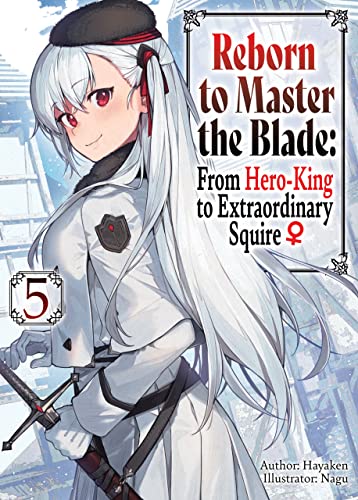
Reborn to Master the Blade: From Hero-King to Extraordinary Squire, Vol. 5

By Hayaken and Nagu. Released in Japan as “Eiyu-oh, Bu wo Kiwameru tame Tensei su. Soshite, Sekai Saikyou no Minarai Kisi ♀” by HJ Bunko. Released in North America by J-Novel Club. Translated by Mike Langwiser.

I am deliberately not reading prior reviews of this (which I normally do), because I know I will be typing the exact same goddamn thing again. There’s just no avoiding it. So here we go: This series only has one joke. It’s STILL a good joke. That said, the dichotomy between Reborn to Master the Blade as amusing reading about a meathead and her slightly less meathead sister and Reborn to Master the Blade as a dark fantasy with a lot of casual death is widening, and it does not always mesh together well. There’s a moment in this book where an entire city rises into the air, and Inglis notes that this is likely due to a LOT of people being executed to harvest their energy. And, as it turns out later, she is correct. However, we barely notice this as we’re listening to Inglis trying to figure out how to clone herself to solve her fighting problems.

Inglis and company are traveling in secret to Alcard, in order to try to do something about the impending war. Unfortunately, Alcard has changed a LOT since the last time Lahti, Pullum and Ian were there. The people are starving to death, their food having been taken at the behest of their heiral menace, Tiffanyer, who has the power to make anyone sing “I Think We’re Alone Now”… erm, well, I’m not sure if her power is literal brainwashing or merely incredible charisma, but she’s won over a lot of the knights of Alcard, including Lahti’s older brother. She’s also hella strong, meaning Inglish is having trouble focusing on the mission and not focusing on getting a really good fight with Tiffanyer. That said, the thing that shows up at the very end of the book makes even our favorite meathead step back and pause to reflect.

Again, the one joke is a REALLY GOOD JOKE. The running idea of Inglis thinking about cloning herself, and being told the many ways this is a bad idea, then trying to fix it by tripling herself… it’s hilarious. It will never happen, and THANK GOD, but it’s hilarious anyway. I also loved the desperate stupidity of the world’s two hungriest girls trying to get by on eating snow with sugar and salt sprinkled on top of it. Beyond that, however, things are pretty dark. There’s one point where they literally find a church full of dead children who starved to death due to the machinations of Tiffanyer. What’s more, she’s not merely evil for evil’s sake – she’s grabbing what she can because she knows the penalty for failure. It’s increasingly likely that peace is not something that’s coming anytime soon. And given what shows up at the end of the book, apocalypse is looking a bit more likely.

If you can tolerate the book turning from “this is a horrible tragedy with the corpses of children” to “dur hur Inglis love fighting!” this is still a fun series. Plus the books read fast.

Slayers: Hatred in Selentia

By Hajime Kanzaka and Rui Araizumi. Released in Japan by Fujimi Fantasia Bunko. Released in North America by J-Novel Club. Translated by Elizabeth Ellis.

At last, I have something to talk about. That is not a good thing. The Slayers novels are fast-paced, action-packed, have some interesting fantasy plotting, and Lina and Gourry are fun, but let’s face it, the reason this series is beloved is that the anime took the characters and fleshed them out, made them human. Character development and deep emotional pain is not something that Kanzaka specializes in or is good at. And that’s going to be a problem with this book, whose second half relies entirely on the death of a beloved character and said death driving another character to an extended murder spree, one that I suspect may continue in the next book. There’s just one problem. The emotional impact is taken as read. The author assumes we will be devastated when this character dies, but mostly we’re merely surprised at how fast and pointlessly it happened. And the roaring rampage of revenge is more of a mildly simmering rampage of revenge. Slayers runs on snark and fighting. When there isn’t either of those, it gets into trouble.

Lina and Gourry come to Selentia, a city where religion is the biggest mover and shaker. There’s a high priest as well as four other slightly lower priests. Unfortunately, the high priest has just burned to death in an “accident” that no one thinks is an accident. Lina and Gourry are hired by the Sorcerer’s Guild to investigate, and find that there’s a lot of motive but not a lot of evidence. That is until we get more killings happening. What’s more, Luke and Mileena are here again, being hired bodyguards for one of the priests. Can Lina and Gourry figure out what’s happening and stop it before the entire city turns into a blood-soaked canvas? Answer: no.

Kanzaka apologizes to readers in the afterword for Amelia and Zelgadis not being in this, but for the wrong reason. He states that if they’d been there, they could have healed the fatal wound and thus avoided everything that came after. That said, I think the bigger problem is: this should have been Zel and Amelia, not Luke and Mileena. After being introduced in Book 9, the two of them have had “replacement scrappy” written all over then, despite occasional attempts at depth. Frankly, if Kanzaka had simply used Amelia and Zel in Book 9-14, and had Amelia killed off and Zel go on a rampage, the impact would have been much greater because we actually care about them. And, see, I say that, but I can’t bring myself to believe that either. Because Mileena’s death is so fast, so lame, and so emotionally void that it took me a while to realize it had happened. Kanzaka cannot write depth. And that means this book winds up suffering terribly, because it’s where depth is needed the most.

This second “arc” in the S;layers series will end in the next volume, and I suspect will wrap up Luke’s plot as well. I hope it’s filled with cool action sequences and magical battles. Because really, why else would you read this?