Category Archives: reviews

Accomplishments of the Duke’s Daughter, Vol. 5

By Reia and Haduki Futaba. Released in Japan as “Koushaku Reijou no Tashinami” by Kadokawa Books. Released in North America by Seven Seas. Translated by Andria Cheng.

Now, I know what you’re thinking, isn’t this series eight volumes in total? And yes, it definitely is. That said, this fifth book is the final one of the main series, resolving most of the plot points and wrapping up the love affair between Iris and Dean. Gonna be honest, it feels a bit rushed. This is very odd, as this comes from a webnovel, so by definition should not have to worry about “the book isn’t selling so well, wrap it up next volume” woes. That said, it still feels rushed. Leticia’s subplot is not exactly out of nowhere, but I wish we had another book to develop it more. Alfred’s fate is handled as dramatically as possible, and certainly devastates Iris, but the reader is just sighing and going “uh huh”, and I’m pretty sure the author knows this, so the impact is lessened. It’s a decent book, it just is not quite as good as previous ones.

Tasmeria is going to war, which means Iris has to return to her domain to prepare. Good thing, too, as her port is one of the first to be attacked… by a completely different country. Is this related to the proposal she got last volume? There’s also the problem of Alfred also having to go to war, as when you’re the recent victor of a throne war you don’t sit back in the palace and let others fight for you. Unfortunately, this turns tragic when Iris hears the news that he was killed by an archer’s arrow. Devastated, she loses herself in grief for a bit before managing to pull herself together in time for the rest of the war to wrap up smoothly… thanks in great part to her mother’s secret identity as the most feared warrior in the land. (Secret to Iris, at least.) That said… is Alfred/Dean really dead?

The best scenes in the book are probably a) the ones with Iris’ mother Merellis, who is sort of what happened if the “ohohohohohoho!” ojou could also kick your ass and stab you, and b) the subplot with Edward and Yuri. By this final volume Iris’ past life in Japan is not even mentioned once, and the villainess part has long been thrown out the window. It briefly comes back here, though, as Iris and Yuri have a final confrontation and Iris states bluntly that the fact that Yuri is afraid to trust anyone is what led to her downfall. If Yuri had confided in any of her love interests, particularly Edward, things may have been different. Edward and Yuri’s story also impacts Leticia, who is essentially taking over the entire country this book, and for the most part doing it regally and stoically – though the cracks do show on occasion. I wish we’d seen more of her.

I also wish we’d seen more of Marellis’ past, but that’s being taken care of, as the next volume will tell us her story. Till then, this is the end of Iris’ story, and she’s happy, but I’d give the book only a ‘satisfactory’ as a grade.
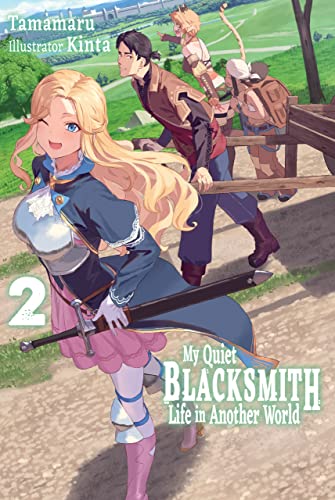
My Quiet Blacksmith Life in Another World, Vol. 2

By Tamamaru and Kinta. Released in Japan as “Kajiya de Hajimeru Isekai Slow Life” by Kadokawa Books. Released in North America by J-Novel Club. Translated by Linda Liu.

One thing that I’m not sure I say often enough here is that you don’t need a reason to like something. There are, of course, numerous reasons to NOT like something, but sometimes, let’s face it, you just vibe despite yourself. My Quiet Blacksmith Life in Another World is, on paper, something that hits a lot of the wrong buttons. Our hero has mad cheat skills. He constantly puts himself down at every opportunity, while everyone around insists he’s the best. He’s not just a blacksmith but a brilliant swordsman (which he will not admit). Last book he accumulated three women who like him, two of whom go so far as to move in with him. In this new book he meets a noble daughter (who moves in with him) and a cute elf. The women, or at least the ones who move in, are clearly in love with him, something he refuses to acknowledge. Oh, and it’s super long. This should be dire. Instead, it’s a great example of slow life.

There are two main plots in this volume. In the first, we find out why Eizo’s friend the gate guard suddenly vanished one day – he’s actually the third son of a noble family, and there’s a dispute over who takes over after the count and his eldest son die in mysterious circumstances. The 2nd son is from a mistress, so Marius is in line to take over, but second son does not like that at all. As part of all this, Diana, the daughter in the family, is sent to live with Eizo and company in hiding. That said, you know Eizo’s gonna get drawn into the throne war as well. After this, an elf named Lidy arrives with a broken mithril sword, which she asks Eizo to repair. This will be tricky, as the sword is also magical, so it can’t be reforged using normal means. Fortunately, it turns out that our hero has the ability to make magical swords too. Phew. Bullet dodged.

As with the first book, get ready for a lot of detailed description of forging swords, which, if removed from the book’s page count, would make this a normal sized light novel. That said, the forging is also what makes the slow life part happen, as for once this is a slow life book that really is slow life, rather than “I am trying to have a slow life but keep getting caught in life-threatening schemes”. And, let’s face it, looked at from the perspective of the women in the home watching Eizo smith, it’s seeing a handsome, kind, and sexy man show off his strong muscles and exquisite attention to detail. They are getting a full meal of eye candy every day. I will admit to being amused at the extra addition to the household, an wonder if this can be the light novel equivalent of the 100 Girlfriends Who Really, Really, Really, Really, REALLY Love You. Well, probably not, Eizo will never try anything. The others might, though.

So yeah, does most things wrong, still quite good. Give it a shot.

Sabikui Bisco, Vol. 2

By Shinji Cobkubo and K Akagishi. Released in Japan by Dengeki Bunko. Released in North America by Yen On. Translated by Jake Humphrey.

Last time I had asked myself how the first volume, which was excellent but felt very much complete in one volume, would become a long-running series. The answer, at least judging from this second volume, is to do more of the same. More mushrooms, more relationships that end up in betrayal and then reverse betrayal, more of Bisco and Milo being as gay as possible, and more love interests who could also function as family who are there to reassure the macho Dengeki Bunko reader that it doesn’t have to be TOO gay if they don’t want. Fortunately for all concerned, there’s one other thing which is the same as last volume: it’s just as good. This is a rollicking action piece, with lots of violence, some death, and a lot of fun dialogue. Plus it gets a move on faster than the first volume. Of course, there’s also the problem that Bisco and Milo accidentally release the man who will become the book’s main villain, but let’s face it, he was gonna get out of there soon anyway.

Now that Bisco is both a wanted criminal and very famous, he not only has to watch out as he and Mlo travel the land, but he also has to deal with a score of two-bit hoodlums pretending to be him in order to shake down others. While dealing with one of these idiots, they end up headed towards the Six Towers of Izumo, where they hope to find an answer to Bisco’s immortality. What they do end up finding is the old man who they rescued from the earlier two-bit hoods has literally cut out Bisco’s stomach, because liver and lights turns out to be a lot more religious and magical in this particular city. Teaming up with Raskeni, a grim but determined doctor, as well as her apprentice, teenage Amli, they try to figure out how to stop Kelshinka, get Bisco’s stomach back, and also perhaps stop the entire city from turning into a tower of death and destruction.

The best part of the book is probably Amli, who is a bundle of sunshine and joy, but who also has a bit of a tragic core that comes out more and more as we get further into the book. She also fills the role that Pawoo played in the first book, which is to say she gets a massive crush on Bisco, though she’s not sure if she wants him as a big brother or as a romantic partner. That said, she has a ways to go to get to the level of Milo, whose love for Bisco, and vice versa, is becoming a literal religious experience. If you told me that this author read Reborn, Gintama, Kuroko’s Basketball, and no other Jump manga, I would not be the least bit surprised. Oh yes, and there are an awful lot of fights, mostly involving mushrooms, and an awful lot of death and gore, also mostly involving mushrooms. It can get very dark. But fear not, it’s Shonen Jump. Sort of.

If you wanted exactly what the first book did, only more of it, great news. This series does not disappoint.