Category Archives: reviews

Ishura: The New Demon King War

By Keiso and Kureta. Released in Japan by Dengeki no Shin Bungei. Released in North America by Yen On. Translated by David Musto.

I almost didn’t get this. It ticked off quite a few boxes in terms of “things I’m not interested in”, was very long, and looked like it would consist of one big fight. Most of those things are true, but I will admit that the book definitely picks up as it goes along, especially in the second half. It suffers from having a sprawling cast, each of which have to get their own introductory chapter to show off why they’re here and why they’re really pretty strong. Unfortunately, this means that it feels like we’re reading 16 prologues at times. In the back half things get much better, the fights are indeed very cool, and there are some surprisingly touching moments. I enjoyed reading it, in the end. That said, I’m pretty sure that this will be the only volume I read because, no matter how well it tries to hide it, this series is going to come down to two genres that I really cannot stand. It’s both a tournament arc AND a survival game.
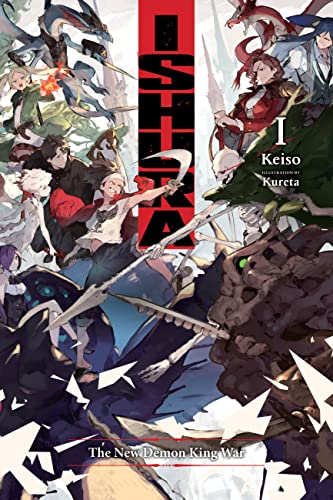
This world we’re introduced to seems to have everything. There’s wyverns AND dragons. There’s various kinds of magic. There’s walking skeletons and walking mandrakes, both super powerful. And there’s isekai’d Japanese folks, though for once they’re just part of the cast pile – we learn nothing about who they were or why they ended up here. The first half of the book sets up for a war between the main city Aureatia, which is run pretty much by humans – called “mitia” here – and Lithia, a city that has split off, with its ruler declaring herself the new Demon Lord. That title is a bit taboo these days, especially after the appearance of the True Demon Lord. In the second half of the book, the war begins and we see who lives, who dies, and who gets tragic backstory and THEN dies.

As you’d expect with a book like this, some character arcs work better than others. My favorite was Kia, a young, seemingly blase elf girl with the power to control absolutely anything with her words. At first she almost comes across as a bargain-basement tsundere, but as the book goes on and she learns about how the world works – and what her powers can do – she suddenly gains morals and ethics, much to the horror of her teacher, an assassin named Elea who is trying to murder anyone who discovers Kia’s secret. I also enjoyed the touching relationship between Regnejee, a battle-hardened wyvern who is a little battle-hungry, and Curte, a blind woman who lives in a tower and marvels at everything Regnejee says… or at least that’s how it looks at first.

I could go on, I’m sure. There’s something for everyone here, and I liked the use of names and titles, which reminded me quite a bit of Katanagatari. As a fantasy series with a high body count, it’s a real winner. It’s just not my thing.
Sword Art Online, Vol. 24: Unital Ring III

By Reki Kawahara and abec. Released in Japan by Dengeki Bunko. Released in North America by Yen On. Translated by Stephen Paul.

Given that this series has now been running for twenty-four volumes, it’s no surprise that the current arc is seeing a lot more discussion of what has come before. This is especially true now that Kawahara has caught up with himself and no longer has to quietly edit the crappy things he wrote when he was 20 years younger. There’s a lot of interesting stuff that never really got developed in the past that can now be looked into at more leisure. This is the concept behind the Progressive series – which these books pretty much make clear have sort of usurped the original first volume as being canonical – as well as the movie, which also gets referenced here. The line between canon versions of Sword Art Online is blurring. And given that, it’s no surprise that, despite the current death game-esque plot of Unital Ring, complete with a Death Collar of sorts for Kirito, we’re still heading back to the Underworld, which may be 200 or so years into the future but still manages to ask the important question: is *he* REALLY dead?

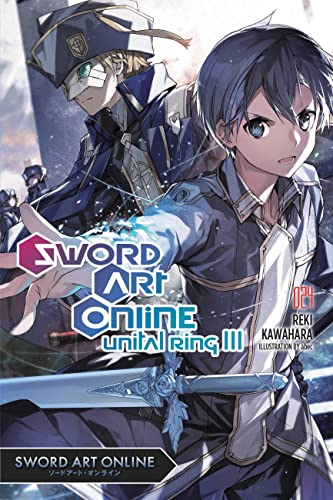
(Man, covers always spoil, huh? So much for my trying to be ambiguous…)

Kirito is having a bit of a rough time at the moment, though honestly compared to “I am in a coma” it’s going pretty well. In Unital Ring everyone seems to be trying to kill his party. Someone has apparently dived into the Underworld without authorization, which means there needs to be an investigation. And, most importantly, it’s Asuna’s birthday and he has to get just the right present. Frankly, he’s pretty much a dumbass about that, and it’s a good thing that Argo is back in his life to give him enough hints that he can do the right thing. Argo and Alice get to spend time with Kirito in Unital Ring this volume, as Argo has finally given in and ported her character in. Good thing too, as it turns out that it’s not just SAO, or ALO, or GGO, it’s lots of other virtual reality games. Meaning we also get GIANT INSECT BATTLES!

I suspect there may be some fans who are a bit grumpy about the supposed reveal towards the end of this book. That said, “Nobody dies in Bleach” is the phrase, not “nobody dies in SAO”. There have been important characters killed off. So I think we’re allowed to give the author a bit of rope here, especially as there’s no confirmation that it *is* who Kirito thinks it is. That said, I cannot help but be reminded of the separation of Alice Zuberg and Alice Synthesis Thirty and go “Hrrrm”. Aside from that, I continue to be amused, given his reputation as the all-powerful light novel hero, how much of this book shows Kirito being mocked or screwing up. I mean, yes, he does some cool things, but that’s mostly because his human strategy guide is back. Of course, he fares better than Asuna, who has an incredibly cool battle… recapped for us as it’s offscreen. Bleah.

This arc is settling in to be another long one, but at least it has the entire cast this time, so fans should be a bit more happy than Underworld. Till next time: d’awwww. sugar maple tree.

When Supernatural Battles Became Commonplace, Vol. 2

By Kota Nozomi and 029. Released in Japan as “Inou Battle wa Nichijoukei no Nakade” by GA Bunko. Released in North America by J-Novel Club. Translated by Tristan K. Hill.

So this was a nice improvement on the first volume, though I will continue to say that I hate it whenever this book has a real plot that it wants is to care about. It’s at its best when it’s just shooting the shit and riffing on Japanese media cliches. Unfortunately, when we run into Chuuni and the Chuutones towards the end, I groaned and wished that Hatoko would simply vanish and reappear back at school. Fortunately, this is precisely what happened. I suppose I’ll have to deal with them more later, but I seriously do not care, whereas I do care about the main cast. Even Andou – I can’t tell if he was far less annoying in this book or if I just got used to his antics, but he worked far better in this book, especially when we get to the relationship between him and Hatoko. Because yes, THIS is the book with “that scene”, and it’s pretty damn epic. Worth the read, definitely, especially given the stress buildup we see all book.

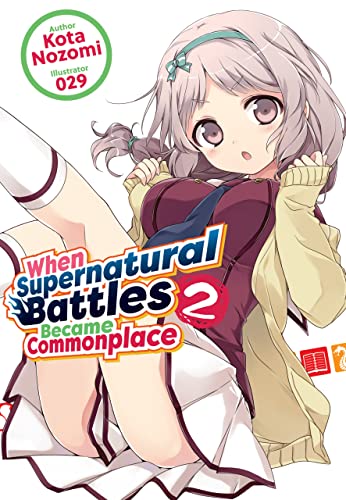
Stop me if you’ve heard this one before, but this is a book of two halves. In the front half we feature once again Kudou, the student council president and vague antagonist from the previous book, who has taken a letter of challenge as a love letter thanks to Andou’s over the top verbiage. Needless to say, she’s the sort to immediately go over the top herself, and Andou has to struggle to find a way to break things to her gently before he breaks her. That said, the confession comes as a shock to the rest of the club, especially two girls who we know have feelings for him. Given her presence on the cover, and the fact that most of the chapters begin with her narration before switching to Andou’s, you can assume Hatoko is especially confused by all this. But, whatever. She wouldn’t understand it anyway.

The book threatens to be drowned out by Hatoko’s rant, which is beautiful, but it also highlights the gulf between them. That said, we see in the flashbacks that this is not for want of trying from Andou – he was attempting for years to get her to understand his way of thinking. But sometimes people just don’t vibe the same way, and the best part of the book is when both of them are told that, in fact, they don’t HAVE to understand each other deeply – they can just be friends because they are friends. The other highlight of the book is the short story competition, which is absolutely hilarious – Hatoko’s grimdark romance, Chifuyu’s incoherent foreign mess, Andou’s summary and character descriptions with no actual text, and Sayumi simply dragging Andou out behind the shed and shooting him in the head. Glorious.

Again, there’s a plot here somewhere, but I plan to ignore it, just as I ignore Andou’s friend Sagami, who is the absolute worst in a way that is clearly deliberate but also I don’t care that it is. Recommended if you use the word “weeb” as a term of honor.