Category Archives: reviews

Sugar Apple Fairy Tale: The Silver Sugar Master and the Obsidian Fairy

By Miri Mikawa and Aki. Released in Japan by Kadokawa Beans Bunko Bunko. Released in North America by Yen On. Translated by Nicole Wilder.

Frequently in romance novels, in both English and Japanese, I find myself waiting for the bomb to go off. It’s always really easy to spot the bomb. It’s the guy who we first meet. He’s not on the cover art. He’s usually a Swell Guy ™. He loves the heroine. He says so. A lot. Ignoring whatever she might have to say about it. Sometimes everyone else around her also assumes that they’re fated to be together. And, credit to our Sugar Apple heroine, she is deeply aware of this and runs away at the earliest opportunity. Alas, the bomb follows her. That’s when I started to get annoyed. I was on edge, waiting for the Asshole Bomb to go off, and when it finally did, I breathed a sigh of relief. Now, it does mean the identity of the villain in this first book is immediately obvious from about page 3, but that’s fine. This first book is not about Asshole Dude, it’s about a teenager who just lost her mother weeks before trying to cope with overwhelming grief.

Our story takes place in the Kingdom of Highland, where they have candy crafters, the highest ranked of which are Silver Sugar Masters, whose candy is basically endorsed by the Crown. Our heroine, Anne, has bee traveling the country with her mother Emma, learning at her elbow and growing up. Then Emma gets sick and dies. Anne resolves to travel to the main city of the Kingdom so that she can pass the test to become a Silver Sugar Master. She needs to do this by the next holy day, so that her mother’s spirit can rest in peace. Of course, she can’t make it in time till she takes a nasty and brutal shortcut… for which she will need a bodyguard. Fortunately, this Kingdom also has fairies! To be their slaves.

So yeah, I liked this book, but it has a very high bar to clear. There’s slavery here, and our heroine immediately buys a slave, because she needs a bodyguard to get there in time and does not have the ability to stick to her principles. She talks about slavery being wrong, and frees him at the end of this book, but… yeah. Fairies are still slaves, that’s not going away. As for the rest of the book, the romance was OK, but I think my favorite part was exploring Anne’s attempts to be plucky and have gumption in the wake of her mother’s death, which the book needs to remind us a few times was only about three weeks before the start. She’s an excellent candy crafter, but she’s not making her OWN candies, she’s making the candies her mother made. She needs to accept her grief, then she can flower as a true artist. That’s the good part of the book.

I also enjoy Culinary Chronicles of the Court Flower, by the same author. This series came out before that one, and is 17 volumes, so we have a ways to go. If you like romantic fantasies, and can get past “slaves are bad, but here I am buying a slave”, this is a solid start.

When Supernatural Battles Became Commonplace, Vol. 4

By Kota Nozomi and 029. Released in Japan as “Inou Battle wa Nichijoukei no Nakade” by GA Bunko. Released in North America by J-Novel Club. Translated by Tristan K. Hill.

As always, this series tends to run on character-based comedy that is 50% decent, 30% good with a side of heartwarming, and 20% godawful. Usually the godawful part involves Andou doing something mind-numbingly stupid, but aside from one poorly-delivered euphemism that causes dangerous searches on the internet, he’s mostly fine now. It’s Sagami that gets the bulk of being awful. That said, it’s good in this case, because it’s showing off that he really IS the villain of this piece. For the most part the overarching plot of this series has been very hit and miss, and we haven’t seen that gang that attacked Hatoko since her book. But Sagami’s preening, salacious inability to see anything except as a fictional construct does make him a good antagonist. And of course this IS a fictional construct that is also a romantic harem comedy, so he gets the added aggravation of being correct. I think most readers were thinking the same thing Sagami was: in a harem of four girls, Sayumi is a distant fourth place.

Each volume has focused on one of the girls in the Literary Club, and as the cover suggests, this is Sayumi’s book. The actual present-day dilemma is fairly easy to resolve, but it also ties back to the past, so we see flashbacks, from Sayumi’s POV, of how she first met Andou and immediately did not get on with him. Unsurprising, this is Andou. In the present, the girls all present Andou with a game that they’ve been coding and ask him to play test it, which gives us a string of great humiliating gags as well as a wonderful sweet heartwarming bit at the end. As for the conflict, Andou discovers that Sayumi was going to run for Student Council President in high school, but never did… and he thinks that he’s the reason for this.

Sayumi is the most mature of the cast, meaning that thankfully we get less of the antics that we got last volume (though they’re still there, sadly, but at least Andou is NOT involved in the stupidity this time). It makes sense that her arc is resolved by simply telling Andou he’s gotten things wrong and that she doesn’t regret what happened. Of course, that’s not really what this book is doing. This is the fourth volume, so we’ve run out of heroines. It’s setting up the next arc, and doing so pretty well. All four girls are explicitly in love with Andou by the end of the book. Chifuyu doesn’t really know what it means, Hatoko knows what it means and who the “best girl” is and is ready to go to war, and Sayumi is getting advice from the devil himself. That just leaves Tomoyo, and if Sagami was here he’d no doubt say that she’s “best girl” at this point, or at least the most likely winner, if she can stop tsunning it up.

As always, I don’t recommend this book to anyone but those who are buried so far into otaku culture that they don’t really notice the bad things. If you’re that sort of person, this is a solid volume.

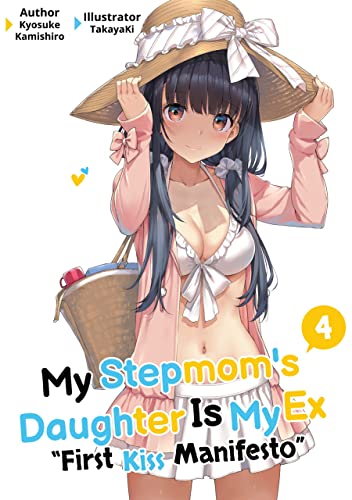
My Stepmom’s Daughter Is My Ex: “First Kiss Manifesto”

By Kyosuke Kamishiro and TakayaKi. Released in Japan as “Mamahaha no Tsurego ga Motokano datta” by Kadokawa Sneaker Bunko. Released in North America by J-Novel Club. Translated by Gierrlon Dunn.

Last time I mentioned that the anime was just starting, and I wondered how it would be handled. Well, now we know, and we also know that apparently the anime producers like Akatsuki as much as I do. Almost the entire third volume was jettisoned from the anime, which decided it really did not need multiple episodes focusing on the world’s most toxic ex-couple. More to the point, they knew something had to go if they wanted to adapt this volume, which turns out to have the perfect “open ending” for an anime that might eventually get a second season. It focuses squarely on our main couple… well, OK, no it doesn’t. It focuses squarely on Yume. The back and forth narrative voices are skewed very much towards the feminine thins time around, because Yume wears her heart on her sleeve and is really easy to figure out, but Mizuto bottles everything up and is not. It takes a family reunion to finally crack the “my stupid ex” facade.

Mizuto and Yume have now gotten comfortable with each other, and with arguing. Perhaps a bit too comfortable, as their parents note they act like a couple that’s fallen out of the “honeymoon” phase. Because Yume is Yume, she looks up online how to deal with this, which apparently involves going with Mizuto to try on swimsuits. The reason for the swimsuit is that they’re making the annual trek into the rural hinterlands of Japan to see Mizuto’s extended family, and this is the first year Yume and her mother will be making the trip. Meeting the in-laws goes well enough, but unfortunately they also come with a hot older cousin, who Yume seems to be convinced was Mizuto’s first love. And in fact Mizuto has been acting even more remote and uncaring than usual lately. Is there something going on?

I don’t want to spoil one of the major emotional parts of the book, which involves Mizuto’s great-grandfather, but suffice it to say it’s really well handled and offers some insight into Mizuto himself. But what this book is really about is Yume coming to terms with the fact that she’s in love with Mizuto. I enjoy the way that it’s framed, as it’s not a case of “oh, I’ve been in love with him all this time”, but rather that the Yume here and now loves him, and her biggest rival turns out not to be Higashira (who is busy trying to write AO3 fanfics of herself and Mizuto, and failing) but her younger self, the one who first captured Mizuto’s heart. The reason that most of the narrative is from her perspective is because we need Mizuto to be mysterious and remote here. I do wonder what his reaction will be in the next book.

I may need to wonder longer, of course, given that the cover art and back cover copy of Volume 5 imply it’s a 100% Higashira focused book. In the meantime, this was an excellent romantic comedy volume… unless you’re Akatsuki and Kawanami, I guess. Sorry, guys, cute pool antics aside, you’re just not important enough.