Category Archives: reviews

From Toxic Classmate to Girlfriend Goals, Vol. 1

By Sametaro Fukada and Fumi. Released in Japan as “Yatarato Sasshi no Ii Ore wa, Dokuzetsu Kuudere Bishoujo no Chiisana Dere mo Minogasazu ni Guigui Iku” by GA Bunko. Released in North America by Tentai Books. Translated by Callum Conroy.

In general these days, if you are in a classroom and you see a girl sitting next to you who either a) has a face that makes her look evil and threatening or b) a cool beauty who no one can approach, odds are that she is going to be an incredibly sweet girl who merely has tremendous communication issues. If you weren’t aware that this book is another in that type of series, you haven’t been paying attention to Tentai Books’ recent licenses, as they’re starting to have a niche in the “sugar sweet romance between weird boy and aloof girl” genre (though Seatmate Killer reversed those adjectives). If you are the sort who believe that good books need conflict, then this is not for you: there’s only one major conflict in the book. Instead, sit back and watch Koyuki be the world’s worst tsundere, and Naoya realize that, in fact, he does want to get closer to her.

Naoya is a young man who has become an expert at reading people’s faces to figure out not only their emotional state but also their backstory, family connections, and what they’re thinking. He credits it to a family backstory that we get some of, but it’s hinted there’s a lot more to it than that. One day he runs across a creeper trying to pick up a young woman who clearly does not want his attention, and proceeds to verbally destroy him to get him to back off. Little does he know that this woman is Koyuki, legendary at their school for her callous words and cool attitude towards everyone. Except, now that he comes to really look at her, he realizes that all this is wrong and that she’;s just colossally bad at offering help or accepting thanks. Worse, she falls for him rapidly, and he is trying his hardest to avoid getting in a relationship. Will she be able to break down his walls?

A lot of the humor in this book for me came from, as I hinted, the lack of conflict. Throughout, we see things set up where they look like they might lead to some drama… but they don’t. Naoya may be reluctant to get into a romantic relationship, but once he realizes that’s where this is heading he doesn’t back off or try to change how he acts around Koyuki. We meet her sister, who’s trying to make sure that he’s good boyfriend material… and he passes easily. Then we meet his family, including an overprotective father… and he STILL passes easily. This actually makes it funny when we finally DO get to the drama in the volume… and it comes from him confessing to her too quickly, something she has (supposedly) spent the entire book trying to achieve. And when she finally gets what she wants? She has a total meltdown.

Not to worry, though, it works out. The author, in the afterword (and apparently also the publicity for the series) guarantees a happy ending. Which is good, because we have other books if we want drama. We have this if we want to see an incredibly dorky girl try to point at her boyfriend in a haughty way but fail because she’s simply too adorable to pull it off. Cute and sweet.
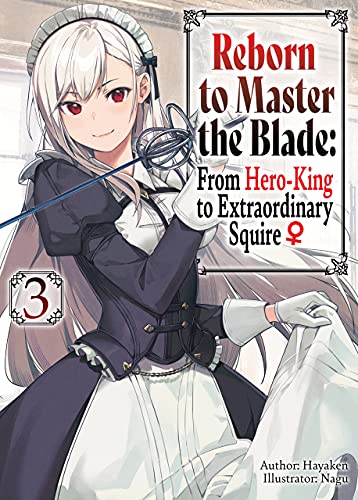
Reborn to Master the Blade: From Hero-King to Extraordinary Squire, Vol. 3

By Hayaken and Nagu. Released in Japan as “Eiyu-oh, Bu wo Kiwameru tame Tensei su. Soshite, Sekai Saikyou no Minarai Kisi ♀” by HJ Bunko. Released in North America by J-Novel Club. Translated by Mike Langwiser.

It can be very difficult sometimes when you are writing a series which has exactly one joke. It gets harder the longer the series gets because, well, it’s just the one joke. But, believe it or not, sometimes that is enough, and you’re able to keep going because yes, it’s a good joke. The joke for Reborn to Master the Blade is that Inglis is a meathead who only thinks of fighting strong opponents. And throughout this book, that’s what we get, over and over. Either she’s fighting them or, more often, she’s trying to fight them and failing because of things like politics or the other party refusing or having to save lives and the like. And we also see other characters knowing this and essentially smacking their foreheads. It’s one joke. But we’re early in the series, and the joke is still funny. And also Inglis as an overpowered meathead is pretty cool. As with previous books, the fights are a highlight.

Our main cast are still trying to deal with Ripple, who is still sucking in mana and letting out monsters (and does not even have a pebble to toss or wind to blow). Unfortunately, the response of the kingdom to this seems to be “send Ripple back home and get a new heiral menace”. Which, it is implied but never outright stated, would mean Ripple’s death. What’s more, it becomes pretty clear that the reason all this is happening in the first place is that Ripple is being “punished” by one of the Highland factions in order to… well, in order to be sneeringly evil, because this is not the most subtle book in the world. Inglis and company try to work out a plan, part of which involves her and Rafinha going undercover as maids to a ceremony held by the King for a Highland ambassador. Sadly, he too is mostly cartoonishly evil. Fortunately, Inglis is there and can hit things very hard.

The other great part of this book, besides Inglis wanting to fight fight fight, is the introduction of her antimatter universe counterpart, Yua. Yua is astonishingly strong, just like Inglis, and you’d think that she’d finally found the perfect opponent. There’s just one problem: Yua doesn’t care about fighting. She’d rather take the path with the least effort where she can be lazy, and even has to be talked into fighting a bunch of potentially lethal monsters. She’s also got that ‘stoic’ Rei Ayanami-ish personality, which also balances next to Inglis’. Oh yes, and she gives everyone nicknames. Inglis is “Big Boobs”, because this is a Japanese light novel. Basically, she’s a hoot, and I am glad she was not killed off towards the end of the book, which looked like it might actually happen for a while. There’s also lots of terrorism and political maneuvering and people losing arms and then getting them sewn back on with magic, but… let’s face it, it’s not Inglis fighting.

So yes, if you like dumb meatheads who only think of one thing, this is still that thing. I do think this will work better in Vol. 3 than in Vol. 17, though…

Holmes of Kyoto, Vol. 7

By Mai Mochizuki and Shizu Yamauchi. Released in Japan by Futabasha. Released in North America by J-Novel Club. Translated by Minna Lin.

This volume was already starting off in a big hole as I read the synopsis before getting the book. I have to be honest, “I’m breaking up with you to keep you safe” is something that I really, really hate. It didn’t help that we get another of the plot devices I hate, which is the threat of rape framed as “I will despoil her”, because Virginity Is Important, Franklin. So yeah, this was already starting from a deep hole, and it’s a credit to the author that I will still likely be reading the next book. That said, they really need to accept that they are better at writing mysteries, antiquing and travelogues than they are romance, and also that the books work better in short story collections. It helps that the first half of the book does NOT involve this plot, even though it too has a trope that I’m not fond of, the “I’ve misunderstood a secondhand conversation and think my boyfriend is in love with someone else”. Honestly, this whole book is land mines.

Holmes and Aoi are dating, and are both calm and intelligent, but that doesn’t mean they aren’t free from stress. When Aoi hears that Holmes and Yoshie, the owner’s girlfriend, had an intimate conversation while in America, she knows it’s gonna be a misunderstanding but goes there anyway. After this Holmes is asked to judge a tea ceremony between two brothers to help figure out who’s going to take over the family. Unfortunately, after this, everyone’s least favorite Moriarty shows up to ruin the book. Ensho is back, trying to get Holmes to appraise an incense container and also to be creepy and threatening. After being startled that it’s actually genuine, he vanishes… only to show up at Aoi’s high school to threaten her. This is enough for Holmes, who decides to break up with her in order to keep her away from Ensho, who clearly has a vendetta.

It is suggested at the end of this book that we’ve seen the last of Ensho as a recurring villain, and thank God. It’s reminiscent of Jon Pertwee’s second season of Doctor Who, where you know who the villain is because The Master is in every story that season. He’s worn out his welcome. As for Aoi, honestly, given everything that happens to her here I’m rather stunned that she managed to sail through her college entrance exams. The “theme” of the book, such as it is, is that words can hurt and affect people even if they are aware that the words are complete bullshit. We see that with Holmes’s grandfather, father, and him, and it’s all the more startling because it’s people we know are calm and intelligent. That said, this series continues to be at its best when discussing antiques or touring landmarks of Kyoto, and those were once more the better parts of the book.

That said, the writer may be running out of Kyoto, as the next volume sees Homes and Aoi headed to Yawata City! Which, yes, is also in Kyoto Prefecture, but it’s the thought that counts. In the meantime, if you do read this for the potboiler soap opera, this will be filled with that sort of thing. For the rest of us, let’s hope it’s done.