Category Archives: reviews

Der Werwolf: The Annals of Veight, Vol. 13

By Hyougetsu and Nari Teshima. Released in Japan by Earth Star Novels. Released in North America by J-Novel Club. Translated by Ningen.

We continue the trend of the series gradually shifting from Veight’s adventures to Friede’s, though as long as the subtitle of the series remains the same I would not worry too much about losing everyone’s favorite vice-commander. (the best joke in this volume, by the way, is how everyone now wants to be a vice-commander because that’s what Veight was and they associate it with being all-powerful.) The narration here is closer to a balance between Friede and Veight, as is the action, though it’s weighted more towards Friede in the front. She’s something of a breath of fresh air in that, while she is undeniably strong and clever, she’s also a kid and thus cannot simply brute force her way through everything the way that Veight does. Indeed, late in the book Veight gets yelled at for solving a problem by blowing it up, even though, to be fair, that was likely the only way the problem could be solved. Friede is not super OP, so we are more interested in how she fixes things.

We pick up where we left off last time, with Friede, Shirin and Yuhette being sent to Rolmund as part of an ambassadorial visit, with the hopes that if it goes well it could lead to actual negotiations by adults in the future. What follows is essentially a continuation of the Rolmund arc from previous books, as it turns out that, unlike Meraldia, things are still very much in flux there politically. Eleora mostly has everything handled, but insurrections keep happening, and she cannot be everywhere. This is problematic when her niece, the heir (you know she’s not gonna get married, she’s one of the women who lost to Airia in the Veight sweepstakes) ends up kidnapped by one of the rival factions. Who’s going to be the one to find her? Will it be those whose job it is to do it? Or will it be our little girl protagonist? Take a guess.

I was amused at the niece/heir, Micha, who at first appears to be one of THOSE rich kids (you even see her pointing, always a sign in Japanese media that someone is rude) but quickly bonds with Friede, to the point where by the time the visit ends they’re best friends. Admittedly Friede also saves her life, which does help cement close friendships, or so I hear. As for Veight, he gets to do more on the back end of the book. Facing off against a sandworm is a scene for those who prefer the old, Veight is badass sort of story, but for me the highlight was the politics, including Veight opening up to his daughter about being a reincarnation. I too would miss easy to access potato chips if I were a werewolf in a fantasy kingdom. Not to mention paper curr3ency, which rears its ugly head as this book ends and will likely come up in Book 14.

Which we may or may not see soon. Square Enix has purchased the rights to Der Werwolf in Japan, so Vol. 14 and forward need to have J-Novel Club negotiate with a new publisher. Till then, fans of the series can enjoy this book which continues to very, very slowly pass the baton to its new heroine.

Culinary Chronicles of the Court Flower, Vol. 4

By Miri Mikawa and Kasumi Nagi. Released in Japan as “Ikka Kōkyū Ryōrichō” by Kadokawa Beans Bunko. Released in North America digitally by J-Novel Club. Translated by afm.

I will admit that after the cliffhanger of the previous volume, I was not expecting the plot for most of this one to be “ghost story”. And yet it also manages to help to drive forward the love triangle as well, as it’s hard to maintain a cool, relaxed, professional demeanor when the person you love is sneaking into your room every night. Especially when they’re really a ghost who is there to slowly sap your life essence. This isn’t QUITE Rimi’s fault this time, but she’s the only one that can fix it, and honestly if she fails execution is likely what awaits. Again. If this were the previous three volumes, then the problem would be solved by food, but here food is only part of the answer. Rimi needs to actually look inside the ghost’s heart and see why they’re doing this. Which will, unfortunately for everyone involved, mean looking inside her own heart and doing what’s best for everyone.

The book starts off with the fallout from the previous one. Both Rimi and Shusei both trying to repress their love, and succeeding only in the eyes of each other (we get monologues from each about how the other one is much calmer about this). And the Emperor is, of course, waiting patiently for Rimi’s answer to his proposal. All this emotion flying around means that Tama, the Quinary Dragon, is feeling ill and lethargic. After researching things, they decide to decamp to a different palace, one with more spiritual energy, in order to heal Tama. Unfortunately, this palace comes with its own version of the Seven Mysteries of the High School, and Rimi finds herself dragged to a cursed well by impetuous consort and repressed lesbian Yo, who decides that investigating cursed objects that scream “do not open this cursed object” is awesome. Unfortunately, it triggers a curse. And now everyone’s going into everyone else’s room – supposedly – like it’s a British farce.

The food may take a back seat this time, but the romance and political intrigue does not. Despite Shusei trying to run away from it at every opportunity, he’s finally told the secret of his birth – and understands the implications for how he can use it to make Rimi his. Unfortunately, Rimi identifies strongly with the ghost here, who had to give up on her true love in order to become the Empress because it would be better for the kingdom. It comes down to waffling about things because of your love or making a clean break without regrets, and Rimi, who has matured more with each volume, makes the difficult choice. Which is very good news for the Emperor, but very bad news for the cast in general, as after reading the last forty or so pages of this book I’m fairly sure that this series is going to be ending with most of the cast dead.

But that’s future Sean’s problem. For now, this was probably the best volume in this series to date, one where true loves goes up against political expediency and comes out the loser.

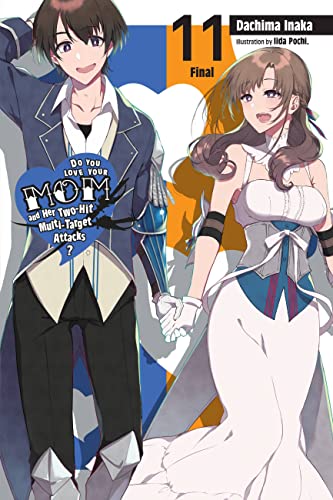
Do You Love Your Mom and Her Two-Hit Multi-Target Attacks?, Vol. 11

By Dachima Inaka and Iida Pochi. Released in Japan as “Tsujo Kogeki ga Zentai Kogeki de Ni-kai Kogeki no Okasan wa Suki desu ka?” by Fujimi Fantasia Bunko. Released in North America by Yen On. Translated by Andrew Cunningham.

Sometimes you need to be careful not to read too much into “this character is overpowered an perfect”, even in a light novel. We’ve spent ten volumes so far watching Mamako and Masato, and honestly it has felt like most of the growth has been on his end. He’s a teenager, after all. That said, the game that we’ve been watching has not been entirely for children to mature and learn to get along better with their mothers, it’s also been showing us some pretty awful mothers. From Wise’s selfish mom to Mehdi’s education mom to Porta’s workaholic mom, each of these mothers has shown us that equal work needs to be done on both ends to repair the relationship. As such, it should not be too much of a surprise that we get to the final volume, which is supposedly about Masato facing off against his father the Demon Lord, only to realize that Mamako has been the real final boss all along.

The reason for the appearance of Masato’s dad (who works for the government) is that the beta is over, and it’s time to stop playing the game and go back to the real world. But first, there are a few hurdles to be overcome. The game ‘resets’ itself somewhat, first by having to get everyone to re-register their roles (fortunately for Masato, no one else really wants to be the Hero); then by erasing the memories of most of the supporting cast, in order to make Masato’s task harder. But he’s matured, something he shows off quite well in the first half of this book. A little too well – not only are Wise and Mehdi disturbed that a Masato who’s not pathetic might actually be… attractive to them, but Mamako is realizing that she’ll soon be unable to be a mom for him 24-7… and she hates that, however much she might pretend otherwise.

So yes, Mamako *is* one of the mom stereotypes we mentioned before. She’s the smothering mom. We’ve seen this throughout the series – the gag is that the game revolves around her and that he’s unable to do anything himself. But slowly, as the books have gone on, he’s managed to take more of a role in deciding what to do and how to solve things. He’s growing up. High school and college are around the corner. And then he’ll move out, marry Wise/Mehdi/whoever (Porta, thankfully, is left in the little sister role), and Mamako won’t have her baby boy around. The finale makes sense in a conceptual way – given the entire game has revolved around Mamako to date, she ends up literally becoming the game writ large… very large. But finally they are able to get through to her, and we end up with an epilogue that has everyone in reality dealing with the Mom game going into wide release.

Ignoring the joke ending that is basically “and the adventure continues…”, this was far more solid than it had any right to be. The series should have ended several volumes ago, but at least it mostly stuck the landing.