Category Archives: reviews

Kuma Kuma Kuma Bear, Vol. 6

By Kumanano and 029. Released in Japan by PASH! Books. Released in North America by Seven Seas. Translated by Jan Cash & Vincent Castaneda. Adapted by M.B. Hare.

Towards the start of the Bakemonogatari series, when the protagonist, Koyomi Araragi, meets Tsubasa Hanekawa for the first time he talks about how he doesn’t have any friends as they would “lower my integrity as a human”. This is, of course, the sort of self-assuring bullshit that a lot of lonely teenagers go through, trying to reframe their social ineptness as cool reserve. Eventually, Araragi grows past this sort of attitude. That said, our bear girl Yuna may have a large number of acquaintances from all over the kingdom, but at heart she seems to think much the same thing about having friends, holding herself at a remove from everyone else and telling herself that she’s really a cool, somewhat selfish teenage girl who is not remotely a great hero. Mostly, I think, as she does not want to deal with potentially tragic consequences if she does end up getting closer to others. That said, I don’t think she can keep this up forever. Sometimes you just want to buy your best friend/protege a really cool knife.

As with a lot of books in this series, there are basically two main plotlines. The first has Yuna reluctantly agree to be a bodyguard for Shia and three of her classmates as they go into the woods as part of their classwork. Yuna is only to help them in a dire emergency. That said, once again we are reminded that, to folks who haven’t met her and seen her in action, Yuna is a small girl in a bear costume. (Later in the book, Yuna angrily reminds the other students that she’s the same age as they are – they thought she was much younger.) Needless to say, by the end Yuan wins over the other students AND defeats a hideous tiger monster. Then in the second half of the book Yuna helps Anz, the girl from the seaside city who wants to start her own restaurant, as well as the four young widows who Yuna rescued from the bandits who want to start over in a place with fewer memories.

I mentioned Yuna’s social ineptness above, and it’s never been quite as visible as it is towards the end of the book. The reader may recall that the four assistants Anz has were all raped by bandits and had their families brutally murdered a couple of months earlier. (Remember, cute bear girl series, really. It’s just like K-On!.) They’re there to help Anz with the restaurant, but Yuna decides to also have them help at her orphanage, which she feels is understaffed. One of the young women is CLEARLY distraught over being around children who are presumably the same age as her own children she saw murdered not long ago, but the story is still from Yuna’s POV, and the most we get out of her is a “huh, maybe I should not have done that”. Fortunately, it all works out well, but there is a reason why I keep highlighting the dark bits in this otherwise fluffy light novel series – they’re the most interesting, character-wise.

As the book ends, Yuna is off to battle a cave of endless golems, and we are briefly reminded that this is supposed to be based on a video game. I assume Yuna will win, but… the jagged edges that surround the big pluffy bear girl are why I really enjoy reading this series.

I Swear I Won’t Bother You Again!, Vol. 1

By Reina Soratani and Haru Harukawa. Released in Japan as “Kondo wa Zettai ni Jama Shimasen!” by Gentosha Comics. Released in North America by Seven Seas. Translated by Kimberly Chan. Adapted by Jennifer Rawlinson.

One of the real joys of reading a large number of novels with the same sort of plot, characters, themes, and plot twists is that when something comes along that is surprising to me, I always enjoy it that much more. Let’s face it, we now have enough “villainess” novels out over here that it’s starting to become old hat. This book is not that, despite featuring many of the same beats you’ve seen before. Our heroine, Violette, is imprisoned after trying to murder her younger stepsister in a fit of rage. She’s filled with regrets and apologies, and swears that if she could only go back to when she and Maryjune were first introduced to each other, she’d do things differently, resolving to never bother her again. And then… she suddenly does return to that day. But she has no memories of a past life, this isn’t an otome game, and she can’t simply avoid conflict. As a result… she falls into depression.

Not to spoil too much about the book, but Violette is not your typical spoiled brat villainess we normally see, but a child of abuse, manipulated by her late mother, who forced her to live as a boy for several years, and then abandoned her when puberty made that impossible. Her father found a mistress he truly loved, and had a child with her, but as for Violette, he can’t stop seeing her mother in her, so is cool and unloving. As for Maryjune, she’s sweet and idealistic, but… she’s naive and VERY idealistic, and was raised as a commoner in a world where you can’t just say “nobility is wrong!” and expect to get away with it. All of this is filtered through Violette’s point of view, and frankly it’s not hard to see why Maryjune’s appearance made her snap. Here, on her second go-round, she just barely holds back, but this does not get rid of the rage, hurt, and loneliness that inhabits most of her being.

While not an “otome game” book per se, the plot certainly resembles that kind of genre, with Maryjune as the “protagonist” to Violette’s villainess. Violette has two allies; her childhood friend Yulan, who adores her but whom she sees as a younger brother type, and Marin, her maid (who was a dying orphan she found on the street as a child… I told you it hit all the standard plot beats), who is sometimes in tears as she sees just what Violette has to deal with every day. Violette tries to avoid the main things that led to her trying to kill Maryjune in her previous timeline, but she’s only gone back in time about a year, so it’s harder to prove that she’s changed. And, above everything else, she’s just so tired ALL the time. She’s resolved to become a nun after graduation, which I doubt will happen, but it does show that far from trying to find a happy life for herself, she’s almost given up from the start.

There’s a manga coming out next month, but I hear that this removes a majority of Violette’s inner monologue (as is common with adaptations), and thus she seems far less depressed and trying desperately to hold everything together. That said, I’m very happy we have this light novel, which shows why the Villainess genre has blown up lately – you can do a lot with it.

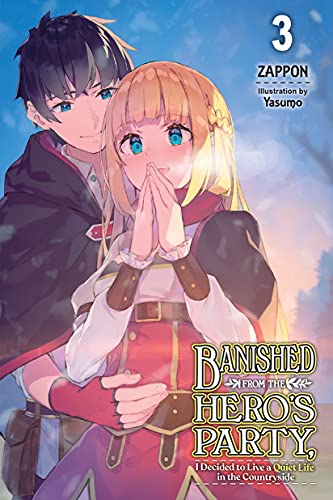
Banished from the Hero’s Party, I Decided to Live a Quiet Life in the Countryside, Vol. 3

By Zappon and Yasumo. Released in Japan as “Shin no Nakama ja Nai to Yuusha no Party wo Oidasaretanode, Henkyou de Slow Life Surukoto ni Shimashita” by Kadokawa Sneaker Bunko. Released in North America by Yen On. Translated by Dale DeLucia.

As far as I can tell, this entire volume had one purpose: to make me feel guilty for calling Ruti terrifying over and over in my previous review. I mean, not to say that she still isn’t a bit much – waltzing past deathtraps that would have destroyed anyone else, taking the killer drug from the previous volume and having it only affect her slightly, and of course saving people when she runs across people who need saving… whether she wants to or not. Indeed, even her companion Tisse, who starts off the book sticking with Ruti seemingly because she’s being forced to, suspects that Ruti is going to turn on her beloved pet spider and kill it, which… isn’t actually true. (The spider’s name is Mister Crawly Wawly, which probably says a lot about Tisse, but let’s move past that.) But in the end, what this book is here to remind us is that behind her hero’s blessing, Ruti is a lonely young girl who HATES being the hero.

In fact, the majority of this volume, at least until the cliffhanger ending, is meant to undercut the previous two. After seeing Ruti as the stereotypical “yandere little sister” sort, she finally is told her brother and Rit are together, and… is not all that happy about it, but does not going on any killing sprees whatsoever. She arrives in town trying to get more of the drug that can kill her blessing, though it’s working pretty slowly so far. It *is* working, though – Ruti’s emotional range widens considerably throughout the book, which also helps to sell what she’s been forced to go through. After two volumes where a “slow life” start was followed by dark content and action scenes, this volume gives us slow life right to the end, with lots of Red and Rit being lovey dovey to each other, etc. Unfortunately, there is that ending… the rest of the hero’s party arrive in town.

I suspect the long term goal for Red and Rit might be figuring out a way to get rid of blessings entirely, though they may earn the ire of the church by doing so. They’re SUCH a liability in this world, with folks who are happy with them outnumber4ed in the narrative by folks who are not. Just as Ruti’s shy, introverted side is transformed by the hero blessing into an emotionless behemoth, so Tisse is an assassin because… well, if she doesn’t kill people, bad things will happen to her, so what choice does she have? (She levels up big time in this book as well, thanks mostly to her emotional support Mister Crawly Wawly.) Everyone is starting to question whether free will is an illusion or not, and this is a fantasy world where that questio9n is very much up in the air. That said, as long as Red is on the side of good they should be fine.

This volume was mostly all slow life, but I doubt the next book will be, as it looks like Ares is going to be having a huge fight with Red. Or Ruti. Or both. Till then,l this remains an excellent example of its genre.