Category Archives: reviews

Reign of the Seven Spellblades, Vol. 2

By Bokuto Uno and Miyuki Ruria. Released in Japan as “Nanatsu no Maken ga Shihai suru” by Dengeki Bunko. Released in North America by Yen On. Translated by Alex Keller-Nelson.

Much to my surprise, after a humdinger of a reveal towards the end of the first book, the second book in the series does not build on that reveal beyond a few ominous scenes. Instead, this book proves to be 100% magical academy adventures. This is not a flaw, as the author is really excellent at writing magical academy adventures. We get broom lore, epic sword and magic duels, wacky classwork, terrifying classwork, and more of The Labyrinth, which is likely going to take up more and more of the books as the series goes on. Here our group of six decides to make a home base inside it, the better to do all the little things they really don’t want others to find out about. Unfortunately, our kids are all Very Special People, and as such have attracted the attention of others. This means even more battles, more secrets revealed, and more magical sword battles. Unfortunately, it also means a nasty cliffhanger.
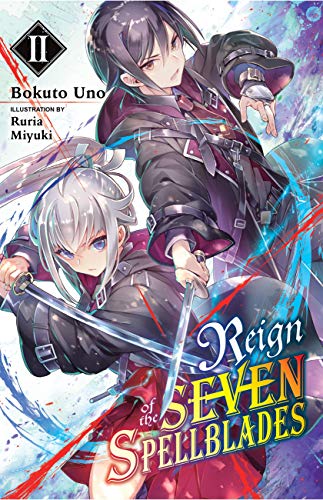
While Oliver and Nanao continue to be the “protagonists” part of the group of six, the others are getting development, and in this book it’;s Pete and Chela who get it. While I will try not to spoil too much, Pete’s plotline in particular is quite well done, and I liked the fact that everyone was understanding and that he was immediately introduced to a support group of people with similarities. And if it also feels like a “fuck you” to a certain other magical academy book writer, well, all for the better. As for Chela, her plot is tied into her family history and the way magical families work in particular. In my last review I compared her to Rin Tohsaka, and that comparison holds up very well here, even including a younger sister that she’s unable to publicly acknowledge. She continues to be my favorite of the six.

As for others, I am hoping Guy gets a book of his own soon, as he’s currently “the other one”. Katie builds nicely on the first book, and I appreciate her discovery that even groups that supposedly share the same belief as she does are not the sort of groups she wants to be involved with. This society is complex, and changing ingrown prejudices is not going to be as easy as a well-timed lecture to the head. The minor villains in the book include an arrogant not-Italian kid (in the same way Nanao is not-Japanese) who tries to show Oliver why learning the basics is bad, the aforementioned younger sister and her servant/best friend, and another guy who acts the part of an arrogant asshole because he was essentially traumatized into it. In this book, both good and bad guys have a rich characterization to them. Well, except Guy. Sorry, Guy.

The cliffhanger makes me want to read the next in the series right now, but we’ll have to wait a bit. In the meantime,l please read this, it’s one of the best light novel debuts from 2020, and 2021 proves it was not a fluke.

Reincarnated As the Last of My Kind, Vol. 2

By Kiri Komori and Yamigo. Released in Japan as “Tensei Shitara Zetsumetsu Sunzen no Kishou Shuzokudeshita” on the Shōsetsuka ni Narō website. Released in North America by Cross Infinite World. Translated by Roman Lempert.

It’s always fun to see a cute, slow life sort of tale fight against its own narrative, which is trying to make sure that the slow life speeds up in a hurry. This second volume sees Tina and her family continuing to try to make improvements to the inn, better food, and better quality potions over the course of about four years. Indeed, when the call comes to invite her to a school where she can learn to be a better alchemist… she declines, as she’d rather stay where she is right now. Unfortunately, these are Troubled Times, and it’s going to be very hard to escape the pull of the incoming war, especially when you’re a prodigy with mad skills that no one has ever seen in their life. And as if that weren’t enough, there’s also a combination religious/ecological crisis going on, which could mean the literal end of the world unless it finds a savior. Two guesses who that’s supposed to be.

The first chapter in this book is unique to the book, i.e. was not pat of the webnovel, as Tina and her family play host to a scholar with a preference for very hot food, which involves making udon. After this we get two larger chapters, featuring Tina at age 10 and 12 respectively. In the first, Lico and the other knights arrive at the inn searching for a group of demihumans that got lost in the forest. This is a fantasy series, so naturally you get one elf, one dwarf, and one kobold, though the angel is a surprise, to both Tina and the reader. They have to fight off a nasty monster attack that almost kills off Lico – again. The second story sees Tina and her family head into the big city to attend the funeral of Marcus’ former commanding officer. Unfortunately, on their way back they meet some twins under attack by a very nasty zombie. In fact… there have been a LOT more monsters and zombies lately…

A lot of this is very fun. I liked Shida, the elf, who is an arrogant SOB in the elf tradition but also strangely likeable, and I appreciated that he and Tina did not remotely hit it off. Marcus’ pathetic attempts at romance, combined with his daughter Nakona’s sheer obliviousness to the many men in love with her is amusing, and we, as read3ers, empathize with Tina’s frustration, especially when Marcus and Lico are trying to out-selfless each other. (Lico wins, by virtue of being near death.) That said, a lot of this book is pretty ominous and scary. Both the text description and the illustration of the zombie attacking Tina and company is harrowing, and you start to wonder if this really will be the sort of series to kill off its regulars. Then there’s the subplot regarding human religion and prayer literally killing the world, which might upset some readers, but is pretty well done in universe.

So the question at the end of this 2nd volume is, will the 3rd book involve Tina heading off to save the world, or will Tina try to save the world while still doing things like making honey and trying to create supreme potions? Regardless, if you enjoyed the first book in the series (and are perhaps not evangelical Christian), this one is definitely worth your time.

Culinary Chronicles of the Court Flower, Vol. 1

By Miri Mikawa and Kasumi Nagi. Released in Japan as “Ikka Kōkyū Ryōrichō” by Kadokawa Beans Bunko. Released in North America digitally by J-Novel Club. Translated by afm.

It is somewhat hard not to start reading this and not think of The Apothecary Diaries, which also features a young woman arriving at the Emperor’s palace and featuring a number of young women who are there to be his courtesans, as well as a eunuch who is rumored not to be. Oh yes, and clearly based on Chinese rather than Japanese tropes. That said, the two series end up going in a slightly different direction, as Maomao’s one smart cookie who’s there to be a Jessica Fletcher sort. Meanwhile, all poor Rimi wants is somewhere to prepare delicious food and a sense that she belongs. Unfortunately, getting either of those proves difficult. Despite almost immediately running into most of the “very handsome men” part of the inner palace, she finds her homemade fermented rice in danger, the other women of the palace bully her tremendously, and, oh yes, the Emperor takes one look at the gifts her nation sent along with her and decides to have her executed. How can she make dashi like this?

Rimi can be a hard character to get a hold of. At first I thought she was a “fluffhead” sort of character, but that’s less due to her natural state of mind and more due to her spending most of her life as an extraneous extra. For the last ten years she’s lived with only one other person, her older sister, and cooking was essentially her entire life. Most of the decisions she’s made over the course of her life have involved “I’ll do this so that they don’t worry about me”. Now she’s having severe culture shock (much of the novel is about the differences between this “not-China” that she lives in now and the “not-Japan” she was born in), can’t even really speak the language very well (the translator does a good job of showing off how her attempts to speak to the emperor or Shusei can occasionally be incredibly blunt or even coarse), and, of course, has been threatened with execution multiple times. She faints more than once here, but she certainly earns them.

As for the men, well, this is a reverse harem series, so they’re all very pretty. I’m guessing the main love interest is Shusei, the self-styled culinary scientist, whose attempts at healthy food are not well-loved. He bonds with Rimi over food, and seems pretty smitten with her by the end of the book, though of course he has no idea what that feeling is. The Emperor may threaten to cut off her head multiple times, but shows himself to be a big softie when presented with food he doesn’t hate – which is to say, food in the proper environment. As for the food itself, well, given the ingredients are clearly meant to be the fantasy equivalent of kombu and katsuobushi, we can guess why she’s so desperately pointing out that they are not “planks of wood”. There is much here to interest a foodie, especially if you like discussing the difference between Chinese and Japanese cuisine.

This is 11 volumes total in Japan, so we’ve clearly got a ways to go. but it’s a very good start, and if you like plucky heroines, handsome bishonen, and a LOT of talk about dashi, this is a winner.