Category Archives: reviews

Kuma Kuma Kuma Bear, Vol. 4

By Kumanano and 029. Released in Japan by PASH! Books. Released in North America by Seven Seas. Translated by Jan Cash & Vincent Castaneda. Adapted by M.B. Hare.

This series remains very off balance, though I do enjoy it a great deal. It sells itself as a slow-life adventure with an OP girl doing cute things with other girls, and that’s what it is about half the time. But once every volume the author wants to remind us that this world (and, it’s implied, Yuna’s past) can be dark and horrible, and it’s always tonally dissonant. Here we see Yuna stopping a gang of bandits. First of all, the bandits are really adventurers paid by the villain to be bandits. Secondly, they go above and beyond their pay, as they apparently kill everyone leaving the city who isn’t a young pretty woman, and then keep the young pretty women in their cave as slaves and (it’s implied) rape them. There’s a horrific scene where, on finding the villain has among the things he’s stolen a ring she recognizes, one of the victims attacks the villain and demands her husband back. It’s… it feels like we jumped genres.
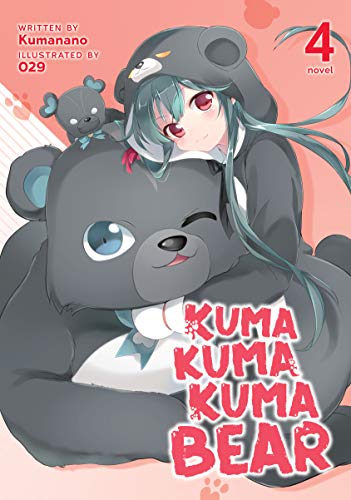
There’s two main plotlines here. First, Yuna returns to Crimonia with Fina and buys a mansion, then converts it into a bakery. This is the more typical Yuna plotline, with lots of OP ridiculousness, lots of cute girls, and tons of bear accessories, bear names, and beat statues. (But still no bear puns. The series is doing a good job at avoiding that.) In the second half of the story, Yuna goes to the ocean in search of seafood, but finds a city under attack on both sides: there’s a kraken in the ocean making it impossible to fish or get supplies, and there’s the aforementioned bandit gang. Yuna cleans up both, though the kraken seems to give her the first hard time she’s had to date, almost exhausting her mana trying to boil it up in the equivalent of a cliffside hot pot. Throughout it all, Yuna is as matter of fact and blunt as ever… except when she realizes the ocean city has rice. And miso. And soy sauce. Then she gets really emotional.

Yuna’s mindset is the best reason to read this book. the anime softened her a great deal. It adapted both of these plotlines, but also had a final episode not in this book where Fina is lonely and Yuna has to learn how to read emotions. That’s not really here, and it’s not just a matter of Yuna being callous, but an actual deliberate character flaw. Last review I said Yuna was trying to avoid getting too well-known or famous, but after this book I suspect Yuna will try to deflect and praise or thanks thrown her way, and is desperate to not have people get too close to her. She also tends to think about this world in terms of a game – of course, it’s a world she was brought into THROUGH a game – and situations like the bandits and their captives make her remind herself this is a real world with real people. It’s something that needs a bit more reinforcement, I think.

So yes, there’s a bit more here than cute girls doing cute things. There were also some great lines in this – Yunqa’s deadpan delivery helps sell them well. Next book Yuna starts a trade route, and I may see that Yuna and Fina scene that wasn’t here.

Wataru!!! The Hot-Blooded Teen and His Epic Adventures in a Fantasy World After Stopping a Truck with His Bare Hands!, Vol. 2

By Simotti and RELUCY. Released in Japan as “Truck Uketome Isekai Tensei! Nekketsu Butouha Koukousei Wataru!!!” by Overlap. Released in North America by J-Novel Club. Translated by Adam Seacord and Roko Mobius.

I have been known to say that the reason I don’t review light novels in the “Bookshelf Briefs” column on Manga Bookshelf is that there is always a way I can spin out 500 words on a light novel no matter what, but I will admit that some series test that to the extreme. Wataru!!! 2 is exactly what Wataru!!! 1 was, and if you liked that you should like this, though probably a bit less as the shtick is no longer new. But this is a gag series. I can’t talk about character development, there isn’t any. We’re literally told that backstories dropped on us will be totally irrelevant later in the book, so it’s OK to forget about them. This book invites anti-criticism. This volume does indeed appear to be the final one, and that’s probably for the best, as even though I enjoyed both I’m pretty sure I don’t need to read a third book of this.

The plot of the 2nd book borrows heavily from Dragon Ball. Wataru and friends are sent to fight a dragon who is destroying villages, but in order to fight him fair and square, they need to collect six orbs that are scattered around the area. Wataru does this by a) winning a hot dog eating contest, b) beating up an isekai author, c) fighting a cute young assassin who immediately falls in love with Wataru, d) solving the most obvious murder ever; e) playing a card battle game in one of the few stores Aria hasn’t been banned from; f) fighting a possessed Résistance, and g) actually fighting the dragon. Throughout all this we get the usual loud shouting, ridiculous fights, dumb gags, and fourth wall breaking. It is quite good at all of those things.

The most amusing parts of the book are probably when it tries to bite the hand that feeds it. The orc who writes OP isekai novels is pathetic, and it’s no surprise that rather than trying to impress him our heroes simply knock him out and take his stuff. That said, they each try their hand at writing a light novel. Aria’s is a typical shoujo LN, with perhaps more swords than usual; Wataru’s is an anime commercial, and Résistance writes a dark emo fantasy. The payoff is at the end, in a side story where we find Résistance’s light novel has been purchased by “Sky-Novel Club”, who get quite a few caustic comments from Aria and Wataru. Other than that, well, there’s lots of punching things, and leaping high into the air, etc. Still no real romance. Aria just isn’t into Wataru, Résistance is too passive, and Elphabelle is pretty firmly rejected. Wataru is a hot-blooded teen in the Ashita no Joe sense, not the Ataru Moroboshi sense.

Again, this is worth picmking up if you really enjoyed the first volume, or just like people shouting, getting grievous head injuries (that can be easily fixed with healing magic), and writing epic tales where Luffy, Detective Conan and Pikachu team up, but fans who like subtlety should stay well away.

The Saga of Tanya the Evil: In Omnia Paratus

By Carlo Zen and Shinobu Shinotsuki. Released in Japan by Enterbrain. Released in North America by Yen On. Translated by Emily Balistrieri.

I mentioned this a bit in my last review, but it’s even more obvious here: the ‘winning’ part of Tanya the Evil is well and truly past, and we’re likely to see more and more of the Empire losing badly down the road. This book has the Empire try what seems to be a very clever strategy, Tanya and her group do their bit fine, and it just… fails. Due to lack of supplies, because the empire is running out of everything. It’s especially interesting as this is framed around a “won the battle but lost the war” siege, in which Tanya’s somewhat smaller corps has to lay wait in a railroad station and let themselves get surrounded, then get rescued. As it happens, they pretty much are able to rescue themselves. This despite the fact that, to Tanya’s surprise, the Federation are getting much better at being mages. After the last volume, where we almost had peace but then got it kicked away, there’s no way this ends for the Empire in anything but annihilation.

The big change in this volume is that Zettour, after pissing off the government, has been demoted and is sent out into the field. Well, OK, it’s not a real demotion, but he’s not allowed to really take charge. He does anyway, though, because it’s hard to say no to a Lieutenant General. Most of this book shows off that, while the title may be “The Saga of Tanya the Evil”, Tanya is more of a pragmatist above all else – the only evil we see here is her explaining to her green recruits why looting corpses during wartime is fine. Zettour, though, can be even worse than she is. That said, he too is getting an upfront demonstration of the fact that the Federation are getting much better at waging war. It helps show off the difference between action at the front and what the leaders in the rear hear about that action.

Oh yes, Visha almost dies. I can’t recall if I’d mentioned this before, but Tanya the Evil is based off a webnovel, but the LN adds a lot of things. One of those things is Visha, who wasn’t in the original story. (This is why fans get annoyed when they hear “spoil me does Visha die?”.) So sometimes you have to worry about her, because she’s cute and less morally void than Tanya (slightly) and we like her, so her death would have impact. The interesting thing is that we don’t get this near-death from her POV, but Tanya’s, who has suddenly noticed that Visha is not reporting in because she’s busy fleeing from a crazed Commonwealth soldier. (Guess who? Yes, Mary Sue is back, and she’s as vengeful as ever. She is, however, attacking the wrong person. See, light novel artist, this is the danger of making Tanya and Visha look too much alike!) Fortunately, she survives to make coffee another day.

The book ends with Zettour ordering Tanya to help him win the war that needs to be one – the one at the capital, which is to say the war against their political leaders who are demanding total victory. I’m sure this will go well! In the meantime, enjoy what is essentially a siege book with added military theory.

(In Omnia Paratus translates to “ready for anything” and, contrary to popular belief, did not originate with Gilmore Girls.)