Category Archives: reviews

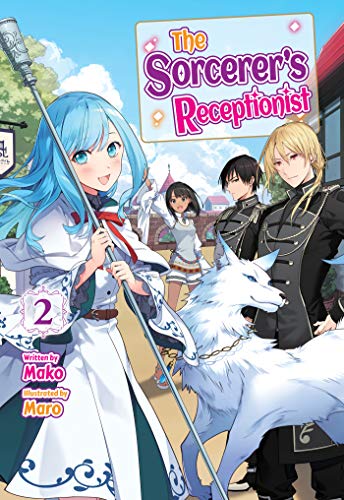
The Sorcerer’s Receptionist, Vol. 2

By Mako and Maro. Released in Japan as “Mahousekai no Uketsukejou ni Naritaidesu” by ArianRose. Released in North America digitally by J-Novel Club. Translated by Roko Mobius.

It should go without saying, really, but fans of this sort of light novel should also be fans of shoujo manga that also runs along these lines. If you, as a reader, read manga where the lead couple are constantly at odds? The girl is constantly angry at the smug arrogant guy? Everyone seems to think they’re already a couple even though she hates his stupid guts? Yeah, that’s this series in a nutshell, it’s just in prose rather than in Hana to Yume. So yes, if smug arrogant guys constantly mocking the heroine are not your cup of tea, don’t read this, because we know who the end guy is going to be and it’s him. The other thing to mention here, which I believe I also did in my first review, is that you’d better love “oblivious to love” and “everyone can see it” as tropes, because the book is drenched in them. When it’s not actually dealing with Nanalie’s actual work, it’s watching everyone smirk at her cluelessness.
As noted above, the book is divided in half. Half the time we are seeing Nanalie at her job at Harre, growing better at it, learning valuable magical skills, and beating up lesser demons. At one point she’s sent to the southern branch for a month to see what it’s like there, and the answer is basically “hot, with added exorcisms”. The other half of the book is her interactions with Rockmann, who always seems to be around despite her best efforts to not see him, and is always there to rub it in her face that he’s still Number One and she is Number two. This even applies to alcohol – Nanalie has an amazingly high tolerance… but not as good as Rockmann’s. The one worrying plotline is that a neighboring kingdom is asking – rather aggressively – for ice witches, and Nanalie is being asked to hide that she is one. What’s really going on here? Also, why is Nanalie being asked to meet the King?

This book is not without its problems. the ending to the first book implied that there was some dangerous demon possession going on… but it’s solved quickly and then dropped. More importantly, the nature of the “Ice Witches Wanted” plotline involves Nanalie not knowing anything about it, and so the climax of the book, frustratingly, takes place offscreen, with most of it explained to her in a “yeah, sorry about this” way by the director. It’s realistic that they would take such steps, but as a reader it is incredibly anticlimactic. Also, Rockmann heals up far too quickly and far too well given they’re making this out to be the first time Nanalie might actually feel something for him. Fortunately, the rest of the book is filled with fun banter and situations, and Nanalie when she’s furious and snarky is the best Nanalie.

There is a suggestion of a few ongoing plots, with some backstory dropped to help the reader along, so I don’t expect this will be ending soon. It’s a fun little series, if a bit uneven, and recommended for those who like shoujo manga where the leads yell at each other all the time.
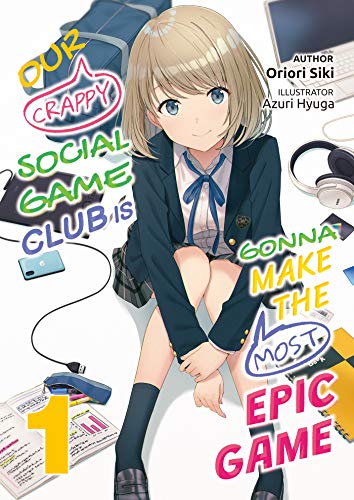
Our Crappy Social Game Club Is Gonna Make the Most Epic Game, Vol. 1

By Oriori Siki and Azuri Hyuga. Released in Japan as “Jakushou Soshage-bu no Bokura ga Kamige wo Tsukuru Made” by Overlap Bunko. Released in North America by J-Novel Club. Translated by Mikey N.

Sometimes you just have to power through even when your initial impression is bad. This novel started off iffy for me. A sad-sack protagonist who had difficulties communicating with others. A perky, happy ball of sunshine who ends up dragging him back into a world he was desperately trying to avoid. Even the world the book takes place in didn’t impress me; it’s not a fantasy or isekai, but it does take place in a world where education has become driven by “gacha”, that game mechanic where you spend money to get a cool thing – possibly. I’m not sure why it needed to jump through the extra hoops, unless a pre-reader asked why everyone cared so much about social games. Fortunately, after a rough start it settles into what the book is actually about: the trauma of past failures crippling your ability to move forward and recognize your own worth, and how others can help you move past that.

Kai has just moved far from Tokyo after being driven from his previous school, one of the best in the country, for sabotaging a popular social game for reasons we are not immediately privy to. He’s trying to move on and have nothing to do with social games, but unfortunately, he’s arrived at one of those “everyone has to be in a club” schools, and the girl showing him around, Aoi, is head of the Social Game club, which consists of her, programmer and gacha-addict Aya, and perpetually angry artist Eru. The club is about to be shut down, and the Student Council President hates it, so Kai joins up impulsively. Unfortunately, the club is a mess – Eru is angry at Aoi, Kai, and most everything else, Aya is never there as she has to gacha all the time, and Aoi’s bubbly, happy side masks a girl who fears she is useless and a burden. Can the club be saved in time?

As I said, when you get past the original cliches (there’s also a pervy older sister who loves to tease Kai, and the arrogant/snarky student council duo are pure 100% cliche), there’s more to like here than expected. Kai, of course, did not sabotage the game back in Tokyo because he was being a villain, it was for a very good reason. Both he and Aoi suffer from crippling self-doubt, and both of them have to have it demonstrated to them, explicitly, that their fears are unfounded. Kai really does have terrific value as a planner, as his sempai at the Tokyo school (who is awesome, and has a great semi-robotic speech pattern) demonstrated to him, and while Aoi’s art is still not as good as Eru’s, she is improving constantly and is ready to take the next step. They make their game better AND they step in to help save the original game that Kai sabotaged. It’s quite the feel good ending.

So yes, there’s gold to be found here, though I’d recommend liking gacha games a whole lot more than I do if you really want to get the full experience.

The Genius Prince’s Guide to Raising a Nation Out of Debt (Hey, How About Treason?), Vol. 5

By Toru Taba and Falmaro. Released in Japan as “Tensai Ouji no Akaji Kokka Saisei Jutsu ~Sou da, Baikoku Shiyou~” by GA Bunko. Released in North America by Yen On. Translated by Jessica Lange.

This volume was always going to have trouble living up to the high point of the previous one, and it does. It’s a very short light novel, coming out at not even 160 pages. And that, I think, is the problem – this volume is too rushed, leaving everything sort of half-baked. The joy of these books is seeing Wein come up with plans, wriggle around as they’re upended by a surprise disaster, and then come up with even more clever plans. but you need time for each of those things to simmer, and we don’t get that here. There’s also very little of Falanya, who was the star of the fourth book, and also a minimal amount of romantic tension between Wein and Ninym. There’s nothing wrong with the book, it’s reasonably fun to read, and gets exciting a few times. But the reader is left with the feeling that “that could have been better”.

Natra has been doing very well for itself under Wein’s leadership… VERY well, and has started to attract attention to itself, both good and bad. It also has to worry about Marden, its recent acquisition, which is far better located than Natra itself, and could easily wind up surpassing Natra itself. They need more allies. So he turns to the nations beyond Marden, Soljest (which is run by Gruyere, the very obese Holy Elite we briefly saw in Book Three, and Delunio, which is basically being ruled by its slimy Prime Minister. Wein heads to Marden, expecting Zenovia to try to solve Marden’s problems by a marriage proposal, which he plans to turn down, and then goes to Soljest, where he ends up suggesting that the two nations ally themselves to each other, something Gruyere quickly agrees to. And then… well, everything falls apart for Wein.

By now, the strengths and weaknesses of this series are pretty well locked in. Sadly, I find the art a weakness, as it’s frequently just too goofy for my tastes, and also leans into fanservice when it shouldn’t (there is a low-angle shot of Zenovia sleeping on her tits at a desk that should be taken out back and shot). The plotting and scheming is fun, both when Wein is being brutally clever and also when he’s being out-thought, and I really liked the idea that Zenovia *is* in love with him but refuses to marry him if she’s not his equal at being a clever person. Gruyere is also a lot of fun, and I did like the introduction of his daughter, who appears to be there mostly so that she can be a rival to Falanya in future books. But… everything happened too fast. The battles, the scheming, the dialogue, even the dumb goofy comedy. Ninym screws up Wein’s hair in an amusing way! Why was nothing done with that?

The series is still worth reading, and I look forward to the next book, but this one just feels… half-baked.