Category Archives: reviews

Heroine? Saint? No, I’m an All-Works Maid (And Proud of It)!, Vol. 2

By Atekichi and Yukiko. Released in Japan as “Heroine? Seijo? Iie, All Works Maid desu (ko)!” by TO Books. Released in North America by Airship. Translated by Matthew Jackson. Adapted by Michelle McGuinness.

If anyone still reads the site TV Tropes, there is a page devoted to what is known as a “Gambit Pileup”, where a storyline is derailed by multiple people who each have their own plan to take control of the narrative. This is frequently used for comedic purposes, but All-Works Maid really takes it to a higher level, as everyone is desperately trying to resolve the plot of the otome game they’ve found themslves in, only to see that Melody has solved everything, done every romantic route, and taken the main villain as her pet puppy. And that’s just in the first volume. This second one gives us an additional reincarnation from Japan, but also shows us that things have not completely been solved. The first villainess boss may now be Melody’s mistress, but the world still needs a first villainess boss, even if it has to use dark powers to create one. Worst of all, though, Melody has a crisis of faith. Maid faith.

We open back in Japan, where a grandmother in hospital, Maika, is talking to her granddaughter about a revival of an old otome game from years and years ago. Maika is upset, as said game was her obsession… until it took the life of her brother and his not girlfriend, who went missing in a plane disaster. Maika then goes to sleep… and wakes up as a little girl in a slum, completely confused. And then gets even more confused when her memories regress to her teenage self. Will she be able to find her brother and interact with the plot? Meanwhile, school has started and Luciana has made a friend… well, one or two. Most everyone else still seems to think of her family’s reputation first. And villain and love interest Bjork has to find a new jealous witch to make violently happy, and uses his knowledge of human behavior to do so. (I’m so sorry.)

The most interesting parts of this book are Melody and new character Micah (as she is spelled in this new world). Melody is at her best when using her talents to do things like resurrect an ancient temple with the power of horrifying magic, or accidentally resurrecting her mother into the spirit of an android maid (the latter is left vague). But at one point she’s asked “what is a perfect maid anyway?”, and trying to find the answer causes her to almost fall to bits, until she realizes how she can move forward and still be happy, even if it does disobey orders. As for Micah, she’s responsible for most of the funny bits in this book, as she goes from desperately trying to resolve plot points that everyone else resolved to simply screaming tsukkomi all the time. It’s good tsukkomi, I like her. I wish her well with her former savior turned evil possessed villain turned butler.

The ending promises we’re still not QUITE done with the main plotline, even if the Big Bad can’t decide whether to destroy the world or play fetch. Whatever he chooses, I’m sure Melody will effortlessly stop it. Very silly fun.

Lucia and the Loom: Weaving Her Way to Happiness, Vol. 3

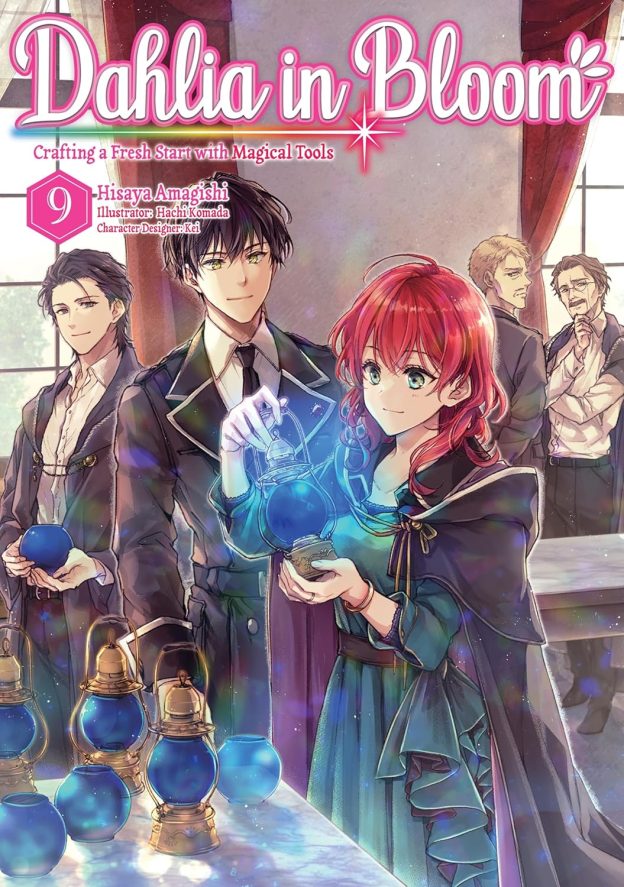
By Hisaya Amagishi and Esora Amaichi. Released in Japan as “Fukushokushi Lucia wa Akiramenai: Kyō kara Hajimeru Kōfuku Keikaku” by MF Books. Released in North America by J-Novel Heart. Translated by A.M. Cola.

As with its parent series Dahlia in Bloom, Lucia and the Loom is an ongoing narrative that also can work as a short story collection. The “plot” of the series, such as it is, is seeing Lucia’s relationships with the various men in her life, and seeing her blithely reject them all (consciously or not) for her one true love, clothing. We get that here, and this book showcases some events from the seventh Dahlia book (without, thankfully, much repeating). And then we get the “short story” chapters, which basically show Lucia getting work for the business. Sometimes this ties to previous books, with former villainesses trying to reform. Sometimes it ties back to Dahlia’s main storyline, such as the kotatsu being invented, and the tailor’s guild determined to make the most beautiful, luxury coverings. And then there’s the story where Lucia is asked to handle a very delicate matter… which, honestly, is *so* good it blows away the rest.

This is actually the second story in the book that opens with Lucia being told she does not have to take the assignment if she doesn’t want to. A 13-year-old girl has died, and her family are asking a female couturier (because it will involve dressing her body) to make an outfit the for funeral. Lucia, who has seen her grandmother pass on, is OK with this, and goes to meet the father, who an Earl and also from a family of knights. As she finds out more and more about Enrica, their late daughter, she starts to realize what she was like (which is not very much like her father imagined her to be) and worked round the clock, enduring the cold of the mausoleum, to dress her in the most appropriate outfit. I have to tell you, it was hard not to tear up at this chapter. It was fantastic, and easily Lucia’s finest hour in this book.

Other highlights for Lucia include protecting Hestia from a leering noble who wants her to become his mistress; making pajamas for Lotto, which includes allowance for his tail (please note Lucia does not remotely consider the idea that making pajamas for a single man, in this world, is at all romantic); getting an assignment to make raincoats for Dante’s ex-girlfriend, which is heartwarming and bittersweet and possibly the second best story in this book; and making a new suit for Jonas, who is Lucia’s childhood hero but who she still doesn’t quite recognize. Dahlia and Volf, in the main series, are in a shonen romance, mostly consisting of food, drink, and willful blindness on both sides. But Lucia is in a shoujo series, with multiple love interests, all of whom seem doomed. Like Dahlia, Lucia needs to be protected. But… that’s gonna be tough, gotta admit.

We’ve caught up with Japan, but fortunately, Dahlia has resolved its issues and we get a new volume of it in just a few weeks. That should have a bit more Lucia as well. This was excellent.

Management of a Novice Alchemist, Vol. 4

By Mizuho Itsuki and fuumi. Released in Japan as “Shinmai Renkinjutsushi no Tenpo Keiei” by Fujimi Fantasia Bunko. Released in North America by J-Novel Club. Translated by Sean McCann.

So remember that angry local lord plot I said would probably happen in this book? Nah. Not even brought up, aside from a brief bit where Sarasa notes that there really should not be as many bandits attacking this village as there are. Instead we get a return to the Salamander plot, and also a return to the marriage subplot. as, even though Lorea says she’s not into girls either, and Sarasa in fact seems to be quite ignorant about most everything sexual (not a surprise given her life), it’s very clear that Sarasa is an amazing catch. A powerful alchemist who is the apprentice of the Master Alchemist, and looks like she’ll surpass her one day. A woman – well, still girl – who can fill the “wife” role in the family and also be Sarasa’a apprentice, who looks to be a very quick study. A powerful knight who’s also pretty and practical. And Zoidberg… erm, and Iris. Who tries very hard. Mostly to seduce Sarasa, which she thinks is the way to get this going. It feels like the author read about yuri in a book once years ago.

A monster researcher, Nordrad, has arrived at the village looking for bodyguards to help him with his latest research project – examining the nest of the Salamander that Sarasa took out last time. Now that the salamander is gone, it’s the perfect time to get a lot more details about it that are otherwise impossible. And he really is offering a lot of gold to just stay with him while he does this, so Iris (happily) and Kate (reluctantly) agree to help him. While they’re gone, Lorea and Sarasa, des;pite both saying they’re not into women that way, propose to each other, Lorea moves in, and Sarasa essentially has a “please be good to my daughter” discussion with her parents. Also, Lorea asks to be her apprentice, but that seems to be secondary to her moving in. And it may just be the two of them, as Iris and Kate are… in trouble.

In a series that already features a very, very eccentric lead character in Sarasa, it would take a lot to top her, and Nord, trust me, is a lot. You want to punch him about eighty times in this book, and I was disappointed that he mostly got what he wanted and then took off, despite trapping himself, along with Iris and Kate, inside a volcanic mountain for over a month because of his research stupidity that said things like “what if I got another salamander to come here, what would happen then?”. That said, there is one benefit, which is that it allows Sarasa to show that, even if she pretends not to be all that interested in them, she will absolutely move heaven and earth to help them if their lives are in danger. She spends a LOT of money and makes a LOT of things in this book, most of which we only hear about in passing, all for the sake of finding her two other not-yet-wives and getting them out of Certain Death Cavern. It’s sweet.

I suspect this book requires a lot more tolerance of weird bullshit than most light novel series, but if you can put up with it, and don’t mind the author avoiding everyone’s barely disguised fetish, it’s quite good.