Category Archives: reviews

your name.

By Makoto Shinkai. Released in Japan by Kadokawa Shoten. Released in North America by Yen On. Translated by Taylor Engel.

I’m coming at this novel from a somewhat unique perspective, I think, as I am one of the few people reading it who hasn’t already seen the movie first. In fact, the author states he initially wasn’t going to write a novel at all (novelization might be more accurate), feeling that it was a story he felt best told through the medium of the animated movie (in particular, the music used for it). But the novel kept niggling at him, and he finally buckled down and wrote it. It’s from the perspective of its two leads, Mitsuha and Taki, which gives an opportunity to better get inside their heads, but also means we only see scenes they’re involved in. So if people are asking me whether your name. is worth reading if you’ve seen the movie, I can’t tell you that. I can say that by the end of the book I was enjoying it enormously, and I’m very happy I read it.

That said, the book comes with a warning from me to my readers: if you are bothered by second-hand embarrassment in your reading, them parts of this book are going to be like crawling through glass. The main premise involves a bodyswap between a boy and a girl, so we already get the normal ‘I’m acting weird and everyone is puzzled’ scenes, but the kids are also teenagers, meaning there’s lots of weird body issues and teen crushes, leading to the most awkward date ever. That said, both kids are nice, and the contrast between the way-out countryside and the middle of Tokyo was a nice contrast. Mitsuha’s perspective takes up a lot of the beginning and near the end of the book, while Taki’s has most of the middle for obvious plot reasons.

There is romance as well, of course, though it’s done so subtly that it almost crept up on me. At one point during the aforementioned awkward date, Taki’s crush says she can tell he’s in love with someone else, and he’s honestly as puzzled as the reader is by this point. But as things snowball, you can see the depth of feelings grow deeper and deeper, and by the end of the book we are quite content to actually not see the final familial confrontation because we’ve gotten what we wanted. More surprisingly, and without wanting to spoil too much, the ending is not quite as bittersweet as some of Shinkai’s other works, even though it still remains somewhat ambiguous. I have a sneaking suspicion that this may be one of the reasons that this movie has been a bigger hit than any of his other movies – bittersweet is lovely, but doesn’t sell as well.

There are a few niggles – The book may be a bit TOO fast and short, for one. I’d also like to have seen more of Mitsuha vs. her father, and the side characters are not as developed as our leads. There’s also a side story volume coming out in the fall (by a different author) that may expand on this, as it apparently shows the story from other perspectives. But your name. is an emotional journey, and as the book goes on you’ll find yourself turning the pages faster and faster. I can’t speak for those who’ve seen the movie, but if you like romance with a touch of sci-fi, this is definitely worth a buy.

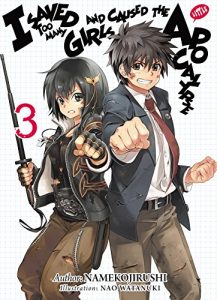
I Saved Too Many Girls And Caused The Apocalypse, Vol. 3

By Namekojirushi and Nao Watanuki. Released in Japan as “Ore ga Heroine o Tasukesugite Sekai ga Little Mokushiroku!?” by Hobby Japan. Released in North America digitally by J-Novel Club. Translated by Adam Lensenmayer.

I had made much in my review of the first volume of this being a parody of the harem genre, and also talked about the humor in it. Book 3 is sadly lacking in good humor (R is barely in it), and the parody aspect is also starting to slip a little too, as we meet our hero’s female counterpart and find that she’s luring him to the dark side. Not that he’s turning evil or anything. But Hibiki also gets caught up in stories, as the heroine, and one of her friends – OK, if we’re being honest, her only friend – was injured because of that and is now in a coma. So ‘the dark side’ in this case means the darkness of the soul, where you wind up pushing everyone away because you don’t want to see them get hurt. And she infects Rekka with this mindset, which is a problem, because the entire premise of the series is therefore at risk.

Fortunately, despite this volume being far more serious than the previous two, it holds up pretty well. The situations are still cliched, but having only one heroine to worry about much of the time streamlines things a bit, even as we still have to solve multiple promises. (Arguably the fox girl is a second heroine, despite Rekka’s cluelessness, but I’ll worry about that if she ever comes back). Rekka manages to overcomes his self-doubt, pushed along by a lack of confidence (something R lampshades, as she is wont to do). And the old heroines all get something to do. The scenes with Satsuki and Harissa are quite good, as thanks to Rekka pushing her away Satsuki has her own crisis of conscience. She’s known him the longest, after all. But Harissa is the ‘purest’ of the girls in terms of her love for Rekka, so she’s able to teach the valuable lesson this time, at least once she wakes up.

The big drawback to this volume, unfortunately, are its heroines. Hibiki is meant to be a female mirror of Rekka, and also show what he could be if he went down the wrong path. As such, she’s a bit of a mess, starting off strong but eventually just hanging off the villain’s arm waiting to be rescued. Also, it feels weird to have one tsundere a mere volume after the classic example of Tsumiki. Hibiki’s crush on Rekka simply doesn’t feel earned, not the way the other girls’ do. As for the other ‘heroines’ here, the fox girl is cute but basically frets constantly the entire book, and Meifa is a living reward who doesn’t even get to speak at the end of the book. I realize that it’s hard to create strong characters every time, but given the premise the author has made for himself, it’s something he’s going to have to muscle up and do.

So I’m a bit annoyed, but in the end turning more serious did not break the series, and there were several cool fight scenes. It looks as if Rekka has remembered the core to his series, which is ‘solve one girl’s problems using another girl’s talents’, and given Vol. 4 is back to three girls on the cover, he should be fine.

(Oh yes, and don’t use alien races as a metaphor for racism if your magic solution is “turn everyone white”. Just… don’t do that.)

Kitaro: The Great Tanuki War

By Shigeru Mizuki. Released in Japan as “Gegege no Kitaro” by (among others) Kodansha, serialized in various magazines. Released in North America by Drawn & Quarterly. Translated by Zack Davisson.

The large majority of this book is made up of the title story, the first really huge epic tale we’ve seen from this collection of Kitaro stories by Drawn & Quarterly. And it’s a real pip, showing off the best qualities of Kitaro in the 1960s. He’s far more heroic here than he’s been in the past two books, but it’s a pretty thankless task, especially when he’s going up against shifty Japanese politicians. Honestly, you’d think he’d be used to dealing with them given that he’s best friends with Nezumi Otoko, who is in peak form here, always siding with whatever appears to be the winning side, and showing no moral qualms about throwing humanity under the bus. There’s also a larger role for Itta Momen, a yokai made up of flying cloth that I thought was meant to be toilet paper for the longest time.

The villains in this story are the titular Tanuki, who have featured in many Japanese folktales, though not usually as yokai per se. These are The 800 Tanuki of Shikoku, who are here to reclaim earth and take over. They’ve got many and varied ways of doing this, each of which seems to set a higher bar of “how on Earth will Japan get out of this one”? What’s worse, they really do a number on Kitaro, taking him out several times via various fatal traps – and I mean literally fatal, by the end of this story Kitaro has to regenerate from a baby for a month or so. It’s very much in the classic serial vein, which unfortunately means that the ending reads like “OK, wrap it up in this chapter” – it’s very sudden. But the grotesque ideas and imagery are pure Mizuki, and really stand out in this epic story, which also borrows from kaiju-style tales.

I was somewhat surprised by seeing the two-faced Japanese Prime Minister tell Kitaro that they will rely on him to save Japan just like Moshe Dayan saved Israel, till I realized that this was running in Shonen Magazine only two months or so after the Six Day War. You don’t think of Kitaro as referencing too many current events, but there are times it does, particularly when he gets involved in politics, as seen here. (Speaking of references, I was rather startled to see the Tanuki declare that they were going to have the Japanese woman serve them as maids – if only they’d been 30 years later they could have gone to a cafe instead!) The final two stories feel a bit like filler compared to the epic Tanuki war, but we do get to see a rare example of Nezumi Otoko coming out on top for once – it reminds me of the rare cartoons where Tom won over Jerry.

This is a very strong volume of Kitaro, though the reader should be prepared for bad things to happen to him – he spends some of the book as a literal puddle of liquid. As always, a must for fans of classic manga, as well as modern yokai readers who want to read something by the master.