Category Archives: reviews

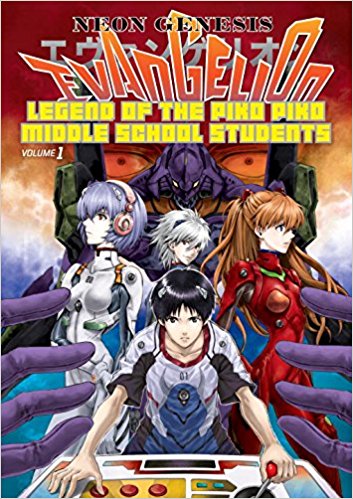
Neon Genesis Evangelion: Legend of the Piko Piko Middle School Students, Vol. 1

By Yushi Kawata and Yukito. Released in Japan as “Shin Seiki Evangelion – Pikopiko Chuugakusei Densetsu” by Kadokawa Shoten, serialization ongoing in the magazine Young Ace. Released in North America by Dark Horse Comics. Translated by Michael Gombos. Adapted by Carl Gustav Horn.

For the most part, if I have reviewed any of the endless Evangelion spinoffs at all, I’ve reviewed them as Briefs, mostly as for the most part it’s very difficult to try to work up 500+ words on the topic. The Evangelion manga is excellent, but its spinoffs and side stories have amounted to a creepy shoujo supernatural comic that barely felt like Eva at all (Campus Apocalypse), a Lowest Common Denominator romantic “comedy” (Shinji Ikari Raising Project), a mystery with BL overtones (Detective Diary), *another* lowest common denominator romantic comedy (Angelic Days, if anyone remembers it), and various gag anthologies. This new title is definitely on the “gag anthology” side, being a spinoff of one of the stories from the Evangelion Comic Tribute that was popular enough to get its own series.
In my review of the Comic Tribute anthology (which I guess I did give a full review to), I noted that the stories by these creators were the best part of the book, so it makes sense that they’d get a chance to add more wacky humor and dense references. The “plot” is mostly irrelevant, but essentially we see NERV trying to defeat the Angels by training gaming nerds to defeat them, and Shinji, Asuka and Rei are the three biggest. What follows is a string of gags, both visual and verbal, which range from average to quite good, though I don’t know that I laughed out loud. Characterization is, for the most part, exaggerations of the “fanon” view, so Shinji is a bit meek and overserious, Asuka’s angry all the time, Rei is stoic, and Kaworu is super gay. But above all else, there’s the boke/tsukkomi comedy we’ve come to expect from Japan, and everyone (well, OK, just Shinji and Asuka) are quick with the retorts.

Those with an observant eye may note that Carl Horn adapted this himself, and it’s very much an adaptation in the nature of his Excel Saga work, i.e. he takes the original and crafts it into something else. If you like overly literal translations, you’ll hate this, but for the most part it works out very well, especially as the original is there to help, being filled with fourth wall breaking, bizarre gaming references, and stupid running gags (it’s just a t-shirt!). Adapting manga that’s solely devoted to comedy can be tricky, but they do a good job. Of course, the drawback is that there is only comedy here – if you like Evangelion for literally anything other than gags, you’re wasting a purchase with this. But the comedy is finny, everyone is exaggerated but not totally loathsome (except Gendo, of course), and the fanservice is surprisingly minimal, something actually pointed out by the characters as they lament their lack of a beach episode. Piko Piko Middle School Students is here to crack dumb jokes and chew bubblegum, and they’ve run out of bubblegum.

Arifureta: From Commonplace to World’s Strongest, Vol. 1

By Ryo Shirakome and Takayaki. Released in Japan as “Arifureta Shokugyou de Sekai Saikyou” by Overlap. Released in North America digitally by J-Novel Club. Translated by Ningen.

First of all, it is very hard for me to read this book and not have ‘Arifureta, gentille arifureta, Arifureta, je te plumerai.” in my head, so I want you all to have it there as well. Secondly, this book in many ways reads like Isekai Smartphone’s dark mirror. They’re both intensely serious attempts at the classic isekai, but while Smartphone is content to be light as air and coast along on the awesomeness of his hero and the goodwill of the reader, in the grim darkness of Arifureta there is only hatred and revenge. Except, of course, we never see the actual revenge that we expect, and the hatred mostly manifests itself as our hero getting impossibly overpowered and badass. It’s a teenage power fantasy, but it has not gone the way most of those types of fantasies go – at least not yet.

The first third of the book starts you off on the wrong foot, leading you to believe this will be a far more traditional isekai than it actually is. Our hero is Hajime, a normal high school student who happens to be bullied by the majority of the class, mostly because the cutest girl in the class, Shirasaki, has taken it upon herself to interact with him every day. This becomes seemingly irrelevant when the entire class is transported to another world, there to become heroes and fight for the sake of the new country they’re now in. All of the class has cool adventurer stats and awesome powers… except Hajime, whose stats are awful and who is basically a blacksmith. So he’s bullied AGAIN, physically and emotionally. Worse, Shirasaki is still interested in him. And so one day, when the class are fighting a horrible battle far above their skill level (which Hajime actually helps out with more than anyone else), one jealous classmate turns to murder and Hajime falls into the deepest, darkest depths of the dungeon.

So far so dull, but then the plot and the writing take a dive off a cliff, just like our hero. Hajime, due to the happenstance of various things I won’t bother to get into, ends up leveling up so much his stat level is ???, acquires innumerable powers, and uses his basic blacksmith stats so do amazing things, and also build lots of guns, because kids who get transported to another world tend to be gun nuts. This is the point of the book where the reader has to throw up their hands and just go with it, because it is absolutely overblown and ridiculous, and the prose verges on the hilarious. It also may be the best part of the book, because he shortly meets a vampire princess trapped in the dungeon with him, and after rescuing her the series (again) becomes far more predictable.

That said, I expected by the end of the novel that he would get back to the surface and get revenge on those who once wronged him. This doesn’t happen, though we do cut back to the surface occasionally to check in on the rest and show how Shirasaki was very, very much in love with dull ol’ Hajime. Instead, the last third of the book relies on long battle scenes (which are done pretty well) and the interaction between Hajime and Yue, which is done less well. Hajime has a tendency at times to act as tsukkomi to Yue, which is a shame as it makes him sound like Araragi from the Monogatari series, especially bad given Yue is a blonde loli vampire. Another surprise, and a warning of sorts: Hajime and Yue have sex, several times. It’s implied rather than shown, but it is worth noting, simply as that sort of thing rarely actually happens in isekai harems like this, and likely shows off its web novel roots. You will have to trot out the old “it’s OK as she’s really hundreds of years old, she just LOOKS nine” chestnut.

Arifureta was less terrible than I was expecting, but there are better isekais out there. I’d only recommend it to those who really like this sort of thing and don’t mind overpowered, overserious heroes.

The Irregular at Magic High School: Nine School Competition Arc, Part 2

By Tsutomu Sato and Kana Ishida. Released in Japan as “Mahouka Koukou no Rettousei” by ASCII Mediaworks. Released in North America by Yen On. Translated by Andrew Prowse.

I’ve been very nice to Irregular at Magic High School in my last three reviews, despite being well aware that the series is very polarizing, and that there are many, many people who vehemently dislike it – not as much as Sword Art Online, I mean, let’s not get crazy, but a whole lot. This is the first volume that, while I still enjoyed it to a degree, I’m beginning to see their point. Everything that’s normally annoying about Mahouka is just that much more so here, and the book even has a huge page count to get it all in there. Tatsuya’s perfectness, the vague incestuous implications, the cartoon nature of the villains, who make even other anime Chinese mafia cringe. And most of all, the endless, endless “magicbabble”, as the reader begins to suspect that without each detailed explanation of what magic is used and how it works in that context, this book would be about 70 pages long.

The games themselves show off our first-years to the best of their abilities, and their are few surprises – there is one game-breaking injury (literally – we’re told she won’t be able to use magic anymore), but it’s to a minor character we haven’t seen much of, and it’s never even brought up again. What we mostly see is First High’s girls beating the snot out of their competitors (the rookie guys don’t have Tatsuya as their engineer, so of course they do badly and seethe at him all the time for being so Tatsuya). Indeed, the competition with the most tension is the one between Shizuka and Miyuki – it’s over far too quickly, and I’d like to have seen more of it, but again, Miyuki is so far above everyone else, I suppose there’s not much we can do. The Honor Student side manga should help.

Of course, Tatsuya is forced to compete himself due to various circumstances, and of course he is amazing, though Leo and Mikihiko are also allowed to show off their chops a bit. (Erika, sadly, gets very little to do beyond be jealous of her brother’s relationship with Mari, though that does give us the funniest moment in the book, as Miyuki teases Erika about her brother complex, and Erika just loses it because it’s MIYUKI doing this. The student council for the most part are there to be a Greek chorus, with Mayumi occasionally showing off her crush on Tatsuya and Azusa gradually realizing Tatsuya’s secret identity due to his complete inability to hide his amazing engineering skills (though he tries, multiple times in the book, not to take credit for things.)

The book is not bad per se, despite my complaining – the action sequences are well paced and work despite all the magic explanations woven into them. Tatsuya’s past and his devotion to Miyuki makes the book take a very dark tone towards the end, as he shows no mercy towards anyone who would hurt Miyuki, and the narrative points out – perhaps a bit too much – that it’s ONLY Miyuki he cares about, not anyone else. So it’s still a good series to read for fans, but I can easily see casual readers deciding that this is the point they may want to abandon ship.