Category Archives: reviews

Baccano!: 1932 Drug & The Dominoes

By Ryohgo Narita and Katsumi Enami. Released in Japan by ASCII Mediaworks. Released in North America by Yen On. Translated by Taylor Engel.

This was the final Baccano! light novel that was used in the 2007 anime adaptation, but even if you’ve seen the anime you should read this anyway, as it’s startling how much was left out and how much was changed. The anime needed a little bit more plot to add to its “let’s move back and forth between various time periods” style, and Eve’s subplot seemed to fit the bill. They had little to no use for Roy Maddock and his drug addiction, though, and so he was completely eliminated. Which is a shame, as while I have little use for Roy himself, who is not as interesting as virtually everyone else in this book, his girlfriend Edith is awesome, and having Roy also means we meet Kate Gandor, Keith’s wife – and actually hear Keith speak more than a few lines of dialogue!

Eve Genoard, younger sister to ne’er-do-well Dallas, is front and center on the cover, and I’d wager that she gets to have the hero’s journey here – as I said before, Roy is a bit too flat for me to really grant that to him. You could argue that Luck Gandor may also qualify – he’s worrying that he’s lost an essential humanity since becoming immortal, and it’s through dealing with Eve and the Runoratas that he comes to accept who he is now and realize that he hasn’t changed as much as he thought. He’s certainly unrepentant about what he did to Dallas – who, let’s remember, killed several men in the Gandor mafia clan – but he allows Eve a chance to possibly rescue Dallas from his watery grave. (Luck wonders why he was so soft-hearted, which is hilarious given that earlier in the book, all three Gandors were terrified about the idea of having to punish a woman, mafia-style, for betrayal – they end up giving her a haircut.)

This happens right after the last two books – in fact, the first third of it actually happens before the last two books, as it begins in late December 1931 and ends in early January 1932. And we do see characters from the previous books. Isaac and Miria have a smaller role than usual, but it’s their theft of the Gandor Family Fortune which sets most of this in motion, and their obsession with dominoes that gives us some more comedy, though I think it’s REALLY OBVIOUS that Narita only added that plot so he could use the title, which comes from Eric Clapton’s band Derek and the Dominoes. Firo spends most of the book grumbling and whining, which seems a bit out of character for him. And we also see a few people who look like they’re being introduced for future books, such as Tick, the Gandor family’s smiling torture specialist, and Maria, a walking Mexican stereotype who can’t stop saying “amigo” but who is a lot of fun anyway. The Daily Days also get a lot more here to do than usual, and the one morally dubious guy of their bunch gets his after a ride on the Rail Tracer express (not lethal, for once).

That said, the book ends with a sort of tragedy, and it involves another immortal who appears throughout the book – Begg, who seems to have been one of Maiza’s group who became immortal back in 1711. He’s now the Runorata family drug expert, and spends his years trying to perfect a drug that will make everyone live in their own happy world, with no problems or worries. Given the halting, jittery way he speaks, you get the feeling he’s tested a lot of drugs on himself. And, despite an attempt at a heartwarming scene with Czeslaw (which is also rife with foreshadowing), in the end we see him at the start of the 21st century, burned out in an institution, barely able to respond to Maiza. Immortals may live forever, but they can still damage their mind, and it’s sad to see, even if you question the entire premise of what Begg wanted to achieve.

All in all, a good addition to the series, with lots of fun stuff happening, though I don’t think it hits the heights of Book 2. Next time we’ll move forward a bit – quite a bit – and see what the cast is up to in 2001.

Yona of the Dawn, Vol. 5

By Mizuho Kusanagi. Released in Japan as “Akatsuki no Yona” by Hakusensha, serialization ongoing in the magazine Hana to Yume. Released in North America by Viz. Translated by JN Productions, Adapted by Ysabet Reinhardt MacFarlane.

In general, I’m always a bit wary of ‘chosen one’ narratives, which Yona of the Dawn is shaping up into being. The difficulty is striking a balance between following the chosen one because you know they will be a good person who can change the world, and following the chosen one out of a literal compulsion you can’t control that draws you to them. Yona of the Dawn tries to have this both ways, and I like that the new Dragon, Jaeha, is reluctant to follow his supposed destiny, being very happy being what he is, which is a showboating, girl-loving pirate with the classic Hana to Yume “sleepy eyes”. Of course, this is still a shoujo manga, and thus the cliffhanger has him running into Yona and immediately his heart skips a beat, because of course it does – if you’re going to write romance cliches, do them properly.

Meanwhile, as predicted, the Blue Dragon decides to come with them, and even gets named by Yona, who is, of course, still the Chosen One but balances this out by being caring and loving and sweet and nice, etc. Names turn out to be pretty important in this book, as the male cast who aren’t Hak gradually start to call Yona by her first name. Hak is an exception, though, and this is the best scene in the volume, as Yona tells him the reasons that she wants him to still call her “your highness” and treat her as royalty. It’s so that they don’t forget her father or what he did. This is immediately followed up with the heartbreaking revelation that most people in the country seem to regard the late King with contempt as a terrible King, much to Yona’s distress. (In reality, putting the distance between her and Hak may be authorial fiat – let’s face it, this is a reverse harem manga with an obvious endgame, and it’s best to delay it as much as possible.)

Most of this volume is, of course, the standard quest, as Yona and company continue wandering the land hunting for Dragon Warriors. This means that they have to stop and fight injustice whenever they can, of course, even if they’re supposed to keep a low profile (Yona’s red hair really does not help with stealth missions). The humor in this book is fairly predictable, mostly revolving around Hak’s inability to practice what he preaches, and everyone (including Yona) seeming to think that he spent time in a brothel, much to his frustration. Jaeha looks like an excellent addition to the cast, balancing nicely with the other guys’ personalities. This of course assumes that he does join the main cast, and I suspect the next volume will show us Yona trying to convince him of the righteousness of her cause.

In the end, this is another top-notch volume of Yona of the Dawn, which continues to be one of Shojo Beat’s best series.

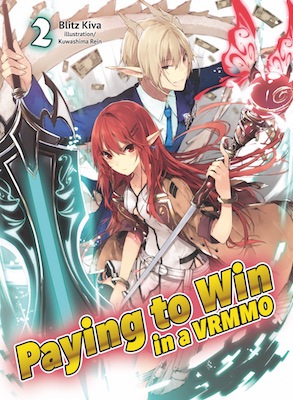
Paying to Win in a VRMMO, Vol. 2

By Blitz Kiva and Kuwashima Rein. Released in Japan as “VRMMO wo Kane no Chikara de Musou suru” by Hobby Japan. Released in North America digitally by J-Novel Club. Translated by Elizabeth Ellis.

Having established its premise and characters in the first book, the Paying to Win series goes about trying to tweak and fix a few things that weren’t as strong as they could be in the second. This involves a) introducing a new potential love interest who isn’t in middle school and Ichiro’s cousin, and is also able to be a little more critical of Ichiro’s callous lack of tact; b) have a flashback to show us how he managed to get so ridiculously leveled up before Asuha was able to join him, and also explain things like how he got a suit of armor that is literally a business suit. But most importantly, and most effectively, this second volume doubles down on showing you how obviously, knowingly, and teeth-grindingly irritating Ichiro is to everyone and everything around him, and the effect this has on both the secondary characters and the reader.

I cannot emphasize this enough: holy Mother of God, Ichiro is annoying. You will want to punch him in his cool, smug, self-satisfied face multiple times as you read this book. It’s far more clear in this second novel that it’s deliberate, and reader sympathy is meant to be with the young gamer and wannabe fashion maven Iris rather than him. He is the sort of character that, were he an antagonist or a villain, would receive the absolute best retribution possible, possibly while screaming “THIS CANNOT BE!!!”. Sadly, Ichiro is the hero, and the book’s whole purpose is that he really is this good at everything. Only King Kirihito was able to actually challenge him in the game, and since this is a flashback to the previous week, you know that he’s going to succeed at everything ridiculously easily here. That said, I liked his insistence that it doesn’t matter if Iris’ butterfly brooch is aesthetically good or not – he likes it, so therefore it’s fine.

Iris herself is a good character, far more developed than Asuha/Felecia, mostly as she gets to express everything the reader wants to. Every time Ichiro praises her creations, it sounds like he’s really calling them awful, simply due to how bluntly he speaks all the time. I liked the glimpses of her real-world life, and showing off how talented kids who are used to being the center of attention can get crushed when they go to a school that specializes in talented kids and realize other people are, in fact, better than they are. She also has a nice sense for biting retorts, as I’ve said. The author’s afterword says that webnovel readers have nicknamed her “the Evil God”, and I look forward to seeing why, though I can hazard a guess or two.

Other than Iris, the main reason to plow through this book despite Ichiro is the writing style – it’s funny and assured, and the narration has its own distinct voice, something I always enjoy. This is also due to the translation, of course, which is excellent – probably my favorite J-Novel Club translation to date in terms of noticing the quality (though Sera did get gendered at one point, which only serves to remind us how ridiculously difficult it is to avoid giving away gender in English). Recommended to anyone who loves seeing smug jackasses win effortlessly and be smug about it. Also, bonus points for having Voltron show up, only one volume after the SAO sentai team parody.